August 2023
Monthly Archive
August 11, 2023
Posted by alexp01 under
Excerpt | Tags:
fiction,
story |
Leave a Comment
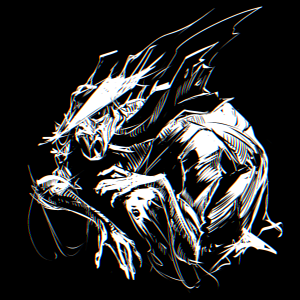
Père Kewgsmkri
Père Kewgsmkri was a senior Inquisitor and also an ordained priest with a decades-long record of unblemished service, such that he had served as interim High Inquisitor to the Archpère Sabaic. However, at the height of his power, Père Kewgsmkri abruptly walked away from the Church. The reasons for this were never elaborated upon, but rumor holds that he refused his final mission and, instead, denounced his vows of chastity to marry. There is no record of who his wife was, but he was seen with his two young daughters in a remote village by the inhabitants there.
Over time, though, Kewgsmkri was seen less and less, and when encountered he would be ever cloaked, ignoring others and refusing to respond. His daughters, too, were seen less and always cloaked when moving about. Eventually, the village to which Kewgsmkri had retired reported that residents had begun to disappear. Jaegers sent to find them similarly disappeared, and over time the disappearances spread to other nearby villages. No one knew exactly where Père Kewgsmkri’s estate was, but the area around it had become fraught with strange perils.
After that, there were occasional sightings of a figure believed to be Kewgsmkri, as they wore his hat and cloak, but the descriptions were in the realm of pure fantasy–a skeletal being, with long distorted face bones beneath burning eyes. Often, there was a pale and terrified face visible as well, according to reports, though whether one of the Kewgsmkri girls or not remains unclear. In all attested reports, however, the Père is quite real and substantial, if horrifying, while the other being, if present, is a spectral shade.
Contact is not advised, and ranged weapons or musketry are strongly encouraged should engagement become necessary.
High Inquisitor’s Note:
There are some who believe that the Père was twisted and driven mad by the deaths of his family, and made a dark bargain to extend their existence. Others hold that Mme. Kewgsmkri may have been a horror of the sort Père Kewgsmkri had once been sworn to root out, with the disappearances mere food to sate otherworldly spouse and spawn. I, who had little contact with Père Kewgsmkri while he was within the embrace of the church, have often been asked what I think. My first answer is usually that I suspect all stories have an element of truth. My second is that I do not want to know, and hope never to learn.
- Like what you see? Purchase a print or ebook version!
August 10, 2023
Posted by alexp01 under
Excerpt | Tags:
fiction,
story |
Leave a Comment
Goblins have been and to an extent are now often treated poorly, often serving as laborers, chattel slaves, and worse despite their innate affinity for magical and mechanical systems. This latter affinity, too, has been the sorrow of many a goblin, as they have all too often been used as hapless experimental subjects by ambitious conjurers or tinkerers.
It can only be assumed that the Manastone Goblin was the result of such an ill-advised experiment, though no records or survivors exist to confirm it.
Appearing to be a rather large goblin of indeterminate age and gender, the Manastone Goblin has been fused with a large manastone or magick battery, which appears to have resulted in further growths not unlike veins of ore appearing above ground. This has had the effect of giving the goblin the ability to tap a nearly unlimited amount of magickal energy in the form of a variety of wild spells, directed energy blasts, and shields which can apparently be summoned at will. It can only be assumed that it used these abilities to decimate whomever or whatever created it.
High Inquisitor’s Note:
While some sources describe the Manastone Goblin as a force for unchecked destruction, it has never been observed harming another goblin, and unsubstantiated reports indicate that it has at times aided or even liberated its brethren. Despite this, however, the Manastone Goblin either will not or cannot suffer the company of its own kind for long, and will actively shun them unless they are in great need. This is in contrast to its behavior for most, which is to attack wildly at the slightest threat or provocation.
- Like what you see? Purchase a print or ebook version!
August 9, 2023
Posted by alexp01 under
Excerpt | Tags:
fiction,
story |
Leave a Comment
These constructs, called Deceivers, were designed to cause havok among enemy formations by using their innate mimicry and illusion skills before rending the combatants apart in a lightning attack. That worked well enough. But the Essenes relied on a wholly inadequate system to control the creatures, denying them calcium for eggshells and iron for their blood, with the former withheld entirely to prevent unauthorized breeding and the latter fed to them only in Essene holding pens. The Essenes soon learned how much calcium and iron was in the natural world, and within a generation or two there appeared wild Deceivers with neither weakness. They remain to this day a scourge in the humid lowlands.
High Inquisitor’s Note”
Deceivers are no more intelligent than any other wild animal, and indeed may be somewhat less clever than their wild forebears. But the feral variety inadvertently bred by the Essenes has a strong and instinctive mimicry that can allow it to seemingly converse and even operate machinery through observation.
- Like what you see? Purchase a print or ebook version!
August 8, 2023
Posted by alexp01 under
Excerpt | Tags:
fiction,
story |
Leave a Comment
The Eye of Nullius is a round, glassy orb with the appearance of a lizardine eye, though whether it actually is such an eye or simply made to look like one requires a level of analysis that is, at present, impossible. It projects a field around them of approximately 10 meters in every direction, in the form of a sphere, and within that field, all activity stops. This includes motion, combustion, aging, and most other chemical, alchemical or magical processes. The sole exception is the Eye itself, which is affected by gravity and can be moved (for instance, via a pole or a rope). Objects which are partly inside the sphere may be pulled out.
It is speculated that the effect is some sort of radiative property, as it can be blocked by a dense enough material, with lead being used for this purpose most often. Lead boxes of a custom design have been used to contain the Eye of Nullius at several points, though the potential immortality that its effect might bring always leads to it being unleashed again sooner or later.
High Inquisitor’s Note:
Is is believed that the Eye of Nullius was discovered in a lead box at an excavation of Essene ruins, and promptly trapped several members for over a year before it could be contained. Rumors that it was found preserving a 5000-year-old Essene that crumbled to dust once the Eye was contained are unsubstantiated.
- Like what you see? Purchase a print or ebook version!
August 7, 2023
Posted by alexp01 under
Excerpt | Tags:
fiction,
story |
Leave a Comment
In the ancient land of Kyumaht, it was long known that carefully preparing and desiccating a body after death, followed by raising it to unholy life through the necromantic arts, would result in an undead servant of both suppleness and strength. The Kyumahtim believed that the soul was sacred and did not dabble in the rebonding of departed souls to necrotic flesh–rather, they used their carefully prepared dead as mere automatons, giving them simple instructions that were then carried out tirelessly.
The Kyumahtim were therefore able to allow their own dead to do much of the labor of tending their crops, building their cities, and fighting their wars. However, they were still mortal, and when the great Plague of Nomurian reached their borders, the living Kyumahtim were taken in droves. There were few left to tend to the dead, and Kyumaht was largely abandoned by the survivors. The control words and necromantic rituals were lost with the deaths of most of the Kyumaht priests.
As a result, the dead of Kyumaht continue their work even in the absence of the living. Their borders are held fast against intruders, crops are sown and reaped, and buildings repaired. However, some secret word or sign seems to be missing, for anyone who attempts to enter a Kyumaht city, even a descendant of the surviving Kyumahtim in exile, will be ruthlessly hunted down and killed, or hounded until they are driven from those lands.
High Inquisitor’s Note:
Some have talked of meeting the dead and preserved Kyumahtim in battle to slay them and take their land. This does not seem to work, as new Kyumahtim dead seem to take their place. There are two theories, not necessarily mutually contradictory, to explain this. First, it is thought that the ancient Kyumahtim established caches of the dead with contingency spells to match. Second, it is suspected that new dead thralls are somehow being made automatically from the bodies of those slain more recently.
- Like what you see? Purchase a print or ebook version!
August 6, 2023
Posted by alexp01 under
Excerpt | Tags:
fiction,
story |
Leave a Comment
Boundfruit is, on its face, a fairly ordinary tree, not unlike an aspen. It is capable of forming clonal colonies in the right conditions, growing a grove of trees that are all united through a network of underground roots, and also produces small kumquat-like fruit that are very sweet. They have heavy requirements for growth, however, and need very specific conditions to grow well.
It just so happens that those conditions are very like those created by people.
Ingestion of the Boundfruit will induce in most people a strong quasi-hypnotic state–the person will be awake, conscious, and coherent. But their sudden and overriding desire will be to care for the Boundfruit tree, and to feed its fruits to others that they may do the same. Victims will not neglect their own health, and will still eat and drink. Most will continue their daily labor, but the Boundfruit tree will never be far from their minds, and they will continue to tend it with whatever spare time and resources they have, and continue to try feeding the fruit to others.
Entire settlements devoted to Boundfruit have grown up in this way, nicknamed “Wormy Boroughs” for the large number of rustworms that Boundfruit thralls routinely clear from them. These settlements are rarely stable, as the needs of a Boundcruit clonal grove grow exponentially, and eventually there will not be enough people to continue the care and the grove will die back or perish entirely, and with it the fruit that is needed to keep its thralls loyal.
High Inquisitor’s Note:
While standing orders are to burn Boundfruit trees wherever they are found, the only cure for a Boundfruit thrall is to be kept from eating more of the fruit by any means necessary. It is not unlike breaking an addiction.
- Like what you see? Purchase a print or ebook version!
August 5, 2023
Posted by alexp01 under
Excerpt | Tags:
fiction,
story |
Leave a Comment
“Blutschiff” is the name given by locals to a mysterious vessel seen on the River Breit, generally in the widest navigable stretch between Breitermund on the coast and the rapids at Nassestadt. It generally appears to be an abandoned boat of an oceangoing type, typically used for fishing or sailing, and it generally in poor condition. Nevertheless, as an odd sight in those waters and an expensive vessel besides, it is a tempting target for boaring and salvage.
Those who have been aboard and survived state that Blutschiff appears to have been abandoned hastily, with many objects where they would have been left or dropped by a crew. However, after boarding, those same survivors often note that the ship seems to be improving–dust and grime disappearing, minor repairs being made–while at the same time the boarders began feeling weak or ill. Around this time, Blutschiff usually breaks any tow lines, floats off shoals where it has grounded, and otherwise makes itself difficult to disembark from.
Eventually, those on board will find themselves losing all energy; survivors’ testimony states that they will eventually lie down and die, disappearing along with their effects soon after. Several particularly large parties have been lost in whole or in part this way, and Blutschiff seems to be in magnificent physical condition at the episode’s conclusion.
High Inquisitor’s Note:
Several attempts have been made to mark Blutschiff to ward off would-be salvagers, or to burn it to the waterline. It has successfully resisted all attempts at marking, with the marks fading away soon after, and had in fact been burned to the waterline several times only to recover. It is suspected that birds and fish are subject to the same draining process, allowing Blutschiff to repair itself slowly even without taking human victims.
- Like what you see? Purchase a print or ebook version!
August 4, 2023
Posted by alexp01 under
Excerpt | Tags:
fiction,
story |
Leave a Comment
Through unknown means, a peasant named Morgan achieved godlike power over an area of roughly 1 square Old Imperial mile sometime around his 20th year. The exact details are not known, as all the people living and working on the estate that occupies most of that area have disappeared and are presumed dead, but through interviews with former inhabitants it seems that Morgan was not particularly strong, not particularly smart, and not particularly well-liked. One witness described Morgan being the constant butt of cruel practical jokes despite (or perhaps because of) rumors that he was the illegitimate son of the lord of the manor.
It has been confirmed that, within that radius, Morgan–who refers to himself as “Godmorgan”–has the full powers of a deity. He has been observed to create, and destroy, both matter and life at will, and can regulate the weather. At various times, the area has, for reasons unknown, been fully occupied with rock or water. It seems, however, that most of the time Morgan is content to create a fantasy version of his childhood, with an idealized version of the manor farm surrounded by simulacrums of those who once wronged him now reduced to slavish subservience.
Locals have marked the edges of “Godmorgan’s” domain, but in the event such a warning is ignored or missed, he seems to be instantly aware of anything entering his realm, reacting swiftly and nearly always fatally to the incursion. He has also been observed a few times outside of this area, but seems to find the experience torturous and also appears to show symptoms of rapid aging; it is therefore speculated that he may be immortal within the confines of the old manor farm but may eventually die of old age if he strays from it.
High Inquisitor’s Note:
It is possible at times to shout into the area of control and to be heard by “Godmorgan,” and he has been known to respond, though only when he deigns. Direct questions about the nature and source of his power have had little effect, though he has mentioned “a reward for my years of suffering” and has claimed to have “learned the truth of my real father” from his dead mother. Considering that he also claimed to have created the world and that the local goats who sometimes wander into his control were conspiring against him, these claims must be taken lightly salted.
- Like what you see? Purchase a print or ebook version!
August 3, 2023
Posted by alexp01 under
Excerpt | Tags:
fiction,
story |
Leave a Comment
In the days of the Old Forests, the trees each held a fraction of the forest’s power in trust, passing it on to seedlings and eventually to the earth. But when the woods began to be felled, the trees would sometimes pool their power and grow a champion to defend their lands from loggers. Made in the same general shape as their enemy, these beings were terrible to behold, easily brushing off most assaults and even persisting through fire due to their dense wood. It was not until the advent of modern explosives that such creatures could be brought down, and even then they are often able to complete their attack and escape. Luckily, few forests can match the Old Forests in these latter days, so sightings are rare and attacks even rarer.
High Inquisitor’s Note:
While ordinarily an implacable enemy of mankind, the Woodfoe will join forces against a greater threat, as the participation of three Woodfoes in the Containment of the Fire Count shows.
- Like what you see? Purchase a print or ebook version!
August 2, 2023
Posted by alexp01 under
Excerpt | Tags:
fiction,
story |
Leave a Comment
In normal circumstances, the departed souls flee the body upon death. However, in some cases, the souls do linger–we know these now as a variety of undead spirits and shambling horrors. There are other, rarer circumstances that are stranger still, though.
Take, for example, the gravewax golem. It requires three crucial elements to form: firstly, a mass grave or entombment after a massacre or plague; secondly, conditions suitable for the formation of gravewax in the deceased; and thirdly, burial in a medium rich in soulstone, which reflects and blocks spiritual energy. Under these specific conditions, the souls of the departed cannot depart, and eventually form a terrible gestalt undead consciousness. The remains, too, are amalgamated, into the rough approximation of a human form.
Eventually, the gravewax golem will burst forth and take its vengeance on any living beings it can find, the cacophony of spirits at play causing it to be violently unpredictable and essentially insensate. Due to its gestalt spiritual nature, any sort of exorcism must be exponentially more powerful to take effect, and due to its gestalt physical nature, it has incredible strength and resilience, though a pronounced vulnerability to fire is present.
High Inquisitor’s Note:
It is possible for the gravewax golem gestalt to evolve into a more ordered form which renders it both able to speak and to understand–Master They of the Blynswick Catacombs is a good example. This is rather rare, though, being most common for ascetics living a communal life or military leaders buried with their slaughtered men.
- Like what you see? Purchase a print or ebook version!
« Previous Page — Next Page »
 Excerpts From Nonexistent Books