Excerpt


The Laughing Road is a stretch, leftover from the long-ago days of the Verdant Empire, of paved road that was built to a strength and precision that is no longer possible since the Fall. Whether because of some subtle wearing of the stone or an unseen resonant chamber beneath, the road occasionally sounds like it is making a guttural chortle as carts pass above it. The timing is difficult to pin down, as the laughs seem to be totally random aside from a few facts that have been established.

For one, the laughter absolutely never occurs during even a light rain. Large crowds also tend to prevent it, whether by drowning it out or preventing its appearance in the first place. Finally, and perhaps most puzzlingly, the laughter seems to be at its most prevalent when the Laughing Road is being inspected by agents of the Church.

Naturally, the idea that the road is cursed, haunted, or possessed has been proposed. But its heavy traffic and Verdant construction means that Church requests to interfere with it have been firmly rebuffed by the local Landgrave. Various remedies, including the sprinkling of holy water and a mass exorcism, have subsequently failed to dampen the laughter.

High Inquisitor’s Note:
The Archbishop of the Landgraviate’s arrival in an official, investigative, capacity resulted in the loudest and longest laughing sounds yet experienced as carts were deliberately driven to demonstrate the sound to him. Incensed, the Archbishop demanded that the road be closed and dismantled immediately. The Landgrave refused, even when threatened with excommunication, and the Archbishop was talked down by his entourage. Instead, the Church posted a public warning about “demonic activity” that most travels have subsequently ignored.
  • Like what you see? Purchase a print or ebook version!

The name Zhalpyil is a curious one indeed. “Zhal” comes from the Old High Church Cant, the liturgical trade language once used by itinerant priests of different nations to communicate. It means “split” or “schism,” with the Great Schism being described in the Cant as Zhalmayr. “Pyil” is, instead, from the tongue of Araksue, the last remnant of the great pagan language that was spoken by the wild tribes before the healing glory of the Church had broken. It means “child” or “baby,” such that “xuepyil” means grandchild (literally “double child”).

It is not known who bestowed such a name on Zhalpyil herself, for she bore it when she came to the Church in the belly of her pregnant mother who, despite her clear illiteracy, had somehow proudly written the name on both a paper tag and in stale blood across her own abdomen. The act of delivery killed her, but Zhalpyil survived. There were those who would have killed her then, but her pitiable sounds stayed their hands, and once it was learned that she could survive by suckling the blood from living rams, the Church reluctantly raised her.

Eventually, due to both her rapid growth and the fearful effect that she, if unveiled, might have on the unwary, Zhalpyil was confined to the old Chapel of the Sated Herb. She undertook some husbandry of the animals she needed to live, read vociferously of the former ecclesiastical library, and became an accomplished seamstress and needleworker, taking in repairs and orders in exchange for the funds needed to keep the Chapel in repair and her larder of rams stocked.

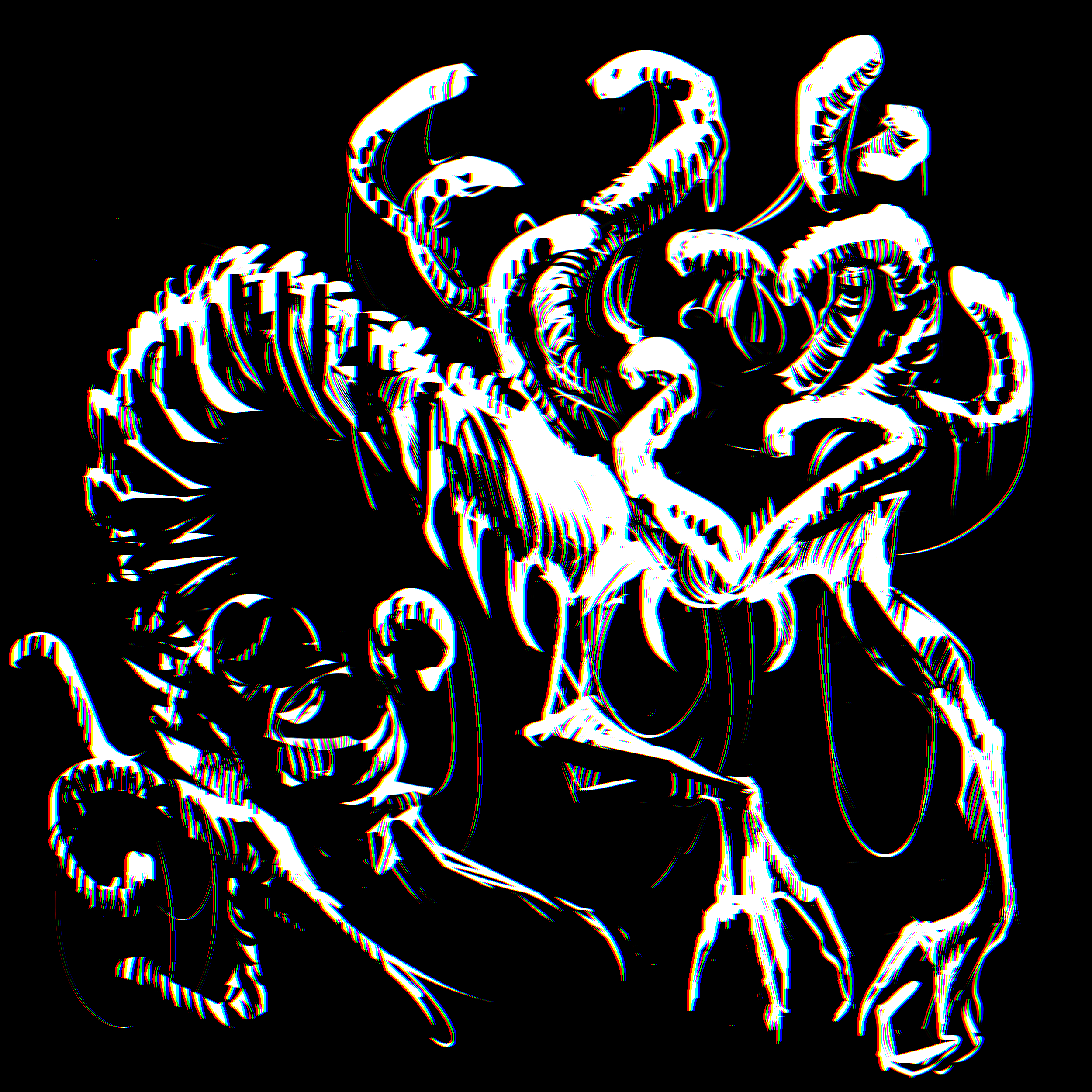
You will note that no images of Zhalpyil exist, and descriptions of her are vague at best. Indeed, if not for the infertile eggs she will occasionally and instinctively cement to the roof of the old belfry, it would not be sure that she is even of the fairer sex. Suffice it to say that she heavily favors whomever her father was, being only approximately human-shaped but far larger, with flightless gossamer wings, a dozen tentacled arms, and a torso more like that of a gastropod than anything human–to say nothing of the eleven feet of height and eight of girth.

It is her face that visitors who have glimpsed her without her veil find most striking–so striking, in fact, that several have gone mad at the sight. It is more like a coral reef than a face, made up of undulating structures that are pure anatomical fantasy. Her eyes, though, are said to be of a deep blue hue and quite kind.

High Inquisitor’s Note:
It has been my pleasure to interview Zhalpyil on several occasions. While she is capable of speech with the organs she possesses, the resultant voice is shockingly ordinary, as if issuing from a milkmaid rather than a monster. One of the reasons that the Church has been so forthcoming in its support of Zhalpyil is her intense piety, which she expresses through daily prayer and intense scriptural study. In this context, I asked her, once, what she thought of her own origin. Her response was: “I think my father prevailed upon my poor mother with false promises of power and glory, as the mighty often offer to the meek. I believe he was desirous of an agent that was partly of this world and partly of his, to act on his behalf. If he has ever sought to contact me, I am unaware of it.”

  • Like what you see? Purchase a print or ebook version!

The Beast of Mocjar

Legend has it that a great and wise Père of the Old Church–long before the Greater and Lesser Schisms–sought to bring righteousness and justice to the world, but found himself hampered by the teachings of the Old Church itself. To heal, he believed that he must sometimes kill, and to help he believed that he must sometimes steal. These are not uncommon beliefs, even today, for hypocrisy is not of an age but for all time. But this Père of the Old Church sought to accomplish his goals without the corruption of the soul that he–rightly–believed would result from murder and theft in the name of goodness and kindness and weal.

So it was that he appealed to any power that would answer him for aid. A voice did answer–the Lunar Essance itself, some believe–and offered the Père to grant his wish. His actions would corrupt not his immortal soul, but rather his fallible flesh. His soul would be left pristine, so that when the time came, he could simply shed his sin-laden and corrupted body and ascend. The Père was warned, though, that he could not kill himself nor allow others to do so, as that act would irredeemably corrupt his soul in a way that no bargain could mollify.

Foolishly, the Père of the Old Church agreed.

He soon put his long-held plans into motion, stealing vast wealth from the corrupt and giving it to the poor and murdering evil men for their transgressions. But he found he had underestimated the folly of humankind, for new malefactors arose as soon as he laid the old ones low, and the more he acted against them, the more corrupted his body became. Worse, he was compelled to retaliate against those who would harm him, remembering well that he could not kill himself nor simply surrender to be killed.

Soon the horrible truth became self-evident: the Père had been maneuvered into an impossible situation. Every sin, every impure thought, corrupted his form still more until he could no longer move among the masses without fear of attack. His twisted form was immune to disease and old age, for how could either corrupt flesh that was already sodden with corruption? Without the option of a merciful death at his own hand, the Père was forced to wait for a champion to defeat him in battle and hopefully release his soul from its imprisonment.

High Inquisitor’s Note:
I have read many descriptions of the Beast from the denizens of Mocjar, and they all agree that his visage is too terrible to comprehend, loping along on an odd number of burnt, flayed stumps of flesh like infernal hooves. Those who have suffered his touch never heal from the burns it inflicts, and die screaming in their beds after months of agony. A reliable witness, before their death, said of the Beast that its asymmetry was the most disturbing, as nothing with so little unity of form should be able to move with such speed and purpose.

  • Like what you see? Purchase a print or ebook version!

Jazz Chicken

The fallen Empire of Jubm’z knew it as Kbaa-Dijdlfo, He-Who-Guards-the-Golden-Gate, He-Who-Is-Reborn-Golden, He-of-Herbs, He-of-Spices. M’Xepc Glenngordon recorded it in his annals Nedd Glmgoir, known by many aliases such as the Crispy M’n, Dawnbringer, Old Scratcher, or Eggman. The Whozm know it as The Qvwqysb of Xonn, and they warn that its desirability is matched only by its danger.

Whatever the name and whatever the legend, all agree that the creature stands like a sentinel against the darkness at the highest points of the world, guarding the gates of dawn and seeing in each new day while holding back that which would cross over. As hard as stone, thousands of years old, and wise even beyond those years, but dangerous all the same. For although its song is sweet, it can easily sound the note that ends the world, sundering the gate between day and night, light and dark, sanity and madness. It less baleful cry is still enough to vibrate the unwary apart, literally dissolving them into sand that is borne away upon a volcanic wind.

With its great knowledge, many have sought the being at the highest peaks, seeking its wisdom. Assuming they are not cut down by its song or its spurs, the being has been known to grant them their boon. But the infinite wisdom it offers is too great to be perceived by mortal minds–blindness, deafness, and madness inevitably follow, with the afflicted locked in a cage of their own limitations.

High Inquisitor’s Note:
Do not trifle with it.

  • Like what you see? Purchase a print or ebook version!

Madfather

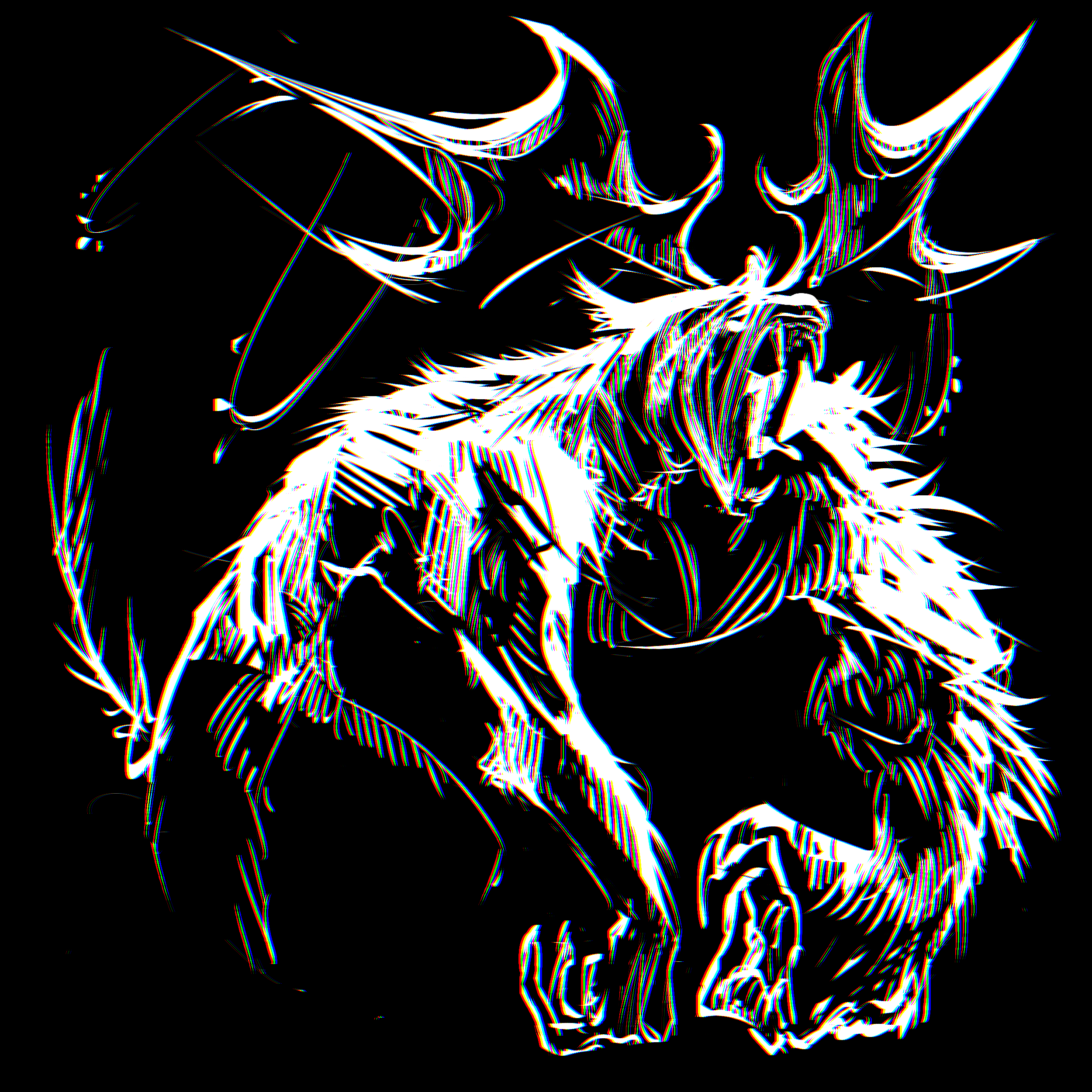
Madfather, as it is known, has been seen stalking the waterways of Thuyhof and the shores of nearby Lake Guhlubs, usually on clear nights with at least a half-moon, and usually around the witching hour of 2am-3am. He–if it is a he–has never been seen in the rare company of the Lunar Presence, but neither has the Lunar Presence ever whispered of Madfather. Those brave or foolhardy enough to inquire have been met with only silence and the sounds of distant screams.

Terrifying in shape and visage, Madfather is 9-10 feet tall even in the hunched state in which it is usually encountered, but can rear to heights of fifteen feet or more when provoked. Its flesh is charnel-grey and sinewy, like a bog body, stretched over misshapen bones too human to be animal and too animal to be human. Its true extent is concealed beneath a tattered cloak, seemingly made from a discarded mainsail, and all that can be seen poking from its hood are the bare long bones of a cervine and the crowned horns of an elder deer.

The “Father” part of the name, occasionally “Père” in the more ornate High Church style, comes from the being’s observed behavior: it makes ablutions at the water’s edge that are similar to many Church rituals, including purification, atonement, and even baptism–although what, if anything, is being baptized is unclear as its immense seven-fingered hands conceal all, bony though they be.

If one approaches or calls out to Madfather, they will soon learn the origin of the first part of its name as the being lopes over to them with a few powerful leaps and proceeds to rend and tear at their living flesh with tooth and claw. For whatever reason, it attacks the eyes first, as if afraid of being seen, and those few survivors clawed back from its grasp are almost always blinded.

High Inquisitor’s Note:
My guess is that Madfather was, or wanted to be, a priest of the church, and turns to the mindless, soulless repetition of ritual as a way to assuage the nightmarish fall from grace it has endured. This is perhaps why it cannot stand to be seen, and why it alone is willing to baptize in running water those horrors from which an ordinary priest would recoil.

  • Like what you see? Purchase a print or ebook version!

Lunar Essence

It has long been known that the demons and fallen deities of the false religions that preceded the Church are ever-jealous of the exalted position that they once held, and seek ever to bring the Church low that they might reestablish their evil fiefdoms upon our world. However, there is one of their number that seems to be different. It appears only on nights of the full moon, in open fields, and its whispers are said to drive many to madness.

The Lunar Essence, as it is known, appears as a many-limbed shadow with no source on the ground, cast by the bright moonlight. Those who have witnessed the form describe it as vaguely canine, with a halo of writhing arms and no visible head, all sources acknowledge the difficulty of any comprehensive cataloguing of a being that is at once so insubstantial and yet so present.

The Church has catalogued many folk names for the Lunar Essence, including the Penitent Demon, the Hideous Angel, and the Virtuous Watcher. This is due to it seeming to act against its fellow abominations and eldritch horrors, whispering hints of their locations and weaknesses to those who would hunt down and slay them. Church doctrine is silent on why this is so, but many laypeople theorize that the Lunar Essence is indicating some form of remorse for its past transgressions. That said, it will not hesitate to defend itself, and those who have attempted to harm it through use of insubstantiation or voidcasting have been torn to ribbons.

High Inquisitor’s Note:
My opinion on the Lunar Essence differs from some of my more optimistic colleagues. I think that it is using us to hunt its enemies and to grow more powerful, possibly with an eye toward supplanting one of the great evils of our world when it is sufficiently weakened.

  • Like what you see? Purchase a print or ebook version!

Dame Sajse Thyph

Born to the noble House Thyph in Luneanz, Dame Sajse Thyph was the eldest of seven and from an early age proved herself very gifted in both the martial and the fine arts. Despite this, the noble title of her house was to pass to her brother, youngest of seven and notoriously dissolute (cf. Lord Juster Thyph, the Decadent Baron), with Sajse to be married to cement an alliance. She instead renounced her noble house and gave herself over to the Jaegers, becoming an accomplished hunter and guide despite the intense opposition she experienced.

This led to her association with the Inquisitors, and she eventually became a lay sister of the church, with both investigative and prosecutory power–all this, as well, before the age of forty years. It was expected that she might, by her very ableness and skill, reform the Inquisitors and become the first female High Inquisitor since the days of the Omen Mother. History was to have other plans.

After a party of Jaegers did not return upon searching for a wayward pilgrim who had wandered up Mount Tadulasz, Dame Sajse ordered a second party to find them. When the second party did not return, she led the third relief herself. No one from any of the three groups was ever seen again, but Sajse did manage a final communication via a carrier pigeon, which arrived at its destination grievously wounded, falling stone dead moment later. In the bloodstained note, Sajse tersely reported that all the Jaegers were dead, and that she had discovered a secret upon Mount Tadulasz that was too dangerous for mortals to know. The note ended with the line “I will kill any that approach.”

In the decades since, there have been several reports of a woman lurking near the summit of Mount Tadulasz–a young woman in the garb of a Old Jaeger, both seemingly untouched by time or the elements. She will reportedly shout a single warning before engaging, and none who have stood their ground have lived.

High Inquisitor’s Note:
Dame Sajse was before my time; I was but a boy when she disappeared, not yet sworn to the Church. But her legend has, still, attracted many theories from idle and curious minds about the nature of what she is guarding. Her seeming agelessness has led some–notably Père Juster the Younger–to speculate that she guards the secret to immortality or eternal youth itself. I find Sister Leanna the Lesser’s explanation more convincing, namely that Sajse has taken an evil spirit into herself and intends to starve it from this world. Save from her own mouth, I doubt the truth will ever be known.

  • Like what you see? Purchase a print or ebook version!

Père Kewgsmkri

Père Kewgsmkri was a senior Inquisitor and also an ordained priest with a decades-long record of unblemished service, such that he had served as interim High Inquisitor to the Archpère Sabaic. However, at the height of his power, Père Kewgsmkri abruptly walked away from the Church. The reasons for this were never elaborated upon, but rumor holds that he refused his final mission and, instead, denounced his vows of chastity to marry. There is no record of who his wife was, but he was seen with his two young daughters in a remote village by the inhabitants there.

Over time, though, Kewgsmkri was seen less and less, and when encountered he would be ever cloaked, ignoring others and refusing to respond. His daughters, too, were seen less and always cloaked when moving about. Eventually, the village to which Kewgsmkri had retired reported that residents had begun to disappear. Jaegers sent to find them similarly disappeared, and over time the disappearances spread to other nearby villages. No one knew exactly where Père Kewgsmkri’s estate was, but the area around it had become fraught with strange perils.

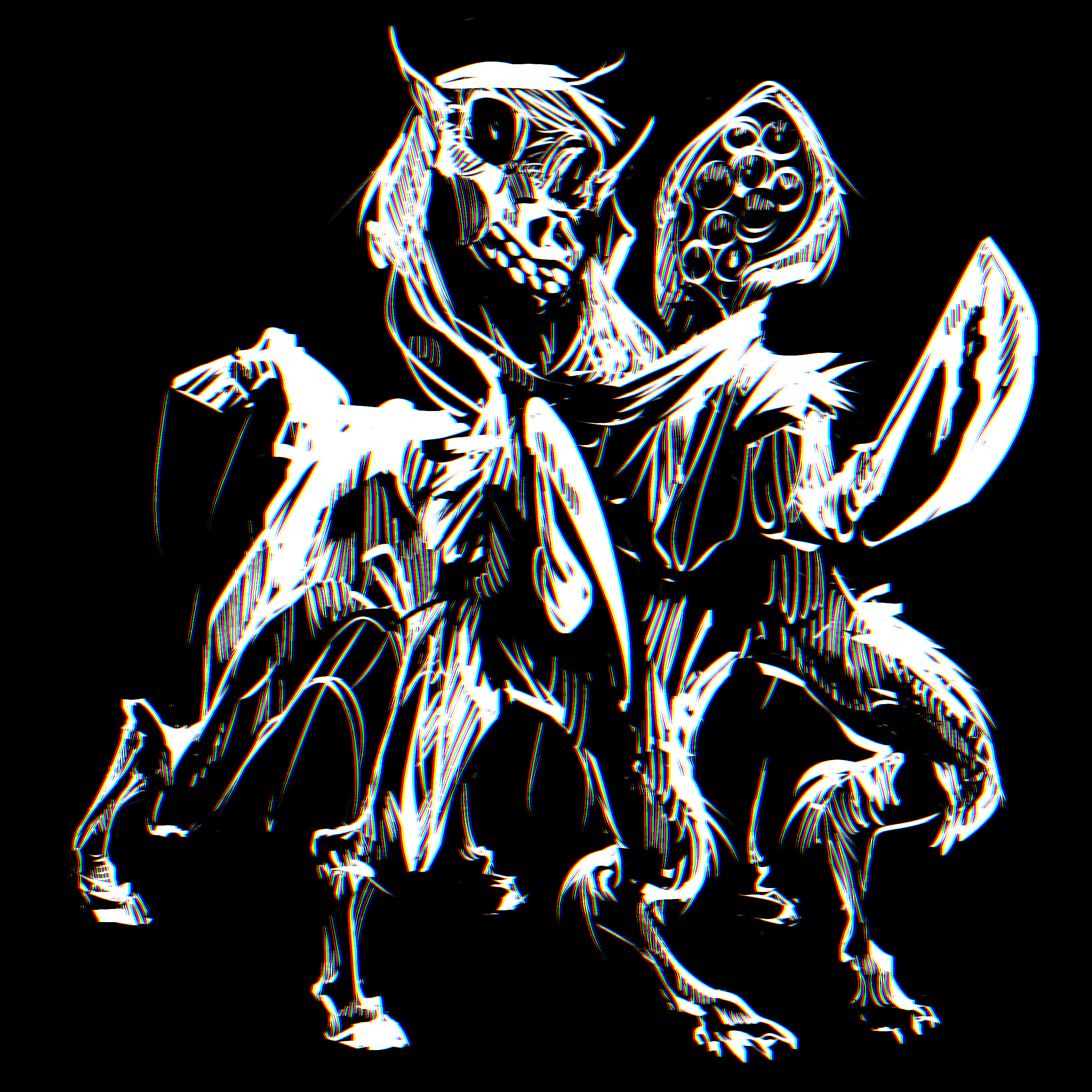
After that, there were occasional sightings of a figure believed to be Kewgsmkri, as they wore his hat and cloak, but the descriptions were in the realm of pure fantasy–a skeletal being, with long distorted face bones beneath burning eyes. Often, there was a pale and terrified face visible as well, according to reports, though whether one of the Kewgsmkri girls or not remains unclear. In all attested reports, however, the Père is quite real and substantial, if horrifying, while the other being, if present, is a spectral shade.

Contact is not advised, and ranged weapons or musketry are strongly encouraged should engagement become necessary.

High Inquisitor’s Note:
There are some who believe that the Père was twisted and driven mad by the deaths of his family, and made a dark bargain to extend their existence. Others hold that Mme. Kewgsmkri may have been a horror of the sort Père Kewgsmkri had once been sworn to root out, with the disappearances mere food to sate otherworldly spouse and spawn. I, who had little contact with Père Kewgsmkri while he was within the embrace of the church, have often been asked what I think. My first answer is usually that I suspect all stories have an element of truth. My second is that I do not want to know, and hope never to learn.

  • Like what you see? Purchase a print or ebook version!

Goblins have been and to an extent are now often treated poorly, often serving as laborers, chattel slaves, and worse despite their innate affinity for magical and mechanical systems. This latter affinity, too, has been the sorrow of many a goblin, as they have all too often been used as hapless experimental subjects by ambitious conjurers or tinkerers.

It can only be assumed that the Manastone Goblin was the result of such an ill-advised experiment, though no records or survivors exist to confirm it.

Appearing to be a rather large goblin of indeterminate age and gender, the Manastone Goblin has been fused with a large manastone or magick battery, which appears to have resulted in further growths not unlike veins of ore appearing above ground. This has had the effect of giving the goblin the ability to tap a nearly unlimited amount of magickal energy in the form of a variety of wild spells, directed energy blasts, and shields which can apparently be summoned at will. It can only be assumed that it used these abilities to decimate whomever or whatever created it.

High Inquisitor’s Note:
While some sources describe the Manastone Goblin as a force for unchecked destruction, it has never been observed harming another goblin, and unsubstantiated reports indicate that it has at times aided or even liberated its brethren. Despite this, however, the Manastone Goblin either will not or cannot suffer the company of its own kind for long, and will actively shun them unless they are in great need. This is in contrast to its behavior for most, which is to attack wildly at the slightest threat or provocation.

  • Like what you see? Purchase a print or ebook version!

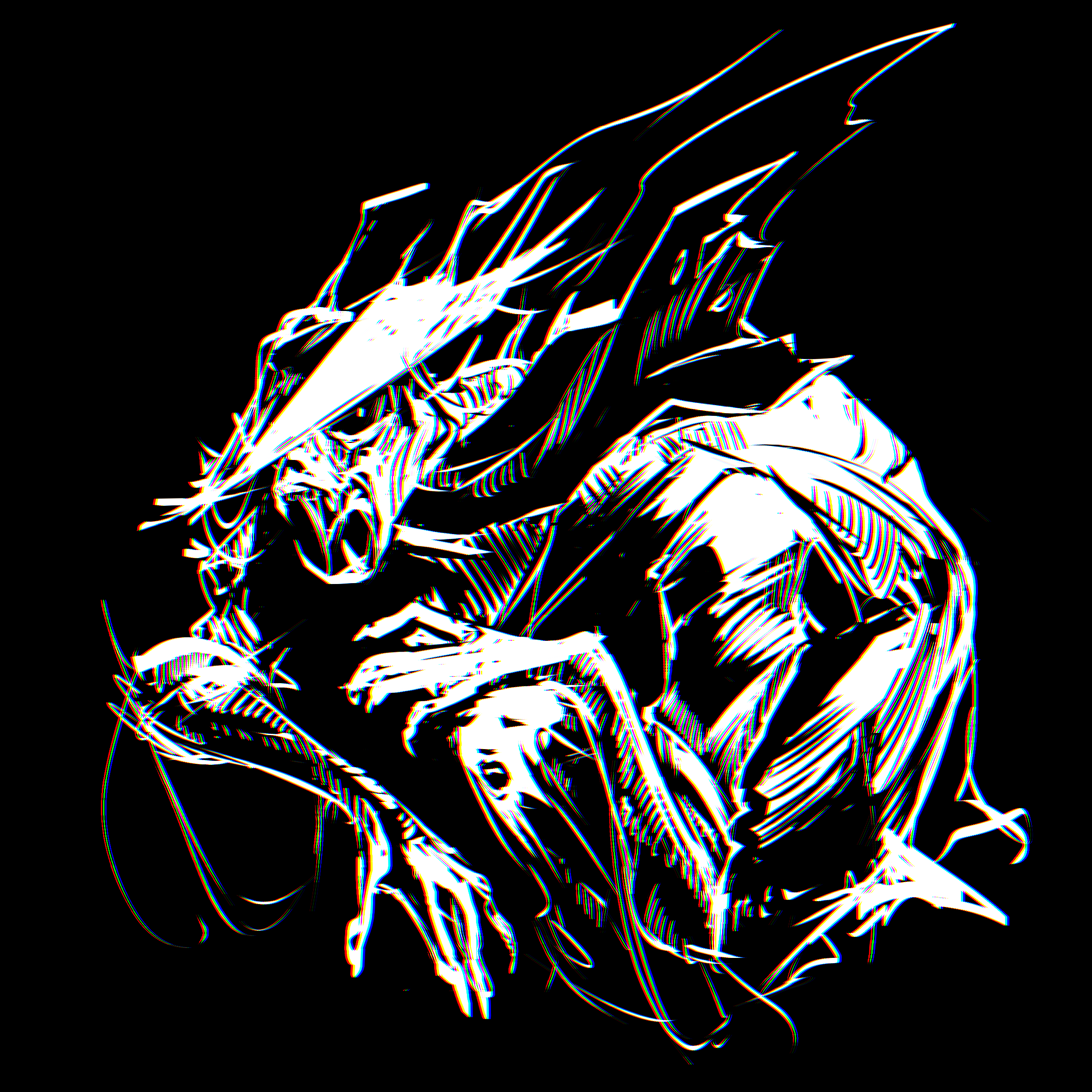
These constructs, called Deceivers, were designed to cause havok among enemy formations by using their innate mimicry and illusion skills before rending the combatants apart in a lightning attack. That worked well enough. But the Essenes relied on a wholly inadequate system to control the creatures, denying them calcium for eggshells and iron for their blood, with the former withheld entirely to prevent unauthorized breeding and the latter fed to them only in Essene holding pens. The Essenes soon learned how much calcium and iron was in the natural world, and within a generation or two there appeared wild Deceivers with neither weakness. They remain to this day a scourge in the humid lowlands.

High Inquisitor’s Note”
Deceivers are no more intelligent than any other wild animal, and indeed may be somewhat less clever than their wild forebears. But the feral variety inadvertently bred by the Essenes has a strong and instinctive mimicry that can allow it to seemingly converse and even operate machinery through observation.

  • Like what you see? Purchase a print or ebook version!

« Previous PageNext Page »