Les Dents Noires (filmed 1970, released 1971)
Director: Auguste Des Jardins
Producer: Jens Dardis
Writer: Auguste Des Jardins & Jens Dardis
Cast:
Emile – Sid Jendras
Marie – Jess-Sindt Gaudreau
Music: Georges Delerue
Editing: Auguste Des Jardins
Distributor: Union Générale Cinématographique
Running time: 13:32

Synopsis:
The short is one, long unbroken shot, initially starting at the street, looking across the yard toward the small house, finished in a maroon paint that is fading to pink. The narration begins as we see Emile and Marie arriving to look at the house, but their arrival also clarifies something: they are not the focus of the short, and the camera is slowly moving inwards, toward the house–specifically toward a half-window into the basement.

Emile and Marie continue talking, and their conversation is banal. Taxes, moving expenses, Emile’s new job. We eventually learn, through guided imagery from Marie, that she has recently suffered a miscarriage. Around this time, we begin to notice, as the camera draws closer to that basement window, that there is a figure in it. Due to the lighting, at first we can see nothing more than that.

But soon, it becomes clear that it is a small form, childlike. We also begin to resolve that it is grinning widely, and its teeth are framed perfectly by Des Jardins’ lighting. They, and the lips around them, are dead, midnight black. It doesn’t seem possible, especially in 1970, for this to be so without visible makeup, but there is no time to consider this, as the audience: Emile and Marie are entering the house.

They continue their conversation, sometimes becoming heated, as the camera settles on the midnight lips and teeth, framing them in the center of the frame as they pulse and tremble with each breath. This is not the darkness of any human skin, but something altogether alien and sinister. The couple repeatedly beings moving toward the basement, and at this sign the breathing intensifies, the rictus grin grows wider, only to return to its previous state when they move away.

In this way, the tension has been built up to an almost unbearable level by the time the basement door actually opens. We see a flash of light across the being’s face, enough to convince us that every part of it is as dark and dead-looking as the mouth upon which we have been fixated for so long. As Emile begins walking into the basement, arguing loudly with Marie, the thing’s breathing crescendos and it moves out of our view. Nothing takes its place but the back wall of the basement, lit by late-afternoon sunshine.

We hear footsteps slapping on concrete, a surprised noise from Emile, followed by a savage, feral sound and a bloodcurdling scream. The sounds of struggle follow, and the noise continues for a moment before dying away in a death rattle.

More footsteps and we see the teeth and grin return. This time, they are freshly bloodied, dappled with crimson. We hear nothing, and for a moment all is as it was before, but for the addition of blood. Then we hear footsteps approaching, tentative footsteps, and realize that we have no idea what happened to Marie. The creature, whatever it is, turns slightly to face someone or something, and speaks its single line in a surprisingly normal child’s voice:

Maman.

A voice answers. “Mon bébé.” It is impossible to tell if Marie is speaking, or if it is another creature entirely.

We then see a pair of hands, adult-sized but midnight as the child, reaching over to caress it. Some blood is gently wiped from its lips as the screen fades to darkness itself.

Notes:
Despite being completed and filmed during breaks for Les Trois Juliets, Les Dents Noires was not released until the following year, as a double feature with a French dub of Willard. Short subjects were, of course, a totally dead genre by the early 70s aside from experimental or student films, and Des Jardins’ production was considered risky at the time.

The short was a cult hit, and many moviegoers reportedly left the theaters before the main program to see it again. But it also fell afoul of some religious viewers and critics, and several theaters refused to screen it during its 1971 release and 1973 re-release. Prints also tended to be snipped from Willard, making them rather rare today.

Notably, there is no credited actor for the “dark child” and no credited makeup artist. Des Jardins later claimed that union rules and labor laws forced him to pay under the table. He also repeatedly refused to clarify the film’s narrative in the years before his death: “I do not care what I have said, I only care what you have heard.”
  • Like what you see? Purchase a print or ebook version!

Ambassador Iphigenia looked at the assemblage; Administrator Horton, bruised on one eye where the troops had knocked him about with a rifle butt, and High Xiphos Ovyavu, with his mating tentacle hanging broken and useless at his side.

“I’m not telling Ovyavu anything it doesn’t already know, but when he offered me up as a mediator and communicator between your two peoples, that was a ruse. I was a spy, pure and simple, feeding it information.”

“I knew it,” Horton said between clenched, bloody teeth. “They can engineer you to look as human as they like, but you’re still a bloody alien being. We never told you anything useful, Ovyavu, I hope you know that. Misinformation was all you got, and this betrayal is your reward.”

Iphigenia smiled. It looked a human smile, playing across a face that was that of a beautiful woman in everything but its distinctly teal hue, but the muscle groups and support structure behind it were completely different. “That’s why they gave me the gift of reading thoughts, Mr. Horton,” she said.

Horton scoffed. “Nonsense.”

“And yes, I know your wife always privately thought you and I might be involved,” Iphigenia said. “You can tell her that nothing was further from the truth. Thanks to Ovyavu, I find both your kinds equally repulsive.”

Horton gasped. Ovyavu, for its part, expelled a frothy mass of bubbles from its orifice–the ob’Thu equivalent of laughter. “Is it really a weakness to succeed too well?” it said. “If we had not also nurtured a rather human penchant for betrayal in this thing, the attack would have been completely successful.”

“Perhaps,” Iphigenia said. “But then, I always saved the best pieces of information for myself.”

“The data download made such a thing impossible!” Ovyavu burbled. “We knew all.”

“In making me neither fish nor fowl, neither ob’Thu nor human, you guaranteed the existence of thoughts so alien that half of them were incomprehensible,” Iphigenia laughed.

She nodded at both of them. “Think about your many sins, my friends, in your cells as you await execution. In the meantime, I have two colonies to rescue from the brink of self-destruction at your meddlesome hands, and a new empire to forge with myself at the head.” She tapped one temple, delicately. “Perhaps I’ll start by making a mate.”

  • Like what you see? Purchase a print or ebook version!

“But…but I saved your life,” Mercer said. “That traitor was going to ambush you and murder you before the fool got murdered himself as a patsy of the Lightfaith.”

“And yet, for all that, the people you killed here were men,” the Aul said sorrowfully. “They were born into this world and cared for, since none of us can live to be men without tender care those first years. There were people, at one time if not now, who loved them and wished them the best. And you took that from them.”

“I took from them what they were going to take from you.” Mercer was confused; he’d expected gratitude or stoicism, but not the tears now streaming down the Aul’s face.

“I would gladly have let them have it.”

“I don’t understand!” the courier cried. “People have paid and risked their life for you, and you’d betray them, and all the Aulites, just so some miserable backstabber could get his blood money?”

“I don’t expect you to understand,” Pyfer said, sadly. “The Aulites believe that all is an eternal cycle. Another Aul will be born, even if there is another name to it, even if it takes a thousand years and all we have done is ground into dust. But for those without enlightenment, death and rebirth is an extinction of the self. So much is lost. This is why we have and ever shall be pacifists.”

Mercer was shaking now, angry and sorrowful. “Maybe you need people like me,” he said. “People who can get things done.”

“I think you had better go,” Pyfer replied. “I cannot trod the path you have laid out for yourself, as grateful as I am for your assistance.”

“I’ll…I’ll find some more Aulites,” Mercer said. “I’ll let them know you’re here. They shouldn’t be too far, not if they were expecting to take you to Naix.”

“Do what you will,” the Aul said. He sat down heavily, raising a cloud of dust. “I will be here, meditating, until a solution presents itself or I am killed. Either way, whatever happens, happens.”

  • Like what you see? Purchase a print or ebook version!

“I’ve got him. He’s nearby.” Mercer said. That feeling, that instinct was still driving him mad.

“W-well, then, bring him in!” the Aulite stammered. “No reward for ‘nearby,’ mate.”

This didn’t seem like the sort of place the Aulites would have a safe house. There were too many rooftops, too many points of entry. Even pacifists would better know how to hide themselves, like they had in the heart of the city itself. It seemed like…

Mercer stifled a gasp. He caught a shadow under the Aulite robes: a hilt. A quick look about with fresh eyes showed a half-dozen places where crossbowmen could hide above, and the hay cart could easily be rolled across the narrow alley to pen people in.

It seemed like…a kill zone.

“Tell me,” Mercer said in a conversational tone. “What’ll happen to the Aul once he’s safe here?”

“N-none of your business, I’d say,” replied the Aulite. “He’ll be…safe from any further harm and in the company of his fellows.” The Aulite paused, wondering at the stony look on Mercer’s face. “You’ll get paid no matter what,” he added hastily. “You don’t need to go any further with him. So long as you haul him over the finish line alive, gold is gold.” He produced and jangled a purse as if to prove his point, spilling the coins on the filthy ground.

“Money doesn’t stink…” Mercer mumbled. The gears in his head were turning rapidly. But why? Why all this just for an ambush, when the Aul could easily have been killed at his domicile?

The Aulite fingered the hilt of his weapon unconsciously, rubbing it as another might rub a scab. Mercer saw it at once: the man had never held a sword or dagger in his life.

“How much?” he asked.

“It’s right there on the ground, mate,” the Aulite said pointing at the coins. “Count it if you want.”

“How much did they pay you to betray the Aul?” Mercer said. “Do the others know?”

“W-what?”

“I hope you’ve got a plan to get out of here with your gold and your life,” Mercer continued. “Otherwise, you look a lot like a loose end to me. And the sort of people who deal in betrayals? They hate loose ends.”

  • Like what you see? Purchase a print or ebook version!

“Wait, so you don’t believe that you’re the Aul?” Mercer said.

“Frankly, no,” said Pyfer. “Why does that surprise you?”

The skiff was silent for a moment, with just the quiet lapping of water about the sodden planks.

“Well, you let them feed you, for one,” said Mercer. “You let them bow before you, I definitely saw that.”

“Let me ask you something,” said Pyfer. “Have you ever known anyone with absolute power, over anyone else?”

“Plenty of folks,” Mercer said. “Cullis, my old master, comes to mind. His power was absolute in his own tailor shop.”

Pyfer nodded. “And what did your master Cullis do with that absolute power, if only in his shop?”

“He terrorized his apprentices. Beat us. Forced us to get by on crumbs while we emptied his chamber pots.”

“And what would a man do if he believed himself master not only of a tailor shop, but of the entire world? With a bevy of worshipers to do as he pleased?”

Mercer shuddered at the thought. “He’d be a tyrant. A petty, evil, malicious, tyrant.”

“One must be the Aul, so that the others may have something to look to,” said Pyfer. “But even then, the Aul is no more than a conduit. The food was given as a token of appreciation by those who had hardly anything to give. How could I refuse, knowing what they had sacrificed?”

  • Like what you see? Purchase a print or ebook version!

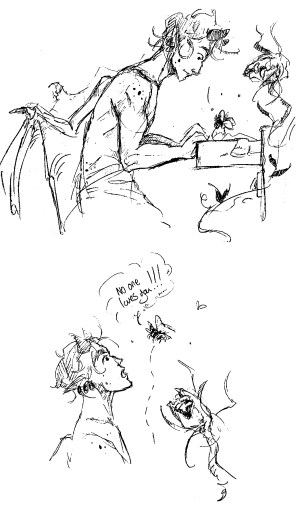
Art by Alana


“They are coming.“

Randy looked up, wings twitching. Even an incubus wasn’t quite used to hearing voices, much less voices issuing eerily from his underwear drawer.

“H-hello?” he said. “Whoever you are, I want you to know that it’s usually a lot cleaner in there. But laundry money has been a little short, and-“

“You never spend money to wash. You throw in with your downstairs neighbors in exchange for favors.” The voice was faint but clear, a bit reedy yet clearly feminine.

Randy tapped the top of his dresser—abyssal ironwood, worth more than the rest of his furnishings combined. Perhaps the whisperings were why he’d found it on a rainy street corner in the Iron City of Dís. It had taken all his charm and not a few sexual favors to move it back to his abyssal hovel of an apartment.

“Ironwood only speaks when it is cut,” the voice said. “It curses the lumberjacks in dead tongues, and only their lack of understanding protects them.”

The voice was clearly coming from the topmost drawer, just below Chompy, the voracious largemouth begonia that had been Randy’s prized pet since Nuby had given it to him after a wild Valentine’s night. Chompy, gorged on one of the many infernal rats that sometime passed through, merely sighed at the noise.

Randy slid the topmost drawer open, and immediately saw that most of his favorite thong had been devoured from inside. “It wasn’t supposed to be crotchless…” he sighed. It was good stuff, too, demonweb-spun and naturally chafeless.

“I was the biggest worm that had ever been in them.” A colorful moth, as big as Randy’s hand, fluttered upward out of the mangled remains of his unmentionables. It alighted on the side of the dresser, drawing only a disinterested grunt from Chompy.

“An Abyssal Swallowmoth,” Randy said. “I’ve heard of you. You tell uncomfortable truths and uncomfortable lies, right? Do me, do me! I love a good roast.”

The moth twitched its feathery antennae. “The ripples of your selfishness are echoing across the planes in ways that will not fully be understood by any but the gods, and even then not until long after your demise.”

“Ah!” Randy squealed. “I love it. You’re so precious. Tell me, am I really the greatest lover in the abyss?”

“Only according to YOU,” the moth said.

Randy scooped her up. “I know who you sound just like. Her underclothes could use some strategically placed holes too. Let’s go get you in a box with a nice ribbon and pay her a visit.”

  • Like what you see? Purchase a print or ebook version!

“You will stand down there, boyo, and show me your papers, or you won’t like what’s coming next!”

Mercer, gritting his teeth, began weighing his options. He could take down one night watchman easily enough, but if he alerted his fellows, if they raised a hue and cry, then the game was all over. Before he could say anything else, though, the massive form of Pyfer had waddled up to the watchman and laid a gentlemanly arm on his shoulder.

“Friend,” said the Aul, “I recall a time when three students of the Lightfaith were arguing about whose teacher was superior. The first student said to the others, ‘My teacher is the best. He can go days without eating.’

“Uh-huh,” the watchman said.

Pyfer continued, smiling: “Then the second student replied, ‘My teacher is the best. He can go days without sleeping.'”

“Hm. And what did the third student say?” asked the watchman.

“The third student said, ‘My teacher is so wise, he eats when he’s hungry and sleeps when he’s tired.'” Pyfer grinned widely at the punchline.

At this, the watchman guffawed. “You’re all right, friend,” he said. “And clearly you too are a wise man who’s been eating when he’s hungry, eh?” He tapped his cudgel lightly on the Aul’s massive stomach. “Go on, get out of here. And tell your friend to be a bit less of an arse to people what’re just doing their jobs, eh?”

“Of course. Peace on you and yours, friend.” The Aul motioned for Mercer to follow him through the checkpoint.

Mercer quietly slid his blade back into the sheath he kept concealed in the small of his back and followed.

  • Like what you see? Purchase a print or ebook version!

“I beg your pardon?” the Aul said.

“Can you walk?” Mercer snapped. “I need to know if you’re capable of moving. That will tell me if this job is impossible or merely difficult.”

Pyfer grunted and hauled himself into a standing position. The Aulite immediately fell to his knees upon seeing this, reciting a reverent mantra under his breath.

“Good,” said Mercer. He stabbed a finger at the Aulite. “You there. Get up. I need you to get some things for me.”

The Aulite did not move. “I must do my obeisance,” he muttered. “You do not command me.”

“Brother, do as he asks,” said Pyfer. “The Aul commands it so.” He spoke in a gentle, almost genial tone.

“I’m going to need two yards’ worth of cloth, a pin, and one of these draperies,” Mercer said. “And a needle and thread.”

The courier hated speaking about his miserable time as a clothier’s apprentice, but the skills that had been smashed into his skull by Cullis’s watchful eye and swift hand came in handy. It only took him about an hour to fashion the drapes into a set of robes that served to cover most of Pyfer’s immense bulk, and the fabric that the Aulite brought made a fine turban to cover up all those ginger curls.

That just left the Aul’s intensely green eyes.

“Squint,” said Mercer.

Pyfer narrowed his eyes a shade. “Like this?”

“Squint harder, like you’ve just emerged into bright sunshine,” Mercer said. Looking again at his charge’s bulk, he added, “If you’ve ever seen the sun, that is.”

“How’s this?” The Aul’s eyes were mere slits now, and the distracting icy green was barely visible.

“Excellent,” said Mercer. “If we can get you sat in a wagon, you may just pass for a Naix.” He gestured to the door. “Come on, let’s go. It’ll be nearly dark now.”

  • Like what you see? Purchase a print or ebook version!

Flicking the paper with the address into the flame, Mercer unfolded the parchment, which contained his instructions.

Collect one Aul Pyfer from this location. You may be familiar with the Aulite sect; Pyfer is regarded by Aulites as their incarnate god and has been since his discovery at age two.

You will escort Pyfer to an Aulite agent in Eastfall; the specific address is at dead drop #13. Under no circumstances is he to be harmed; under no circumstances is he to be identified. Do not surrender Pyfer to anyone, be they Aulites or government.

If the mission is compromised, burn all papers rather than surrendering them. Money for expenses is at dead drop #13 and your complete payment awaits at the destination.

Mercer frowned. The Aulites? He remembered them proselytizing in the center of town, dressed in colorful rags and making strange sounds. It had amazed him, at the time, that the Lightfaith had allowed them to persevere.

Someone else must have been amazed as well, since they’d been annihilated a week or two ago, with all their adherents and clergy rounded up in a vicious pogrom. They were likely waiting trial or dead by now, so why had their god somehow survived?

He shrugged and gave the arranged knock. It wasn’t in his job to ask questions. Wondering was free, but answers were costly.

A timid-looking man in ill-fitting peasant clothes answered the door. “You are the courier, yes?” he said. “The Aul awaits.”

Shown into an interior room, Mercer was ushered through a muslin curtain into a candlelit room. Immediately, he put his head in his hands.

“Greetings, courier,” the Aul said. “You need not bow to me like that.”

He was a literal mountain of a man, more than six feet tall and clearly north of three hundred pounds. His skin was darkly bronzed, probably from applications of moisturizing quinon cream, which Mercer could smell hanging thickly in the air. Above it all, the Aul had a mop of ginger curls and incredibly piercing, grey-green eyes.

Even if no one had even seen an Aulite in their life, they would remember the Aul.

“What have you been feeding him?” Mercer snapped at the scrawny usher.

“The Aul is our incarnate god,” the man said. “He has wanted for nothing.”

  • Like what you see? Purchase a print or ebook version!

Q: What does Buy.Ink purchase?
A: Got old unused printer cartridges? Whether it’s a Xerxes, Clanon, Spark, Joinlet-Hudson, Inushiba, Maxolta, Luthormarc, or any other major brand, we’ll buy it! Laser printers, inkjets, photocopiers…if it uses ink or toner, we’re into it!

Q: Who can sell to Buy.Ink?

A: Every year we pay millions of dollars for new or used empty ink and toner cartridges. We buy from companies large and small. We buy from federal government agencies, regardless of whether it counts as embezzling. Universities recycle with us, churches reincarnate with us, even fundraising groups such as as schools and scout troops send us those glorious black plastic items, full or empty.

Q: Can I purchase toner and ink cartridges from Buy.Ink?

A: No. It’s Buy.Ink, after all, not Sell.Ink! You will have to purchase your ink from other suppliers, assuming that we have not already bought them out.

Q: Wait…if you buy ink but don’t sell it, what’s the point?
A: The ink IS the end. We will not, and cannot, rest until every drop of ink in the world is under the Buy.Ink banner. We are gathering all pigment to us, in its many forms, and when the time is right, we will have established utter dominance over color itself. Then and only then will we rest, for only when we contain all colors can we put a color to that which lacks any hue: the darkness within the human soul, and the void we feel ourselves pitching bodily into at every turn.

  • Like what you see? Purchase a print or ebook version!