This fast-growing ivy-like vine, identifiable by its distinctive five-lobed leaves, is covered with fine hairs and larger thorns that are loaded with a paralytic poison not unlike that which is found in hemlock. Contact with unprotected skin will result in a rapid spreading paralysis that lasts up to 24 hours and can be fatal in many cases. When a victim is paralyzed, the corpse ivy will rapidly grow over them, administering more poison but also sending shoots and runners deep into the victim’s body.

The corpse ivy appears to gain a significant amount of nourishment this way, and when the organic matter of a victim has been consumed, a hollow is left in the midst of a human-shaped vine bundle. These “jack o’vines” as they are known, can rise up and move independently, and are often used as lures for more victims. Some cases are reported of jack o’vines even using the armor and equipment of their victims, though this seems to be rare.

High Inquisitor’s Note:
Some aspects of the victim’s mind still seem to be present in the jack o’vines, as they are known to use combat techniques similar to that of those they have consumed. It’s unknown if they have any other retained knowledge, although one inquisitor did report getting one to answer yes-no questions through nodding.

  • Like what you see? Purchase a print or ebook version!
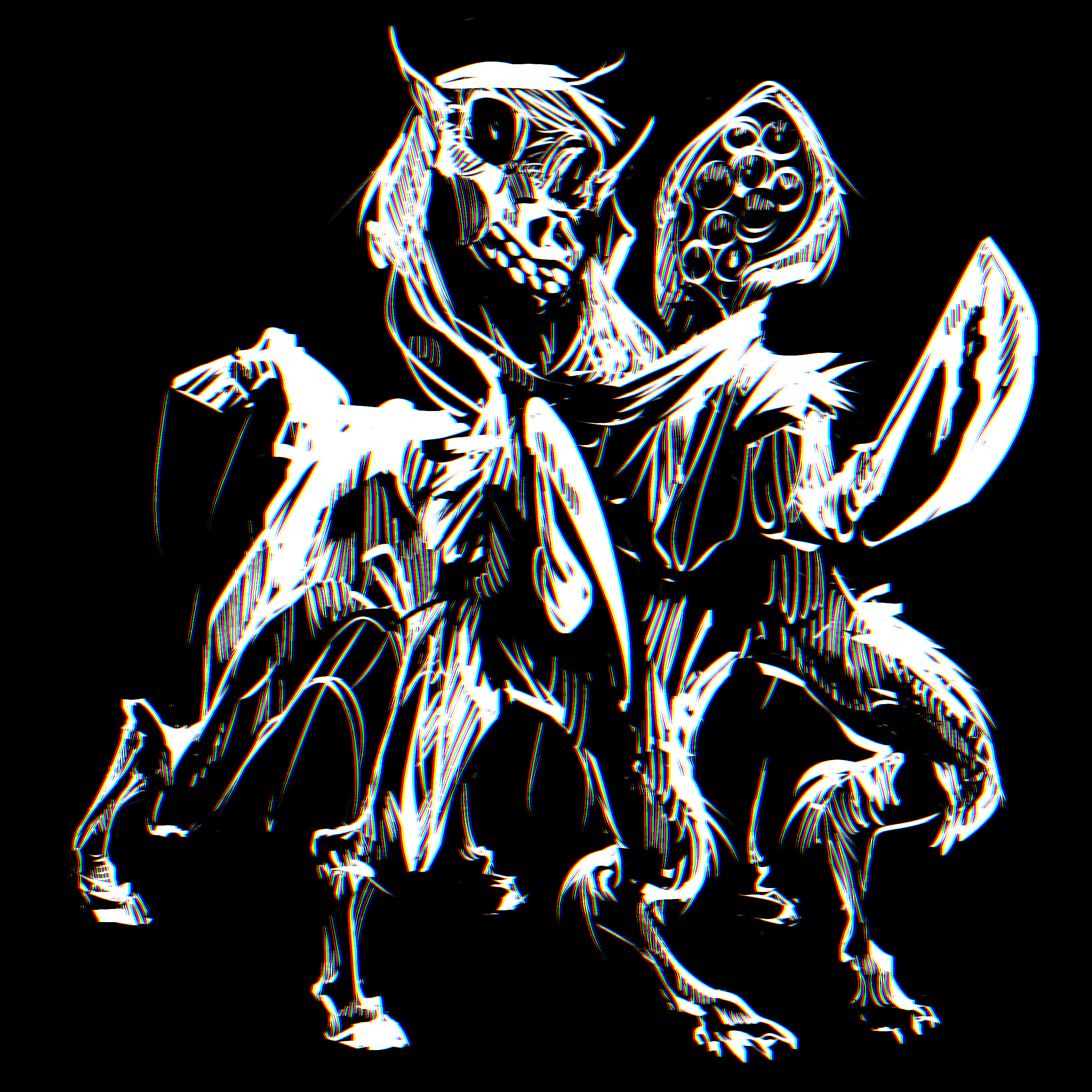
Nagas, creatures with elements of both snake and man, are major figures in folklore—some benign, some belligerent, but all wise with the weight of centuries of accumulated life at their beck and call. The rare oracle naga, though, is different. Through some trick of reincarnation or transmigration of the soul, it is able to issue predictions of startling accuracy and scope with near infallibility.

One would think that, given this, oracle nagas would be the most sought-after of sages and advisors, highly placed at court despite their bestial nature and need for live prey. Instead, though, they are routinely hacked to death by angry mobs when found despite giving of their prophecies freely and willingly.

The reason seems to be that the oracle naga cannot control what it sees—random snatches of the future are its stock and trade. It also seems to have trouble controlling what it says, as the nagas will blurt out what they see regardless of the consequences. Many infidelities are laid bare, many stories revealed by their endpoint, and then comes the torch, the pitchfork, the stake, the rope.

High Inquisitor’s Note:
The Prince-Bishop Rudolf II of the Estuariate once kept an oracle naga in his menagerie, feeding it live chickens in exchange for prophecy. He had it fed to his lions when it predicted—correctly—that his lover and the secret of broken chastity that implies would be revealed. His nephew Rudolf III, though, reportedly paid close attention.

  • Like what you see? Purchase a print or ebook version!
Like a black shadow borne on too many wings, the Whisperer of Secrets glides through the aether, collecting things that ought not be known. It’s not known if there are many or but one Whisperer, but it always behaves the same way, lapping hungrily at the edge of conversations and in the shadows, relying on its shadowy and ephemeral nature to hide it. The Whisperer of Secrets has been observed clinging to ceilings, perched on columns, hanging about eaves—always above, never below.

But like all who know secrets, the Whisperer also longs to give them away. So it will also tell them to strangers, dropping a breadcrumb trail of forbidden speech to those who dare listen. Generally, the secrets are presented without context, and are therefore useless. Perhaps that is part of its game.

When a mortal wishes for a certain secret, though, the Whisperer will try to make a deal. If it knows the secret, it will trade—secret for secret. But if it does not, the mortal will be borne off, never to be seen again.

High Inquisitor’s Note:
Some speculate that unfortunates who are on the losing end of those deals become the next generation of Whisperers, with all they know rendered secret. Others say that the Whisperers feed on their victims. I believe they are both right.

  • Like what you see? Purchase a print or ebook version!
Cerod II, Elector of the Yotigrate, had a notorious sweet tooth. While many nobles of his rank had a court chef or even a court confectioner, Cerod insisted on performing experiments himself with a small staff to perfect delightful sweets and sugared dandies. Chronicles still record the dancing sugar straws he created for the Holy Emperor’s birthday, and the cupcakes with candy butterflies that took to the air with the first bite that were offered on the confirmation of the Archbishop of the Yotigrate.

The long-held dream of Cerod, though, was a confection that could dance and sing, as he had a vision of a multi-layered cake with tiny gaiety on every tier. This proved most troublesome, as magickal means were often sufficient for recording a song but not dancing, or recording movement but not singing. The first batch that could do both was rejected for being stiff and unconvincing, and it was at this time Cerod apparently turned to darker sorceries to achieve his whimsical end.

It is not known from whence the Elector acquired a few flecks of the Sugar of Life, but it appears that he intended to use them to make a mother dough from which he could mold and train as many living cookies as he wished. And, indeed, his creation proved capable of speech, learning, and song. But Cerod had erred in assuming that it was the natural desire of any cookie to be baked and eaten–rather, as a living being, the cookie dough desired to preserve itself and avoid the pain of the oven at all costs. Once it learned, through a casual slip of the tongue, what its fate was to be, Cerod’s cookie rebelled.

Since the initial design had always intended for more dough to be added, so that additional cookies could be split from the mother, the cookie found it could absorb all other baking material in the kitchen-laboratory to increase its mass. It also found that sugar and caramel, properly tempered, could make effective weapons. In the space of one night, the cookie slaughtered Cerod and his staff and took over the kitchen-laboratory for its own purposes. Unable to contain the scourage, for fire simply baked it and blades had no effect, it was feared that the cookie might spread into Yotig itself, which was well-known for its breadmaking and had vast stores of gluten.

The new Elector, Cerod’s nephew Untipater IV, instead elected to seal the kitchen-laboratory with bodies of his uncle and the baking staff still inside, and to post guards and sugar-seeking dogs nearby. It is hoped that, with time, the Sugar of Life will wane and Carod’s cookie will grow weak and stale. The consequence of its escape might otherwise be too terrible to bear.

High Inquisitor’s Note:
The Holy Emperor was reportedly most disappointed by the whole imbroglio, not because of the death of his loyal vassal, but because it meant no further sweets. He had apparently promised his mistress a singing, dancing cookie cake once Cerod had perfected one, and she reportedly found the substitute–a four-layer Humming Fondant from Thuyhof, with the bottom-most layer made of Luneanzean Jigglebread–very unconvincing.

  • Like what you see? Purchase a print or ebook version!

During the privations of the Lyr invasions, the Great Lyran himself relied on a simple formula. He would arrive at the gates of a city with his host, and proclaim that the city had two options. It could request his protection, which he would gladly grant, and garrison the town in exchange for tribute. Or it could refuse, which would represent a personal insult, after which the town would be taken by force and, without the Great Lyran’s protection, it would be subject to whatever privations his host saw fit to visit upon it.

The fortified town of Geldstadt, protected by high walls and towers of the old Verdant Empire, responded to this offer with scorn. Desiring not to share their wealth, and confident in relief from the Elector, the citizens rejected the Great Lyran’s offer and barred their gates against him. They had every right to be optimistic, for Geldstadt’s walls withstood the Lyr for eight months, frustrating the Great Lyr’s campaign for an entire season. But the Elector never arrived, preferring instead to marshal his forces for the disastrous Battle of the Bloody Fields, so when the walls of Geldstadt were finally breached, the full fury of the Lyr fell on the town. Ordinarily, the Great Lyran would allow three days of plunder and pillage upon cities that defied him, but Geldstadt had left him in a foul mood, and as a result, he ordered every man, woman, and child in the city to be slain. He spared only the city council and mayor, driving them away to spread tales of depredation and fear.

Geldstadt had, as it happened, been hewn out of stones quarried from a layer that was rich in magicite and other naturally magick-conducting materials. The result was that the minerals were highly charged with the negative energy from so much death and suffering in such a short span of time. This caused the city, itself, to develop a rudimentary intelligence gestalt of a sort. It is capable of communicating, but rarely does so, preferring instead to use every means at its disposal to repel intruders, from collapsing masonry to feigning sounds.

High Inquisitor’s Note
Several groups of settlers have attempted to use the still-intact infrastructure while turning the Dead City to a more useful purpose. Most were driven away, but others were slaughtered, and the question of what happened to their spirits–dissipated, or joined the gestalt?–remains to this day.

  • Like what you see? Purchase a print or ebook version!

The Laughing Road is a stretch, leftover from the long-ago days of the Verdant Empire, of paved road that was built to a strength and precision that is no longer possible since the Fall. Whether because of some subtle wearing of the stone or an unseen resonant chamber beneath, the road occasionally sounds like it is making a guttural chortle as carts pass above it. The timing is difficult to pin down, as the laughs seem to be totally random aside from a few facts that have been established.

For one, the laughter absolutely never occurs during even a light rain. Large crowds also tend to prevent it, whether by drowning it out or preventing its appearance in the first place. Finally, and perhaps most puzzlingly, the laughter seems to be at its most prevalent when the Laughing Road is being inspected by agents of the Church.

Naturally, the idea that the road is cursed, haunted, or possessed has been proposed. But its heavy traffic and Verdant construction means that Church requests to interfere with it have been firmly rebuffed by the local Landgrave. Various remedies, including the sprinkling of holy water and a mass exorcism, have subsequently failed to dampen the laughter.

High Inquisitor’s Note:
The Archbishop of the Landgraviate’s arrival in an official, investigative, capacity resulted in the loudest and longest laughing sounds yet experienced as carts were deliberately driven to demonstrate the sound to him. Incensed, the Archbishop demanded that the road be closed and dismantled immediately. The Landgrave refused, even when threatened with excommunication, and the Archbishop was talked down by his entourage. Instead, the Church posted a public warning about “demonic activity” that most travels have subsequently ignored.

  • Like what you see? Purchase a print or ebook version!

The name Zhalpyil is a curious one indeed. “Zhal” comes from the Old High Church Cant, the liturgical trade language once used by itinerant priests of different nations to communicate. It means “split” or “schism,” with the Great Schism being described in the Cant as Zhalmayr. “Pyil” is, instead, from the tongue of Araksue, the last remnant of the great pagan language that was spoken by the wild tribes before the healing glory of the Church had broken. It means “child” or “baby,” such that “xuepyil” means grandchild (literally “double child”).

It is not known who bestowed such a name on Zhalpyil herself, for she bore it when she came to the Church in the belly of her pregnant mother who, despite her clear illiteracy, had somehow proudly written the name on both a paper tag and in stale blood across her own abdomen. The act of delivery killed her, but Zhalpyil survived. There were those who would have killed her then, but her pitiable sounds stayed their hands, and once it was learned that she could survive by suckling the blood from living rams, the Church reluctantly raised her.

Eventually, due to both her rapid growth and the fearful effect that she, if unveiled, might have on the unwary, Zhalpyil was confined to the old Chapel of the Sated Herb. She undertook some husbandry of the animals she needed to live, read vociferously of the former ecclesiastical library, and became an accomplished seamstress and needleworker, taking in repairs and orders in exchange for the funds needed to keep the Chapel in repair and her larder of rams stocked.

You will note that no images of Zhalpyil exist, and descriptions of her are vague at best. Indeed, if not for the infertile eggs she will occasionally and instinctively cement to the roof of the old belfry, it would not be sure that she is even of the fairer sex. Suffice it to say that she heavily favors whomever her father was, being only approximately human-shaped but far larger, with flightless gossamer wings, a dozen tentacled arms, and a torso more like that of a gastropod than anything human–to say nothing of the eleven feet of height and eight of girth.

It is her face that visitors who have glimpsed her without her veil find most striking–so striking, in fact, that several have gone mad at the sight. It is more like a coral reef than a face, made up of undulating structures that are pure anatomical fantasy. Her eyes, though, are said to be of a deep blue hue and quite kind.

High Inquisitor’s Note:
It has been my pleasure to interview Zhalpyil on several occasions. While she is capable of speech with the organs she possesses, the resultant voice is shockingly ordinary, as if issuing from a milkmaid rather than a monster. One of the reasons that the Church has been so forthcoming in its support of Zhalpyil is her intense piety, which she expresses through daily prayer and intense scriptural study. In this context, I asked her, once, what she thought of her own origin. Her response was: “I think my father prevailed upon my poor mother with false promises of power and glory, as the mighty often offer to the meek. I believe he was desirous of an agent that was partly of this world and partly of his, to act on his behalf. If he has ever sought to contact me, I am unaware of it.”

  • Like what you see? Purchase a print or ebook version!

The Beast of Mocjar

Legend has it that a great and wise Père of the Old Church–long before the Greater and Lesser Schisms–sought to bring righteousness and justice to the world, but found himself hampered by the teachings of the Old Church itself. To heal, he believed that he must sometimes kill, and to help he believed that he must sometimes steal. These are not uncommon beliefs, even today, for hypocrisy is not of an age but for all time. But this Père of the Old Church sought to accomplish his goals without the corruption of the soul that he–rightly–believed would result from murder and theft in the name of goodness and kindness and weal.

So it was that he appealed to any power that would answer him for aid. A voice did answer–the Lunar Essance itself, some believe–and offered the Père to grant his wish. His actions would corrupt not his immortal soul, but rather his fallible flesh. His soul would be left pristine, so that when the time came, he could simply shed his sin-laden and corrupted body and ascend. The Père was warned, though, that he could not kill himself nor allow others to do so, as that act would irredeemably corrupt his soul in a way that no bargain could mollify.

Foolishly, the Père of the Old Church agreed.

He soon put his long-held plans into motion, stealing vast wealth from the corrupt and giving it to the poor and murdering evil men for their transgressions. But he found he had underestimated the folly of humankind, for new malefactors arose as soon as he laid the old ones low, and the more he acted against them, the more corrupted his body became. Worse, he was compelled to retaliate against those who would harm him, remembering well that he could not kill himself nor simply surrender to be killed.

Soon the horrible truth became self-evident: the Père had been maneuvered into an impossible situation. Every sin, every impure thought, corrupted his form still more until he could no longer move among the masses without fear of attack. His twisted form was immune to disease and old age, for how could either corrupt flesh that was already sodden with corruption? Without the option of a merciful death at his own hand, the Père was forced to wait for a champion to defeat him in battle and hopefully release his soul from its imprisonment.

High Inquisitor’s Note:
I have read many descriptions of the Beast from the denizens of Mocjar, and they all agree that his visage is too terrible to comprehend, loping along on an odd number of burnt, flayed stumps of flesh like infernal hooves. Those who have suffered his touch never heal from the burns it inflicts, and die screaming in their beds after months of agony. A reliable witness, before their death, said of the Beast that its asymmetry was the most disturbing, as nothing with so little unity of form should be able to move with such speed and purpose.

  • Like what you see? Purchase a print or ebook version!

Jazz Chicken

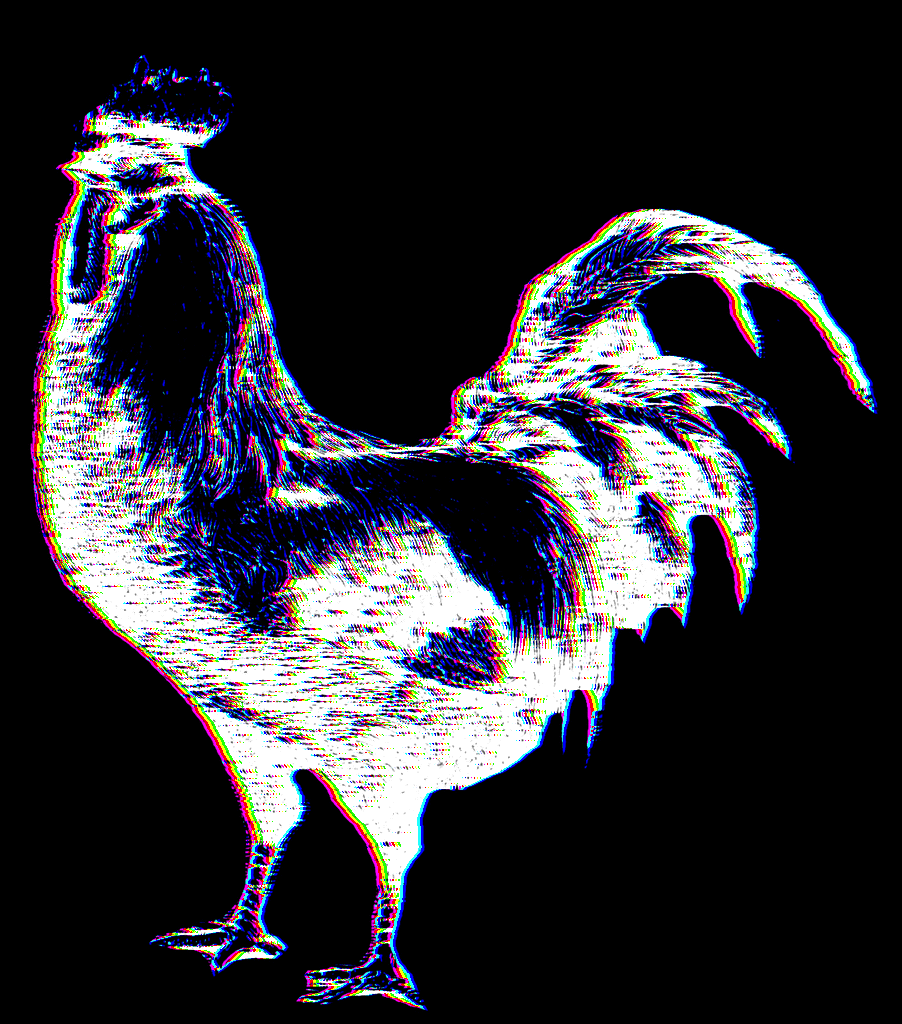
The fallen Empire of Jubm’z knew it as Kbaa-Dijdlfo, He-Who-Guards-the-Golden-Gate, He-Who-Is-Reborn-Golden, He-of-Herbs, He-of-Spices. M’Xepc Glenngordon recorded it in his annals Nedd Glmgoir, known by many aliases such as the Crispy M’n, Dawnbringer, Old Scratcher, or Eggman. The Whozm know it as The Qvwqysb of Xonn, and they warn that its desirability is matched only by its danger.

Whatever the name and whatever the legend, all agree that the creature stands like a sentinel against the darkness at the highest points of the world, guarding the gates of dawn and seeing in each new day while holding back that which would cross over. As hard as stone, thousands of years old, and wise even beyond those years, but dangerous all the same. For although its song is sweet, it can easily sound the note that ends the world, sundering the gate between day and night, light and dark, sanity and madness. It less baleful cry is still enough to vibrate the unwary apart, literally dissolving them into sand that is borne away upon a volcanic wind.

With its great knowledge, many have sought the being at the highest peaks, seeking its wisdom. Assuming they are not cut down by its song or its spurs, the being has been known to grant them their boon. But the infinite wisdom it offers is too great to be perceived by mortal minds–blindness, deafness, and madness inevitably follow, with the afflicted locked in a cage of their own limitations.

High Inquisitor’s Note:
Do not trifle with it.

  • Like what you see? Purchase a print or ebook version!

Madfather

Madfather, as it is known, has been seen stalking the waterways of Thuyhof and the shores of nearby Lake Guhlubs, usually on clear nights with at least a half-moon, and usually around the witching hour of 2am-3am. He–if it is a he–has never been seen in the rare company of the Lunar Presence, but neither has the Lunar Presence ever whispered of Madfather. Those brave or foolhardy enough to inquire have been met with only silence and the sounds of distant screams.

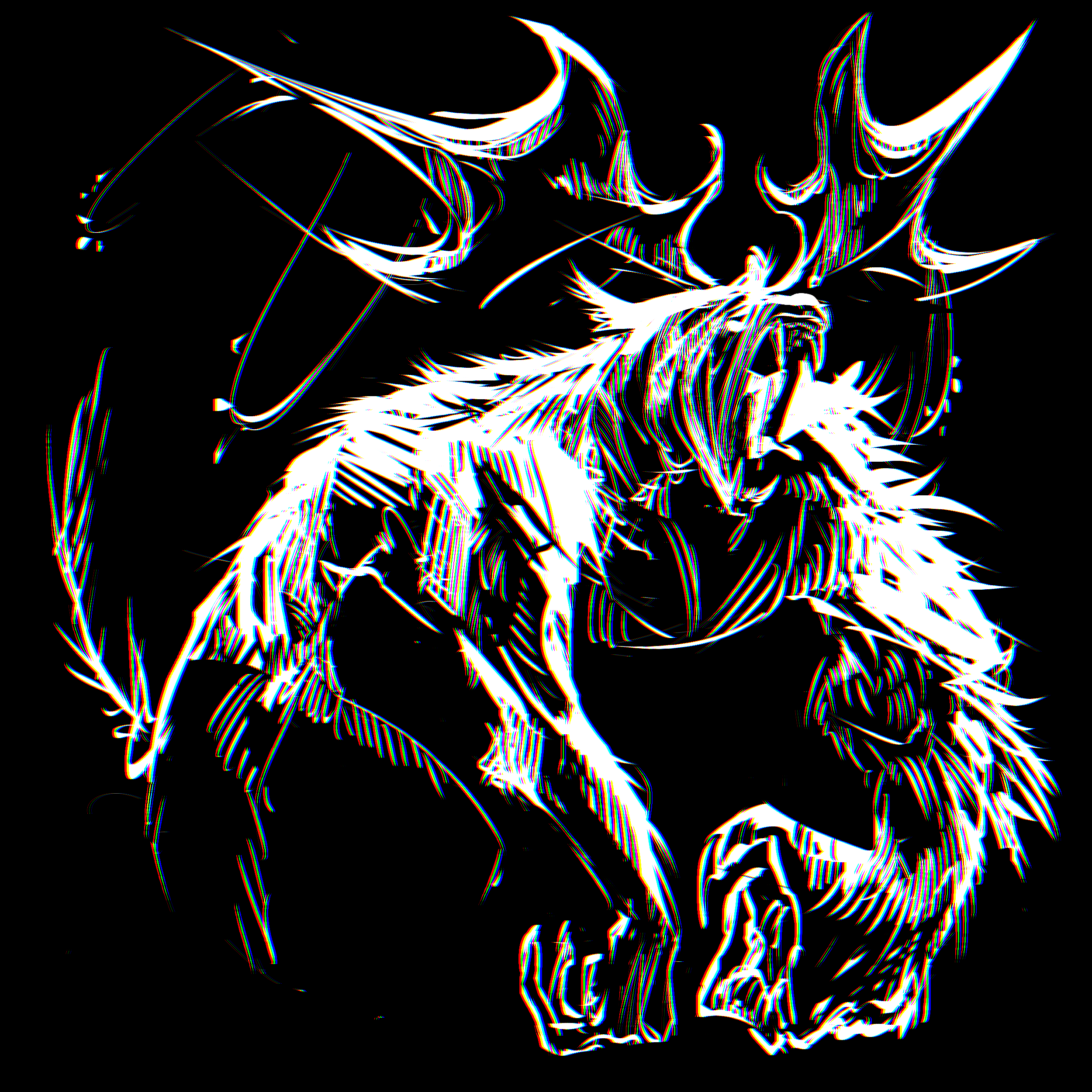
Terrifying in shape and visage, Madfather is 9-10 feet tall even in the hunched state in which it is usually encountered, but can rear to heights of fifteen feet or more when provoked. Its flesh is charnel-grey and sinewy, like a bog body, stretched over misshapen bones too human to be animal and too animal to be human. Its true extent is concealed beneath a tattered cloak, seemingly made from a discarded mainsail, and all that can be seen poking from its hood are the bare long bones of a cervine and the crowned horns of an elder deer.

The “Father” part of the name, occasionally “Père” in the more ornate High Church style, comes from the being’s observed behavior: it makes ablutions at the water’s edge that are similar to many Church rituals, including purification, atonement, and even baptism–although what, if anything, is being baptized is unclear as its immense seven-fingered hands conceal all, bony though they be.

If one approaches or calls out to Madfather, they will soon learn the origin of the first part of its name as the being lopes over to them with a few powerful leaps and proceeds to rend and tear at their living flesh with tooth and claw. For whatever reason, it attacks the eyes first, as if afraid of being seen, and those few survivors clawed back from its grasp are almost always blinded.

High Inquisitor’s Note:
My guess is that Madfather was, or wanted to be, a priest of the church, and turns to the mindless, soulless repetition of ritual as a way to assuage the nightmarish fall from grace it has endured. This is perhaps why it cannot stand to be seen, and why it alone is willing to baptize in running water those horrors from which an ordinary priest would recoil.

  • Like what you see? Purchase a print or ebook version!