“Don’t worry about the E-Z Inn/E-Z Out Motel,” Kunstler said. “I’ve seen the manager. A weak man, skulking about sucking money from those who have nowhere to go. A good, firm grasp is what’s needed.”

“Good, firm grasp, eh?” Sexton said. “You going to rough him up?”

“I’ll just tell him that if he breathes one word about this to anyone, I will lash him to a telephone pole with razor wire, facing his wretched little establishment, so that he can watch it burn to the ground as the life dribbles out of him.”

Mercifully, Sexton’s phone buzzed before Kunstler could further elaborate. “Okay, I need to take this call,” he said. “From the boss.”

Kunstler grunted and walked onto the balcony; a moment later, he could be heard lifting one of the metal deck chairs like a dumbbell.

“You did well, Sexton,” Fairburn said. “It will take the authorities weeks to figure out that the body in Kunstler’s cell after the fire was not his, if indeed they ever do. My analysis has so far proven correct, which is why I have your third and final recruitment ready. Complete this, and statistically speaking, your team cannot fail–you, and they, will all have their lives back and be none the wiser.”

“Who is the third one,” Sexton said. “Let’s get it over with.”

“Are you familiar with internet videos, Sexton?” asked Fairburn.

“I’ve seen some, mostly with cats,” Sexton replied. Kidnapping a celebrity cat would be a nice change of pace after two impossible jobs.

“I need you to acquire for me Crys Appleby, who is probably better known as Crystal_Apple or Crypple. They are a singing star of online streaming videos, which they record, edit, and promote themselves.”

“Easy enough,” Sexton said. “Live in mom’s basement?”

“Currently, the subject is on tour with a number of other internet celebrities as part of a marketing stunt. However, security is very tight due to an assassination attempt against another star late last year. There have also been noises that the subject is due to be signed by a major record company and/or a major film studio. This is immaterial to their value to this enterprise.”

“Which is?”

“For the time being, also immaterial,” said Fairburn. “Get it done.”

  • Like what you see? Purchase a print or ebook version!

Sexton looked uncomfortably at the hologram of Dr. Fox, which was looking out the window at squirrels playing in the motel parking lot and muttering about the quantum causality loops inherent in acorns. “You were not lying about the insanity problem,” he said.

“Sanity is a social construct,” Fairburn replied, his voice jumping an octave for a split-second as the quality of the call wavered–probably thanks to the power drain of Dr. Fox. The E-Z Inn/E-Z Out Motel was not going to like their electric bill. “As long as she can do what is asked of her, the rest is of no concern.”

“So what do you need me to do next? You said there were three targets.”

“Yes, your next target should be ready for recruitment as we speak,” Fairburn said. “He is Captain J. Oran Kostler III. Are you familiar with him?”

“Never heard of him,” said Sexton. “Boat guy?”

“He is currently serving a life sentence without possibility of parole in the Armed Forces Disciplinary Barracks Annex,” replied Fairburn. “You will be expected to extricate him from this predicament.”

“How the hell am I doing that?” Sexton cried.

“You were able to recover Dr. Fox from a similarly secure location. It’s why I recruited you, after all. Refusal is not an option, but it is also not needed; my analysis says that you are more than capable of such an assignment.”

“I just…fine, fine,” Sexton muttered. “What is he serving life for, anyhow?”

“His unit fired into a group of unarmed protestors. I’m not surprised that you haven’t heard of it, the incident was largely covered up.”

“Is he…is he guilty of that?” Sexton said.

“It is absolutely immaterial to our endeavor,” said Fairburn. “You can ask him yourself, if it matters that much to you, once he is freed.”

  • Like what you see? Purchase a print or ebook version!

The line buzzed. “The first agent you must recruit is the late Dr. Zariquanna Fox. She was instrumental in developing the security systems I need you to bypass, and I believe she may have even left herself a back door, if you can get her to agree to use it. Which I suggest you do.”

“Hang on a moment,” said Sexton. “The late Dr. Zariquanna Fox?”

“That is correct,” said Fairburn. “My psychological and personality profile indicates that she is not fond of her given name, so do be sure to call her Dr. Fox when you meet.”

“I feel like you’re leaving out a pretty important piece of information, Fairburn,” Sexton said. “How ca I recruit her if she’s dead?”

“Ah yes. A tragedy, that. The operation would be so much easier if she were still alive in the traditional sense. But no matter. How familiar are you, Mr. Sexton, with the fields of emergent intelligence, neural nets, holography for data storage, and quantum encryption?”

“They sound like things that save the day just before the credits roll on Star Trek.”

“Well, luckily you were recruited for your interpersonal skills rather than your technical knowhow, Mr. Sexton. Dr. Fox used herself as a model for an early and experimental computational matrix based on a full neural scan of a living subject. The system is still active at her previous place of employment, the Summers Institute of Computing. You will retrieve it.”

“And I’m just supposed to walk out with a computer on my back, am I?” Sexton said.

“If necessary. Be sure to lift with your back.” Fairburn waited a beat, presumably for Sexton to chuckle at his joke, before resuming. “But it is my belief that her program is considerably more portable than that, luckily for you.”

“Bullshit,” Sexton said. “If they could miniaturize technology like that, I’d be using it right now.”

“They’ve been able to do it for years, Mr. Sexton. Decades, perhaps. But the cost is simply too high for consumer applications; if you’re looking at a billion dollars per unit, that simply doesn’t scale. Believe me, in the future everyone will have one , assuming they are able to solve the insanity problem.”

“The what?”

“On your way, then,” said Fairburn. “I will upload detailed instructions and schematics when you arrive.”

  • Like what you see? Purchase a print or ebook version!

Imperial Flag of the Czardom of Poccnr.

The Czars of Poccnr consider their vast realm to be the successor to the now-destroyed empires of old, and thanks to a fortuitous marriage to the niece of an emperor hundreds of years ago, they do have a tenuous claim to such a title. This is where the three-headed Imperial Seal of the Poccnran Czars comes from: one head each for the fallen empires and a third, exultant, head for Poccnr itself, each with a crown. This is also reflected in the Triple Crown of the Empire, which is so heavy that it can only be worn for a few moments during coronation and is often merely displayed nearby for weakling Czars. Michael III was removed from power after only a year for the crime of being too weak to wear the crown, for instance.

The original Poccnran banner was a simple triple eagle on a field of yellow, but this led to battlefield confusion with the Teutons, Poccnr’s on-again off-again frenemies to the west, who used a similar banner with a single eagle. As such, Czar Paul II revised the flag, placing the imperial triple eagle on a shield displayed on a banner of ‘stainless’ white. His son Paul III quickly realized that the flag looked too much like a white banner of surrender with no wind after the disastrous Postmyśl Incident, and instituted new colors based on that of the standard Poccnran infantry uniform of the time: crossed red belts over green with the Imperial triple eagle as a ‘buckle.’ With minor modifications, this flag was used until the deposition and murder of the last Czar.

  • Like what you see? Purchase a print or ebook version!

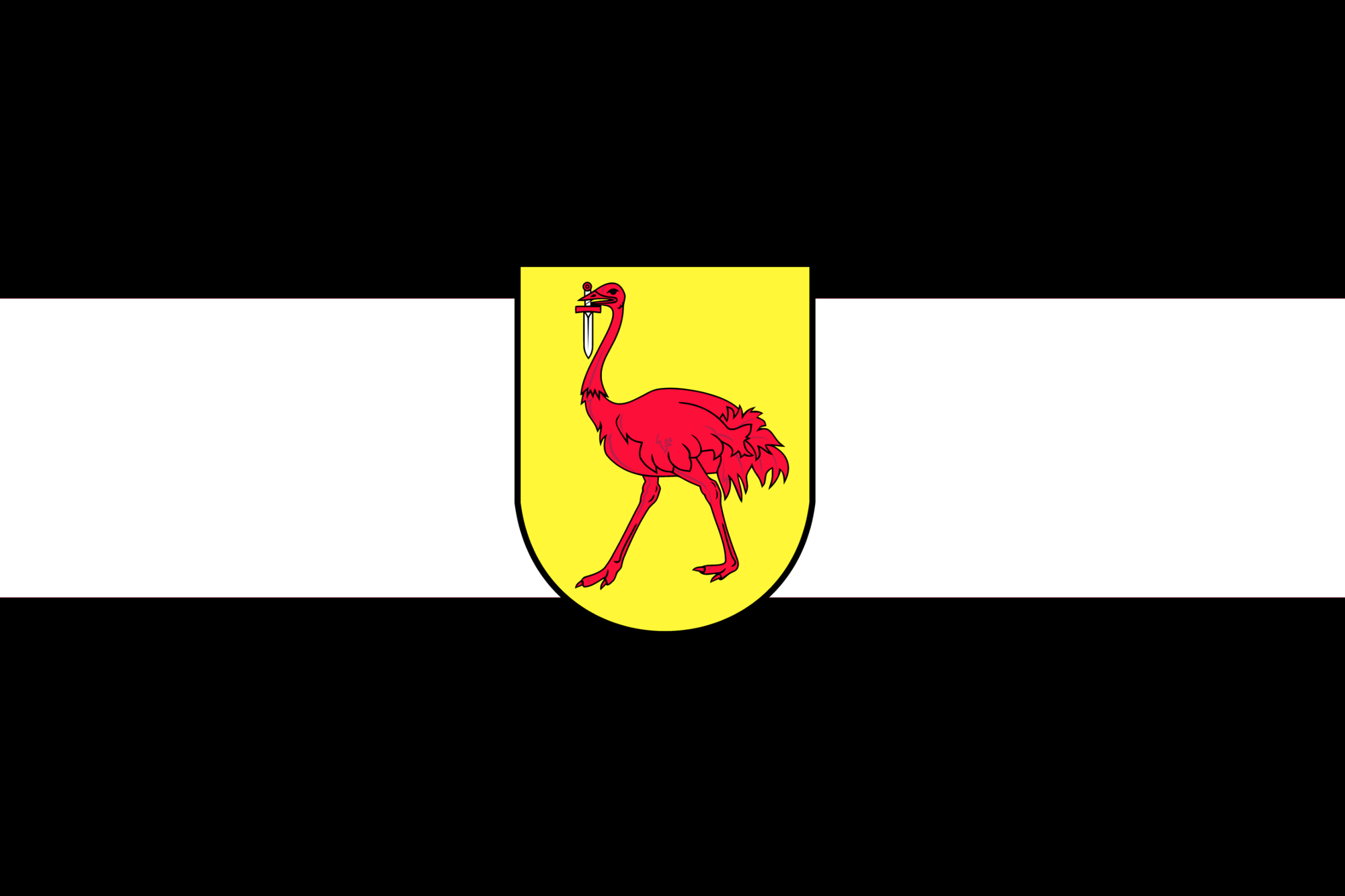
Flag of the Empire of Ostrich prior to the First Republic.

The traditional flag of the Empire of Ostrich is made up of the Emperor’s personal colors of black and white with the arms of the Von Streuthen dynasty. The Empire’s name comes from the Old High Church Teutonic word Ostarrîchi, itself a more-or-less literal translation of the Latin Marchia Orientalis, the Eastern March of the Teutons, with the Marchia Occidentalis, the Western March of the Teutons, essentially corresponding with the Holy Teuton Empire, Ostrich’s greatest rival and closest ally.

While the name of the Empire and the name of the African flightless bird are only identical thanks to an etymological quirk, this was not lost on the old Emperor Karl II, famous for his whimsy. It was Karl II that made the bird the symbol of his empire, adopting an ‘ostrich close with dagger’d beak’ as his personal arms, with its addition to the flag coming at a later date. Karl II responded to his chancellor’s suggestion that he choose “a more distinguished bird” with the retort that he “would make it distinguished.” He also noted the ruler of Luxnebe, the Prince of Chartreuse, had made ‘a humble color his own, and an Ostrich was far less humble than a Pear.”

White ostrich feathers were thereafter popular parade and dress plumes in the imperial Ostrichian army, though the term “Ostrichia” came to dominate as time went on and represents the modern name of the (much smaller) modern nation-state.

  • Like what you see? Purchase a print or ebook version!

To this day, it’s not entirely clear what happened, but Rezograd had been a center in the manufacture of magical scrolls and other sorcery development. It had pioneered the combination of the standard Flame and Wind spells into the popular Fireball conflagration, after all, and many of the basic spellwriting languages originate from products that were created or at least improved there.

What seems likeliest is that a small but significant error was made in the Rezograd labs, perhaps in a spell that relied on crystal resonance for its motive power. In any case, the entire town and a good portion of the countryside was turned to clear, faintly purple crystal in a matter of moments. Some of those on the outskirts, notably a family of farmers, were able to flee the cataclysm but thousands of others had no such chance. The countryside for 66.66 versts around a point just south of the center of Rezograd were crystalized, with every indication that this extended to 66.66 versts above and below. Onlookers reported birds and clouds plummeting, crystallized, to the ground and subsequent excavations showed a smooth crystal surface sloping away near the boundary.

This would be a tragedy, surely, simply on the basis of the lives lost, but everything, living or dead, that touched the crystal inside that 66.66 verst limit subsequently became crystallized itself, as the bodies of some unfortunates found half-inside and half-outside demonstrated. Crystal brought outside the limit would endure but seemed to lose its infectious properties.

The Rezograd crystal turned out to have many properties that made it an ideal soulstone and summonstone, with the properties increasing in potency the closer to the epicenter the shards were collected. Pieces of living things were also more potent, with shards from crystalline humans near the old city center being worth more than their weight in gold.

Crystal hunters still travel into the region, alone or with guides, despite the littered remains of those who in the years since have become part of the marvelous, pure, and terrifying sculpture.

  • Like what you see? Purchase a print or ebook version!

Royal Flag of Calleporto.

Calleporto was a small kingdom that had been an uneasy neighbor (and sometimes province) of larger Esper for centuries. It had maintained its independence largely thanks to its mercantile navy and far-flung trading empire, pursuits reflected in its flag designed by Dom Manuel IV the Great, the king who led its expansion into a world power.

The white crosses against a blue sea represented the trade routes pioneered by Calleportese vessels plying the ocean, while a gold armillary sphere represented those same mariners’ famed navigational prowess. The crown of Manuel I, the first king of the nation after its reconquest from the Saracens, tops a heater shield upon which is each of the possible rolls of a six-sided die. This represents the Wager of Manuel, in which a key siege against the Saracens was decided by a single roll of the dice, both Manual and his opponent Mullah Hacén having agreed to “let the Lord, or Allah, decide without bloodshed.” A long-held legend attributes the iconography to another wager, this time for the port of Sindapur, that was also won by the Calleportese. A more cynical view makes note of Manuel IV’s love of gambling, the debts of which the state inherited on his passing.

In any case, unlike neighboring Esper, Calleporto was never fully occupied by Valois. Its royal family escaped overseas and the Valoise Emperor did not even deign to name one of his relatives as a puppet king, instead seconding whatever conquests his troops made to Esper. This had the effect of inflaming Calleportese sentiment still further, and their struggle against the invasion remains a point of national pride in contrast to Esper, which “rolled over and died before it rose again.”

  • Like what you see? Purchase a print or ebook version!

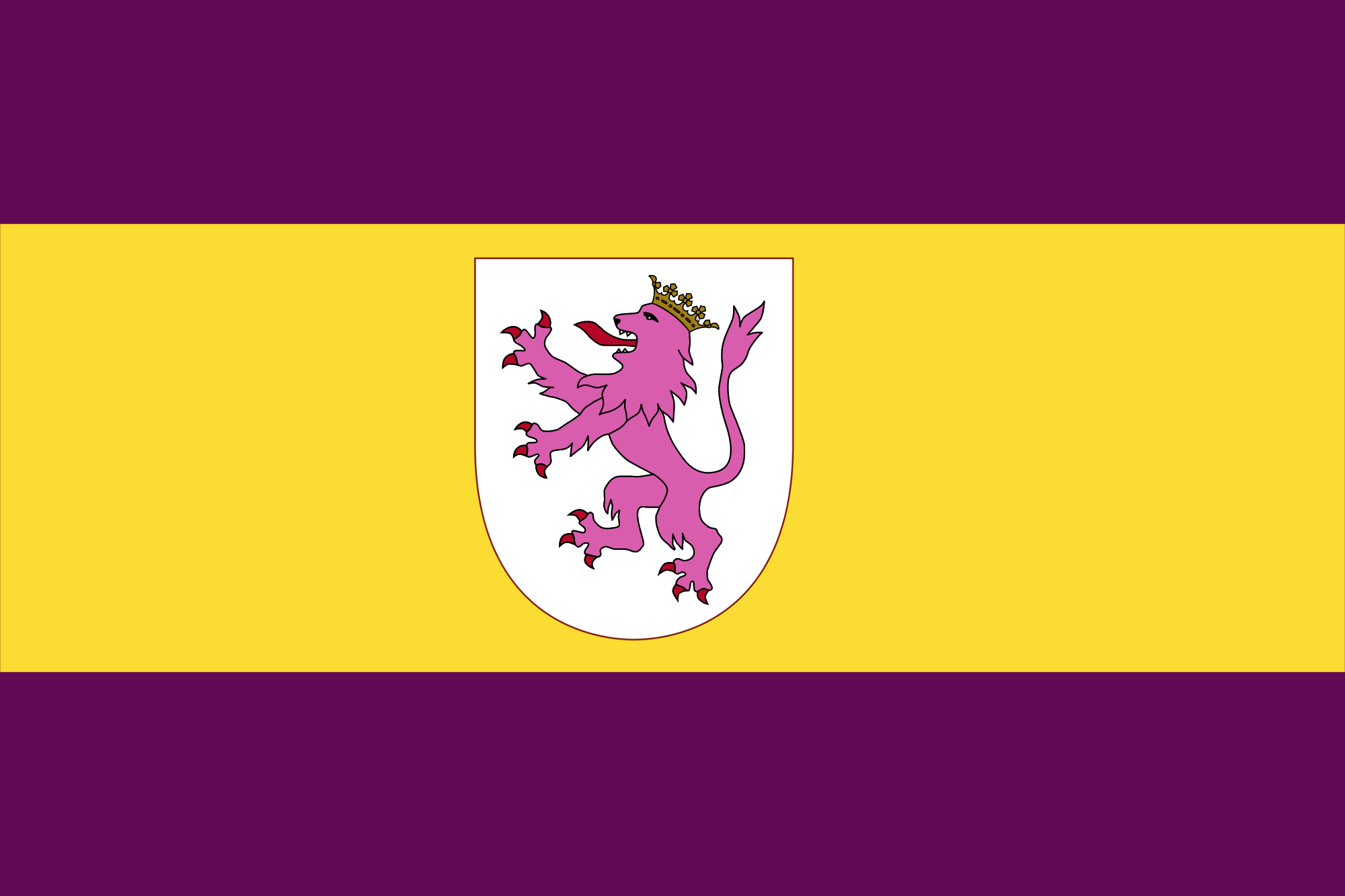
Royalist Flag of Esper.

The Kingdom of Esper, also known as Hesper or Hesperia depending on the language used, had become a world power under the Catholic Dynasty of its founders but by the time of the Empire of Valois had fallen on difficult times, defeated in multiple wars and had long periods of unrest, child kings under regencies, and general disorder. Its flag still flew across half the world, with the yellow and murrey (purple) of Esper’s predecessor kingdoms along with the Pink Lion of the Catholic Dynasty on a pure white shield, but it no longer commanded the respect it once had.

It was this unreliability, along with the persistent fear from its ally Valois that Esper would defect, that led to its eventual invasion and virtual annexation under the Emperor’s brother as King of Esper, overthrowing the young King Amadeo XXII and his regent Queen Joanna IV. Young King Amadeo eventually became infamous as “the basest king in Esper history: cowardly, selfish, grasping, suspicious, and vengeful, incapable of any perception of the commonweal, thinking only in terms of his power and security, unmoved by the enormous sacrifices of his people to retain their independence and preserve his throne.” But his youth and inexperience, compared with the despotic incompetence of the Valois-installed regime, led his standard to be raised again and again in revolt against the occupiers.

Flag of Valois-Occupied Esper.

Valois modified the flag of Esper during its occupation in what one contemporary called a “base mockery,” modifying their Scierie-Soleil flag with the gold-and-murrey colors of Esper and making the center of the sun the same shade as the Pink Lion. Intensely unpopular, this flag was repeatedly hauled down in an act of vandalism and at one time nearly one eighth of cloth shipped from Valois to Esper was for replacement banners. When the Emperor’s brother fled the country for the third and final time, the remaining flags were widely burned in streets.

  • Like what you see? Purchase a print or ebook version!

Flag of the Teuton Confederation

Flag of the Teuton Confederation, also known as the First Teuton Republic.

After the Valois Empire destroyed the old Holy Teutonic Empire, reducing the former Emperor to a mere tributary/allied King, the Valoise reorganized the other lands into the Teuton Confederation, sometimes also called the First Teuton Republic especially after the creation and fall of the Second Teuton Republic 150 years later. Despite the name, the Confederation was only nominally republican, and virtually all of the reigning monarchs retained their thrones. Each was, as a condition of peace, required to send a delegate to a central legislature or Bundesrat as well as providing troops to fight alongside Valois in its further campaign.

In theory, the Bundesrat and its presiding officer, the Bundeskanzler, were a more democratic alternative to the old Imperial Electorate and Emperor, voting on all major decisions. In practice, though, the Bundeskanzler was derisively referred to as an ersatzkaiser or valoisenkaiser–the ‘substitute Emperor’ or ‘Valoise Emperor.’ All decisions were nakedly made for the benefit of Valois, there was little room for discussion or debate, and all the delegates were essentially Valoise puppets. This perhaps contributed to the swift collapse of the Confederation in the face of the resurgent Preuben, Ostrich, and Poccnor forces.

  • Like what you see? Purchase a print or ebook version!
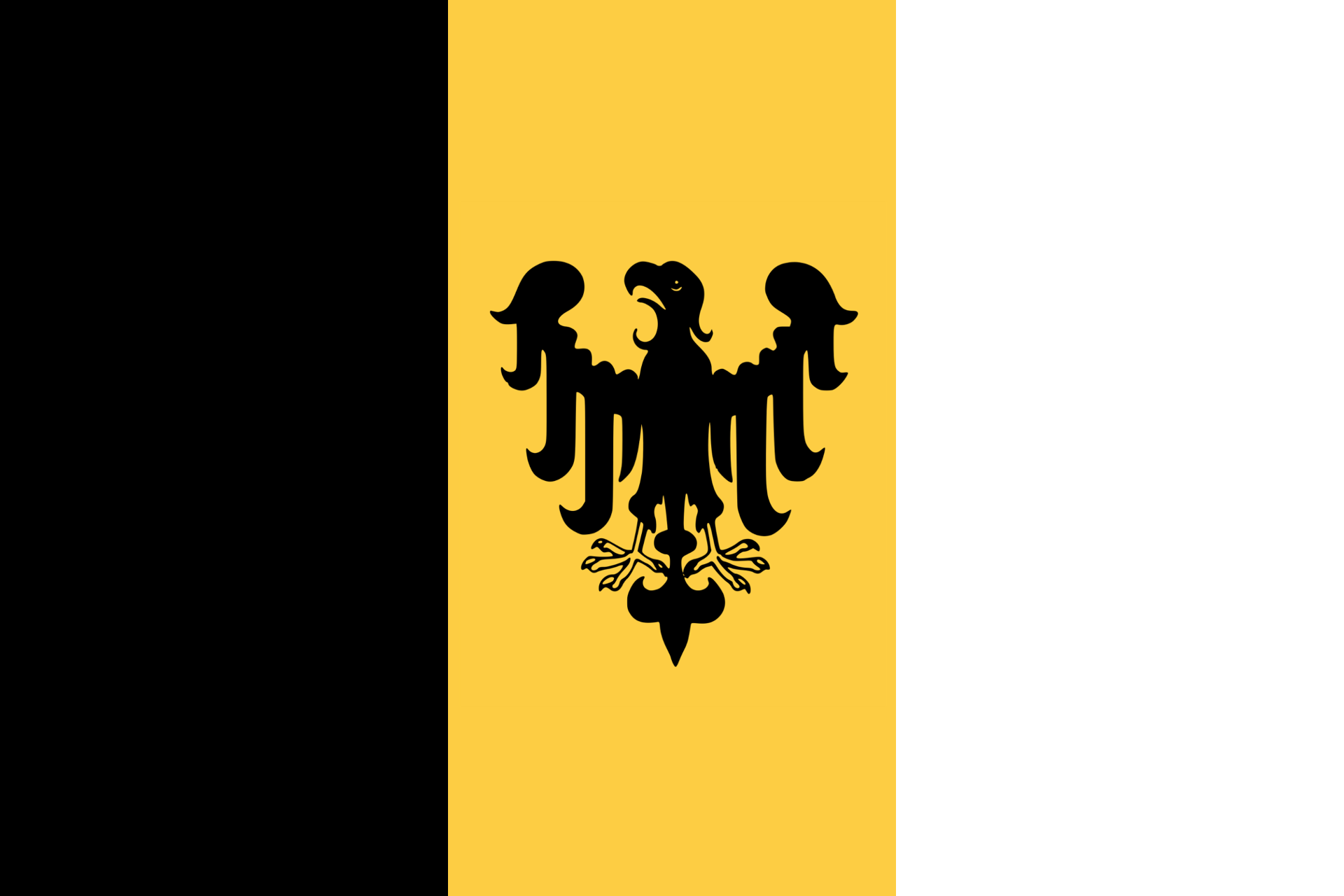
Flag of the Teutonic Empire

Flag of the Teutonic Empire and later the Kingdom of Preuben.

A decentralized and incredible confusing jumble of principalities, kingdoms, duchies, grand duchies, and bishoprics, the Holy Teutonic Empire was famously denigrated as “neither holy, nor Teutonic, nor an empire” by the Duc d’Arouet in Valois. In this case, it was a literal truth: the Reformation had destroyed the stranglehold the Church had once had on the religious sphere, less than half of the subjects spoke Teutonic at home, and the decentralized and elective nature of the Imperial crown meant that few Emperors were able to act as anything but a first among equals.

This was, perhaps, one of the reasons why the Valois Revolution resulted in the Empire’s total downfall and dissolution. Other than a common currency, a common flag, and a common army, there was little to bind the various states together, so after the armies were shattered and the last Emperor captured, there was little to prevent a catastrophic breakup of the Teutonic lands. Only the core of the Emperor’s personal lands in the Electorate of Preuben remained loyal, leading Emperor Frederick Wilhelm VIII to declare himself King of Preuben in an attempt to maintain his royal power and prerogatives. This led to the old Teutonic Empire flag continuing to be used as the flag of Preuben for over a century afterwards.

  • Like what you see? Purchase a print or ebook version!