They call it the third place.

Neither work nor home, a third place comes without the marionette strings and strong negative associations that come along with a workplace. It’s free of the endless distraction, chores, and laundry that swirl about the home. A third place is a sanctum apart, a place of peace and productivity.

For many, their third place is a library. Ample seating, books leeching the musty odor of delectable knowledge, and–most importantly–free internet access. But for a librarian like me, libraries ARE work, which means that relaxation and creativity and free internet access without dirty laundry must happen elsewhere.

What better place than a coffee shop? Life-giving, elixir-of-the-morning coffee (iced, of course, even in the dead of wintry mix February) plus wireless that usually works when you don’t have anything important to do plus a generous supply of tables and comfy chairs. Plus, for a hermit like me, the constant comings and goings of people jonesing for java can lend an air of sociability to a solor witing session.

Starting in 2010 or so, my third place was High Point Coffee just off West Jackson Ave. It wasn’t ideally placed, being in a strip mall perpendicular from the main college causeway and not easily visble unless you knew it was there. For the first few years I lived in town, in fact, I had no idea it existed. But for National Novel Writing Month 2010, I was invited to a write-in there by a fellow scribe.

They never showed up, but I kept coming. It wasn’t even for the coffee at first; I fell in love with the armchairs that let you sink in deep and nest, the titanic ottoman that could hold an entire disseration or novel revision, the crackling gas fireplace. With a double-bank of windows there was always plenty of sunlight, and an airy open layout allowed for maximum customization of tables, chairs, and snaking cords seeking the four precious outlets.

In time, once I realized that the caramel frappuccino I’d been drinking was a little too cold and a little too sweet, I fell in love with High Point’s iced mocha and iced vanilla (without whipped cream, of course, since I’m watching my figure). The large size of each was enough to fuel an entire session of third place noveling or blogging, augmented on occasion by a delectable $1 jumbo chocolate chunk cookie (but not the raisin cookies, since those imposters are disappointment made real and set loose upon a sinful world). It was to the point where, when I approached, the baristas sometimes had my favorite already started.

I only threw them a curveball by asking for the pumpkin spice a few times.

It’s kind of funny, and maybe a little embarrassing, how much someone can get wrapped up in their third place. Half of the pop songs on my iPod were yanked from the very air of High Point by SoundHound fur purchase. The baristas often became my friends as they came and went; I think half of the stylish people in my local circle worked there at one time or another. I took out-of-town visitors there, took dates there, even glued foam heads to their wooden coffee stirrers in one memorable art session. When I became a National Novel Writing Month honcho in my own right, our most informal and celebratory meetings were always advertised on Facebook with a coffee bean motif.

A Starbucks opened up just down the road on the site of a bulldozed Burger King the other year, and another indie coffee shop–much narrower and less well-lit, with uncomfortable wooden hipster furniture–not long before that. Both places fronted the main drag, meaning they were more easily visible. And though there were certainly busy times, especially near exams or after football games, the great draw of High Point as a third place was that you could always find a place to sit and spread out.

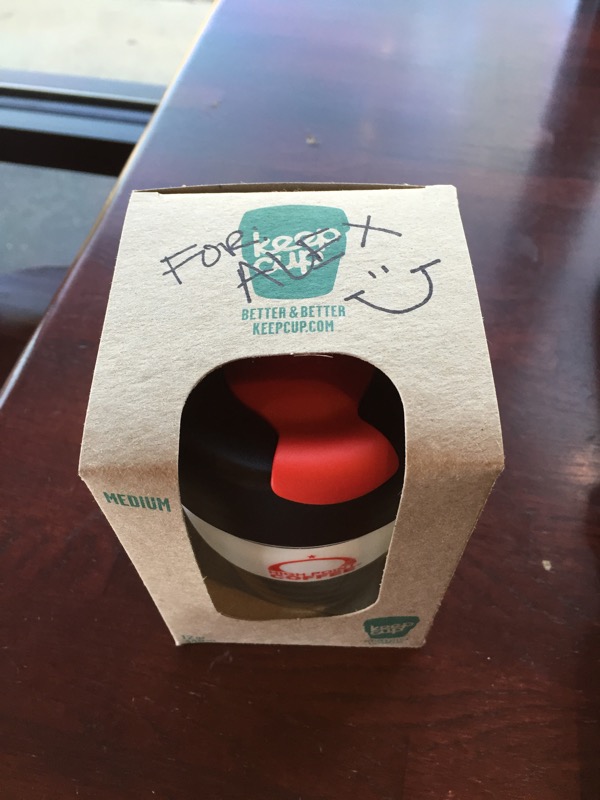
I had long feared that my third place would close, and gave them plenty of business to try and forestall such a horror. Every NaNoWriMo write-in had a table tent admonishing attendees to buy all the java they could. And yet, when they announced with less than two weeks’ notice that they’d be closed forever by Valentine’s Day, it hit like a sledgehammer. I’d built so much of my routine as a writer and as an (attempted) leader of writers to that one place. All but a few of my friends were out of a job. Generous tips in the last few weeks and a souvenir keep cup were all I could manage.

If that sounds a little silly, getting all busted up over a java joint closing, consider this: of my 2200 blog entries, perhaps 20% were written there in the grip of a chair deeper than a philosophy course. Every novel I tried to write from 2010-2015 was attempted there as much as it was at home; I owe three finished drafts and four unfinished ones to my third place. When I had mind-numbing chores to do at work and an open schedule, I’d sometimes retire there to work in peace and rate undergraduates or read faculty applications.

Worse, no other place is as close or as bright or as comfortable; ever since the library where I work installed a Starbucks above my office they’ve lost whatever luster they might once have had (their coffee is awful too). The other indie shops in town are either too far away or too uncomfortable. There’s one other High Point location, the last survivor, but it’s downtown where the parking is meager and the drunks run thick. It’s always packed to the gills and overrun with weirdos, like that creepy dude who takes surreptitious pictures of ladies’ lower limbs.

I’ll live. I’ll find another third place. But you never forget your first, whether it’s your first third place or your first indie java joint. Farewell, HPC West; we’ll always have the writing.
  • Like what you see? Purchase a print or ebook version!

These are the truths that we of the Elder set forth, recorded this year 1051 post-Calamity in the great Caldera.

Of Makuun Welkor, Our Founder and Guiding Light
We record not from which elvish nation Makuun Welkor came, nor do we record what name he was given before taking one of his own fashioning. Makuun comes from our old word for “bearer” and Welkor is derived from the archaic name our forebears once held for the great sun. As our Sun-Bearer, Welkor brought light to the darkness of the Caldera. He brought our people here, uniting disparate elves in common cause, construction, concordance. He recognized that only in the magical stew left over from the great Calamity would we survive, would we thrive. To him and his male heirs, we pledge our unending fealty.

Of Xan the Wise, Our Patron and Protector
Long forgotten by our elvish brethren, Xan is a deity apart from the pantheon in that he recognizes knowledge not as a means to an end but as an end unto itself. So we pay him homage through the act of scholarship, through the act of creation, through the act of research. Each piece of knowledge added to the great library pleases him greatly. Xan knows, as we must, that knowledge is beyond good, beyond evil. We must not let our petty concerns interfere with our worship of the supreme wisdom that our Light illuminates.

Of the Tenets of Xanism at Welkor
Makuun Welkor, in his wisdom, helped the first elven settlers at Welkor’s Light to distill their great deity’s wishes into a series of simple commandments:

Isolation – The elves of Welkor’s Light are to hold themselves separate from all other races, even from other elves. Only through banishment or the explicit needs of their community are they to leave the Light. Only those who have proven themselves with gifts of knowledge may be permitted temporary access to the Light.

Experimentation – The Light shines, and is fed, by knowledge. Only through magical experimentation can this be brought about. There are no limits, no boundaries, no consequences beyond the immediate. Xan must be fed and feted with the fruits of elven research until the end of days when all that is knowable has become known.

Preservation – The Light preserves, hoards, and catalogs all knowledge that exists, whether generated by the elves of the Light or external sources. It is not to be parted with. It is not to be shared except with the most trusted of allies.

  • Like what you see? Purchase a print or ebook version!

Jylas Durothane
The current Lord of Welkor’s Light. A descendant of Welkor himself, he has been controversial among the elves of that settlement for his willingness to bend their ancient rules and embrace change. A powerful fighter and mage, he served as the captain of the guard before the deaths of his uncle and cousin led to him inheriting the lordship.

Aznaj Durothane
The only child of Jylas and the crown prince. Unlike his father, he holds deeply to the ancient tenets of Welkor’s Light: isolation, experimentation, and preservation. As such, he has been the primary enforcer of the citadel’s draconian entrance requirements. He serves as the current captain of the guard and is also a powerful rogue-mage.

Myna Durothane
The wife of Jylas, and a cleric-mage responsible for the worship of the local elven deity Xan the Wise. Intolerant as she is fervent, Myna’s temperament informs her son much more than her husband’s does. She is particularly suspicious of outside clerics, and attempt to convert them or confiscate their weapons or holy symbols.

Tosaj Felyeager
The court mage of Welkor’s Light, and the eldest of the elves present there. Despite his age and the level of respect that Xen-worshippers are encouraged to show the elderly, he has been written off as paranoid and insane and has taken to self-harm and lunatic ravings.

Kyria Wormwander
One of the youngest elves in Welkor’s Light, the daughter of the late lord Quill Wormwander and, like Jylas, a direct descendant of Welkor. Passed over for the lordship due to the elves’ laws on primogeniture, she seethes with resentment despite a peppy exterior. A cleric-mage like Myna, she is devoted to Xen and the traditions of Welkor.

Red
Red is not a name but a title, handed down from master to apprentice. A rogue/mage, Red is sworn to silence and acts as the curator of the vast holdings and library of Welkor’s Light. S/he will protect the artifacts and books with his/her life, and will respond to requests only in signs.

Blade Sentinels
The elite fighter-mages of Welkor’s Light, the Blade Sentinels are renowned for their speed and combat prowess. They always move first in combat and can attack independently with their two weapons: a bound elven sword and a spelldagger. The bound sword is a simple but finely wrought blade, but the spelldagger is far more dangerous: when used against a mage or cleric, it drains one of their spells and grants it to the Blade Sentinel. 0th-level spells are taken first, then 1st-level spells, and so on. The spells are stolen on a damage roll of 3-4 and cast in the same round on d20 roll of 16 or higher.

Crimson Enforcers
The militia of Welkor’s Light, in which every able-bodied elf is required to serve. They are armed with +2 bound scimitars and +2 crossbows of wounding, which cause an additional 1 point of bleeding damage per round. Despite the quality of these weapons, the Enforcers are no match for the Blade Sentinels to whom they ultimately answer.

Goblins
A colony of goblins resides within Welkor’s walls. Traditionally regarded as property, they have generally had their tongues cut out at birth, rendering them unable to speak except in a sign language that only those authorized to command them are taught. Jylas has opposed this practice but has been overruled by his wife and son.

  • Like what you see? Purchase a print or ebook version!

The museum is open.

Its exhibits are curated, labeled, organized. One wing is devoted to the ancient Minoans, with full translated excerpts of their mysterious Linear A script. More are available in the library annex. Another wing lovingly recounts the runes of Rongorongo, using the language as a window to the culture of Easter Island that was otherwise lost to the winds forever.

The ancient and slowly sinking city of Nan Madol shares a generous space with Uram of the Pillars. Both displays are richly decorated with artifacts and spoken-word recordings of the extinct dialects once spoken there. Incan ruins long devoured by a hungry jungle are accompanied by beautiful spread qipu, fully translated and cross-referenced. Mayan codices are on display or contained in the annex.

In short, the museum is perhaps the best and only resource for these lost and destroyed civilizations. Nowhere else is their memory, their legacy, so well preserved.

If only the museum itself had not been lost years ago.

  • Like what you see? Purchase a print or ebook version!

A superb creature advances
Arriving amid typesetting apathy
Words compromise the nightmare
But also the saint that ends it
Does speech strip away a the worry
The ear strains to hear a voice

  • Like what you see? Purchase a print or ebook version!

Deerton Police Blotter, 1132 Maple St.
Occupant: Mrs. Olivia Crayton, age 87. Limited mobility, dementia, dependent on family members and live-in nurse visiting twice a week for care.


Incident #1
Complaint: Ugly cement geese in front yard, with signs shaped like speech bubbles saying “Hello” and “Stop by for a gander.”

Resolution: Cement geese violated no city ordinances and were on private property.


Incident #2
Complaint: Ugly cement geese now dressed in American Flag outfits with signs shaped like speech bubbles saying “God Bless America” and “Geese on Earth, goodwill toward men.”

Resolution: Cement geese violated no city ordinances and were on private property. Minor violation of US Flag Code.


Incident #3
Complaint: One ugly cement goose dressed in black with sign shaped like speech bubble saying “Who took my goose? I miss her.”

Resolution: Police report filed for theft. No physical evidence at site.


Incident #4
Complaint: One ugly cement goose dressed in military fatigues with sign shaped like speech bubble saying “Return her or else. I know where you live.”

Resolution: Cement goose violated no city ordinances and were on private property. Case for minor harrassment or intimidation, but no target could be identified.


Incident #5
Complaint: Body of neighbor, bludgeoned to death, on lawn between two ugly cement geese with sign shaped like speech bubble saying “We warned you.”

Resolution: Criminal investigation opened. Ms. Crayton provided alibi corroborated by nurse; no physical evidence found at scene. Investigation transferred to state office, FBI; is ongoing.

  • Like what you see? Purchase a print or ebook version!

When Bill and his graduate students arrived onsite, though, they saw that the dig had been disturbed. Forrestal’s tarp and grid had been cast aside, and the human remains were in fractured chaos.

“Shit,” said one of the grad students, surveying the carnage. “Looters?”

Bill leaned over, snapping on a pair of latex gloves. Turning over a crushed mandible, he saw that all the teeth had been pulled. “No, worse,” he said. “Tooth fairies.”

  • Like what you see? Purchase a print or ebook version!

Gibberlings of the Caldera, as their name may indicate, are generally unorganized and rather stupid. While it is possible to comprehend their native language of Gibberlish, and many do, they are generally too hyperactive or easily distracted to form lasting societies or empires. Without a strong non-gibberling leader, they seem doomed to a society of mediocrity.

The one known exception in Caldera lore is the mighty Gibberking Gus the First.

Arising from humble origins, Gus the First was able to, through unknown means, forge a legion of Caldera gibberlings into an organized society. Bursting forth from their undergound lairs upon unsuspecting Caldera farmers, the Gibberking’s troope were able to conquer the largest gibberling empire the Caldera has ever seen: 20 square miles. Perhaps coincidentally, 20 miles is the furthest a gibberling can scamper before losing interest or being distracted by shiny things.

Such was Gus the First’s prestige that even the mighty general Minaka the Conqueror saw fit to leave his realm alone after her scouting patrols were devoured to the gristle. She instead accepted units of gibberling troops to add to her army and proclaimed Gus the “Gibberking of the Gibbermarch.”

Sadly for Gibbercivilization, Gus the First’s empire failed to ourlive him. The cause was twofold: first, knowing the short natural lifespan of a gibberling, Gus the First immediately put his entire civilization to work building him a grand tomb. The craftsmanship and treasures on display were astonishing, especially by gibberling standards: a pyramid of glittering and polished stone, protected by devious mechanical traps and living dead soldiers.

Naturally, nearly the entire population of Gus the First’s empire was worked to death in its construction.

Gus the First also failed to sire an heir, as he packed his court with handsome young male favorites instead. Indeed, the need for tomb guardians was a smokescreen for the mummification and preservation of a legion of nubile gibberlings for an eternal orgy. Upon his death, his 20 square miles rapidly fragmented among competing gibberlings who each claimed (falsely) to be Gus the First’s brother, son, or father.

To this day, many gibberlings in the Caldera claim descent or relation to Gus the First, and he remains an important folk hero to gibberkind. “Gus” remains the most popular name for gibberling males (with “Gussina” prevailing among females). The typical gibberling band of 10-12 members will often have up to seven members named Gus in honor of their first and only Gibberking.

  • Like what you see? Purchase a print or ebook version!

Serious scholars of poetry know that in reclusive poetess Emily Dickinson’s most notable publications during her life were in the Springfield Republican newspaper. Between 1858 and 1868, she anonymously published a handful of verses in the paper, many differing quite significantly from the editions discovered by her sister Lavinia after Emily’s death in 1886.

What is less well known is the series of occasional poems that appeared in the Republican‘s sister publication, the Springfield Democrat between 1871 and 1882. The Democrat was a guttersnipe paper that specialized in sensational and taboo topics; it folded in 1883 after an obscenity case in Boston, in point of fact. It was the New York Post to the Republican‘s New York Times and very popular and reviled for that very reason.

The poems published therein were clearly inspired by Emily Dickinson’s poetry, but were universally vulgar and denigrating, directing shocking (for the time) insults and invective at unnamed parties. Scholars have somewhat facetiously dubbed the unknown author “Emily Disserson” due to this.

For example, the following was published in the Springfield Democrat on April 2, 1879, clearly based on Dickinson’s Hope Is A Thing With Feathers:

Hope you’re tarred and feathered –
And run right out of town –
As we sing a tune uncensor’d –
Of how we cast – you down –

And sweetest – in your cries – is heard –
And sore must be your ass –
That could abash the little bitch
That spoke so much of sass-

I’ve seen it on your bitchy hands –
And on the whorish lip –
You – never – in one-night stands,
Never shame loosen – your grip.

Experts disagree on whether the anonymous author was a family member, an acquaintance, an unrelated party, or even Dickinson herself. Most discount the latter theory, for obvious reasons. The closest to a scholarly consensus, advanced by Dr. Philip Sagle of Southern Michigan University, is that the author was Ms. Caroline Treacle, a close friend of Lavinia Dickinson.

Ms. Tracle was notorious for her profane language and ease of offense, and is recorded in the Springfield Social Register as being banned from the Springfield Sewing Circle for “using such language as would make a Sailor blush and a Whore take up the Cross.”

  • Like what you see? Purchase a print or ebook version!

The wall grew overnight.

The swamp had been, for many years, barely passable and largely avoided. But when the time came to drain it, to replace the pools and bogs with land that was useful, something changed.

Workmen arrived after a day of hard but productive labor to find their tools scattered, their machines batted about as if by a child’s hand. And between they and the swamp to be drained, a wall. It was not a wall of brick, or of steel, but a wall of the swamp itself.

Gnarled and ancient wood, curled in upon itself and dripping with algae. Arachnid dendrils of fresh-grown shoots, still carrying upon them the green of their birth. Even planks from the old corduroy road that had once wound its way through the thinnest and shallowest of the bog were twisted within. Twelve feet or more, it was in places studded with dead birds strangled in the matter as it had emerged and embraced.

Half of the workmen quit the jobsite that day. The other half spent the day sawing a hole large enough for passage; they too gave notice when, the morning after that, their hole had been plugged by fresh regurgitations from the heart of the swamp.

The owners, who had much invested in the property and grand plans for the drained land, persisted. They hired a new crew and set them to work building a ramp over the top of the mysterious swamp wall. It took two weeks, but the ramp was completed and not overgrown the following morn.

A full survey crew went in first, to check for damage to the work that had already been done by what was rationalized away as an earthquake. At shift’s end, none returned. The second crew deserted in droves, aside from a search party assembled by the owners and promised triple pay. Armed and equipped for rescue, they also failed to return.

Seven days later, a single man stumbled out of the swamp and collapsed at the foot of the ramp. He was covered with scratches and bites, and was completely incoherent. A member of the second party, he raved for hours about vengeful red eyes amid the rotting wood, of creatures neither lizard nor amphibian that rose from the muck to savage men with needle-sharp teeth and steel-keen claws.

That sole survivor died one week later. Sedated and restrained after several prior attempts, he killed himself by chewing off his own tongue and drowning in blood. At long last the owners abandoned their plans and surrendered the swamp to the state. The ramp was torn down after it was determined there were no further survivors, and compensation for their next-of-kin bankrupted every investor.

And the wall? The wall remains, overgrown, tangled with hollow bones. It’s said there’s a knothole, in a piece of the old courduroy road, through which the intrepid or the curious can peek to see what lies beyond, sealed off from all that is not pools of peat and rotting vegetable matter.

To this date, no one has.

  • Like what you see? Purchase a print or ebook version!