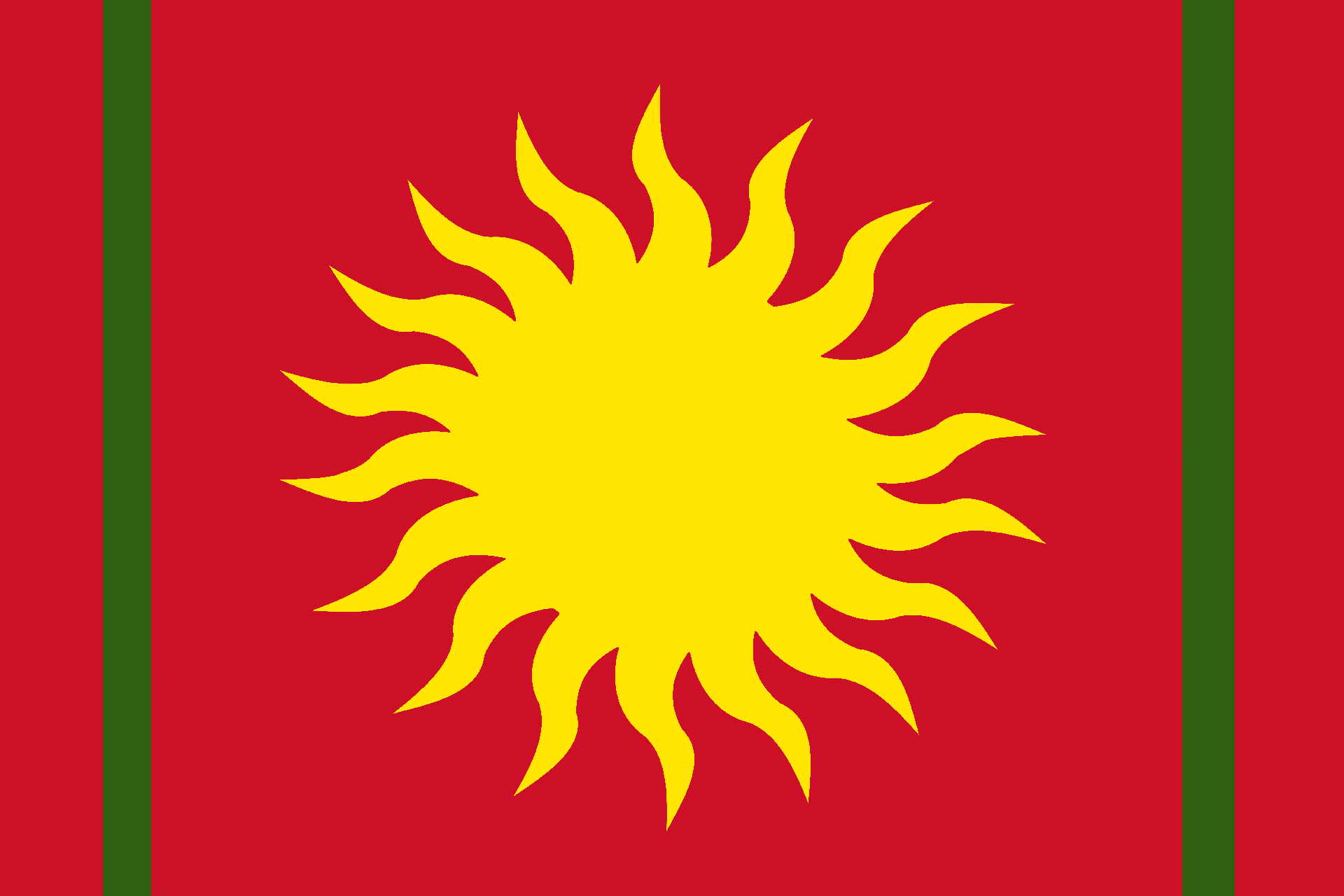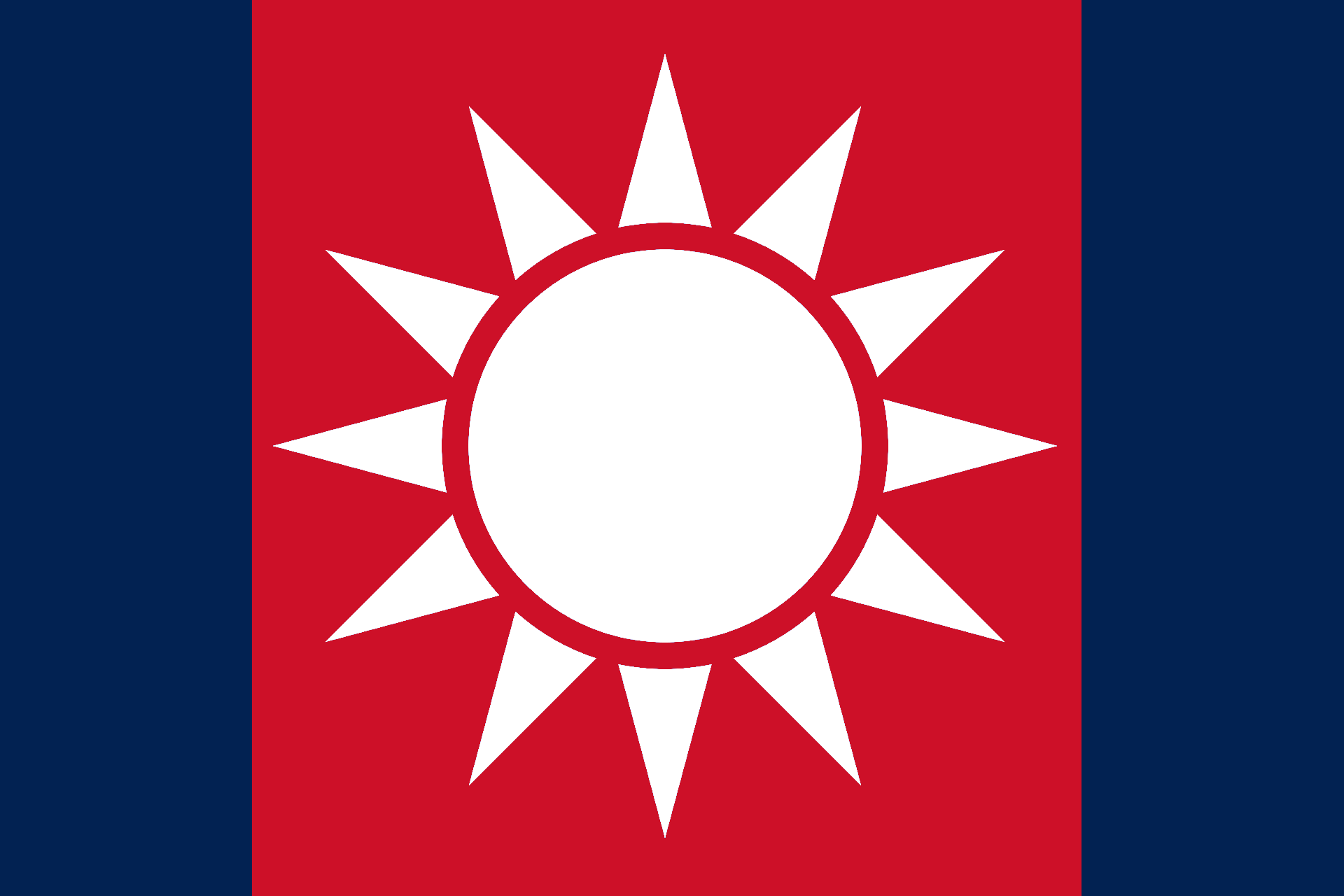
The third revolutionary Valoise flag.

The First Valoise Republic had been so chaotic and nigh-ungovernable that it rapidly lost the support of the majority of its people and, crucially, the army. As a result, a coup of the presidential cabinet led to the institution of the Valoise Directorate, in which supreme executive power was shared in a complex arrangement among a small group of politicians. While still ostensibly a republic, it was in practice more of an authoritarian oligarchy. With the decline of the chaos, infighting, and executions that had plagued the Valoise Presidency, as the earlier period came to be known, the Directors turned their attention to more mundane matters.

First and foremost was a revision of the national flag. Rémy Hauet had by this time been imprisoned as an enemy of the people, so the task fell to one of the Directors, Jean-Claude Fouquet. Rather than reconstitute the Flag Committee, he simply revised the design himself, simplifying the old recolored Oriflamme into a series of geometric shapes. This new design, which he called the Republican Sun, greatly eased manufacture of the flag and hastened the incorporation of white suns into the revised military uniforms then coming into service. Foquet also toyed with a revival of the Morsflamme, with no bars and a white sun of the simplified design, for use against enemies of the state. A number of these flags were prepared for, but not used in, the desert campaigns in Khemet–the Osmans occupying the area were coincidentally using a very similar black flag.
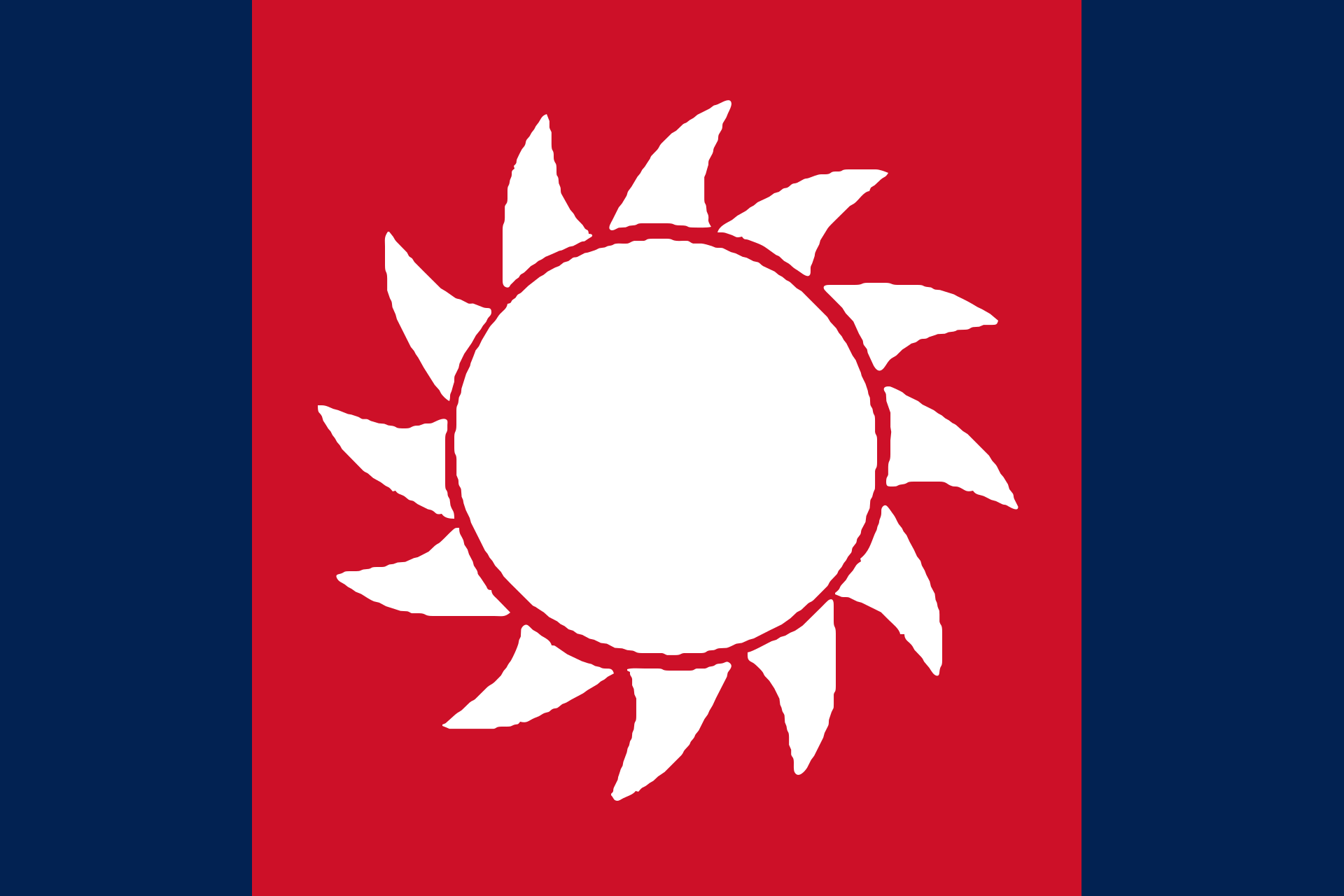
The flag of the Empire of Valois, also known as the Scierie-Soleil.

When the Directorate was overthrown in favor of the Despotate, the three Despots were divided about whether to keep the flag or revise it again. Given that the Despotate was, at least in theory, a temporary government until a new constitution could be drafted, the First Despot elected to keep the banner largely the same, and his opinion was the one that really mattered. Jean-Claude Fouquet did not object, as he was executed along with all the other Directors who did not become the three Despots. As such, the flag remained unchanged for the relatively brief period of the Despotate, even as the First Despot solidified his power base and undermined the others in what was essentially a military dictatorship with republican trappings at that point.

When the Valoise Despotate evolved in the First Valoise Empire, the Emperor himself revised the flag. Iterating on Fouquet’s simplified white sun design, the Emperor gave the rays emanating from it a rakish tilt reminiscent of the original Oriflamme, perhaps as a reflection of the newly monarchical nature of his regime. This flag, which became known as the Scierie-Soleil, or Sawmill Sun, persisted through the Emperor’s ultimate overthrow and the restoration of the royal standard following over twenty years of near-continuous warfare.

  • Like what you see? Purchase a print or ebook version!

The first revolutionary flag of Valois, also known as the Merde-de-Poulet Flamme.

When the Royal Sénat purged itself of royalists and declared itself the Revolutionary Assembly, one of the first orders of business was to design a standard that could be distinguished from that of royalists who had risen in the Touraine and were also fighting with the Teutons in their campaign to return the monarchy to power.

Assemblyman Rémy Hauet, an enthusiastic amateur vexillologist who had been denied entry to the Academy of Arms since commoners were not permitted to be heralds, chaired the Flag Committee. Much to his disappointment, the committee voted almost immediately to retain the existing flag with changed colors. White replaced royal yellow for the sun, supposedly standing for a desire for universal peace, while blue replaced the green stripes. The latter was Hauet’s doing, having argued passionately that the “color of liberty” should be reflected in the new standard. Since many of the revolutionaries had worn blue ribbons, which had been produced in quantity but never delivered for an anticipated state visit from the Prince-Regent of Albion, this seemed to make sense, and the Flag Committee’s recommendations were enthusiastically taken up by the Revolutionary Assembly.

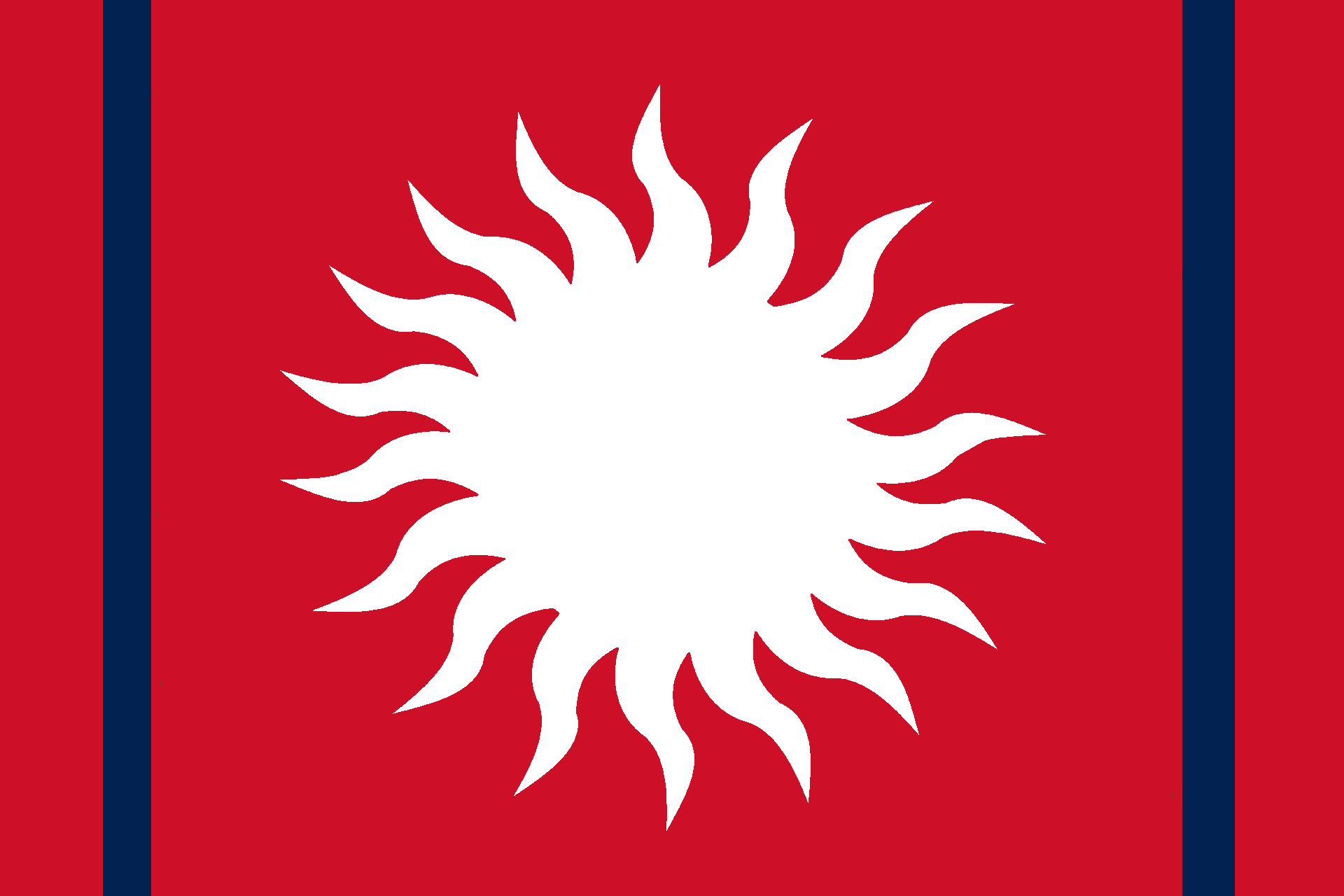
Second revolutionary flag of Valois, also known as Les Barres-Bleues.

One benefit of the decision was that the existing flagmakers could reuse their old patterns, and record show that the new flags were delivered to military units on the frontier less than two months later. However, it quickly became apparent that the new flag, nicknamed the Merde-de-poulet Flamme–roughly, the Chickenshit Flame from its white color–was too close to the old Oriflamme to be easily distinguished at a distance or through battlefield smoke. After a friendly fire incident in Artois, where two Revolutionary Guard units fired on each other while a battalion of Royalists and their Teuton allies slipped by, Hauet and the Flag Committee were recalled to service and told to modify the design.

Once again, Hauet was frustrated by the committee’s conservatism, as he had prepared dozens of unique drafts that can still be seen today in the Museé Vexillologie. Obsessed with creating a new flag as cheaply as possible, they instead voted to increase the width of Hauet’s liberty-blue stripes to the edges of the flag, leaving a much-diminished red field and the white Merde-de-poulet Flamme. “A chicken is a noble animal, the animal of the people, and we should be grateful to be associated with it,” one assemblyman said when confronted with the derogatory nickname.

This period coincided with the Constitutional Convention and the First Valoise Republic, and as a result the revised flag, which came to be known as Les Barres-Bleues or the Blue Bars, can be seen in many contemporary paintings. Given the instability of the period, and the number of presidents and prime ministers that came and went in short order, the official edict that each inauguration had to be painted left a dazzling array of examples of the flag.

  • Like what you see? Purchase a print or ebook version!

The Oriflamme Valoise royal standard.

The flag of the Kingdom of Valois dates back to a standard carried by Valoise kings in the medieval period. Known as the Oriflamme, from the Latin aurea flamma or “golden flame,” this standard was carried before the king in battle when the rules of chivalry were in play. A similar banner in black, called the Morsflamme from the Latin mors flamma or “death flame,” was used when no quarter would be given nor prisoners taken. The Oriflamme was famously flying when the Vaoloise captured King John III of Albion, while the Morsflamme notably flew during the Edessan Crusade when the Dauphin Robert, later Robert III, sacked Gargar and put all its inhabitants to the sword.

The medieval Oriflamme and Morsflamme both featured a stylized yellow sun, while the Oriflamme featured green edging and a red background and the Morsflamme was flat black with yellow edging. The origins of these symbols are obscure, but the use of yellow and green as courtly colors in Lothardy is attested from the mid-800s, and the sun was used as a symbol as far back as the Roman province of Lugdunensia in the early 1st century AD. Regardless of their origin, contemporary illustrations show Valoise kings riding under a long, thin Oriflamme banner from at least the late Viking era.

Rare Morsflamme variant standard.

Over time, the unwieldy banner evolved into a more modern ensign, with the green edging reduced to two decorative stripes on a rectangle. The Morsflamme was rarely used during this period, but is attested–generally used against peasant rebellions, heretics, and others the Vaoloise wished to terrify into surrender. The Oriflamme remained the royal standard through the Wars of Religion, the troubled reign of Charles XII, and into the Revolution. Indeed, rumors that the then-king was due to raise the Morsflamme against “enemies of the kingdom” helped usher in the monarchy’s overthrow. In the chaos following the end of the thousand years of monarchy in Valois, the royal banner persisted in use for a short time, often with the sun cut out or the flag truncated into a square, before an official replacement was created.

  • Like what you see? Purchase a print or ebook version!

I found you unappealing
A gregarious bully
Before I knew you were
Endangered
Now I look at you
Iridescent in the sun
And wonder how poorer
We will be
When you are gone

  • Like what you see? Purchase a print or ebook version!

A flock on the wing
Spots over iridescence
A clamor outside
Like baboons trooped
I wish the man
In New York City
Shakespeare lover
Was able to see
His wildlife dream
Thespian invasives
Like a theater crowd
That can only heckle

  • Like what you see? Purchase a print or ebook version!

Necrosia wasn’t her real name, of course. But with the given name of Nancy Crozier, abbreviated to N. Crozier, and a flair for the melodramatic, the nickname stuck early and hard. In fact, it was what had first drawn she and Mortis together when they were matched on an app that was sophisticated enough to recognize their extremely metal nicknames.

And now, after both of them had died, she was supposedly working UnDeadCon 21’s Fast Zombie booth, for the slower and more lumbering undead who were interested in speed training.

“Fast Zombies? Pfft. That’s a fad.” A mummy wearing an UnDeadCon 21 staff tee said. “Slow and steady wins the race.”

“I didn’t ask for your opinion on them,” Mortis said. “I’m not joining up. I just want to talk to the girl running their booth.”

“Slow and steady,” the mummy said, jerking a thumb at his chest. “I’ve been doing it since 1824 BC, I should know.”

“I’’m just interested in 2021 AD if you don’t mind,” Mortis said. “Now are you gonna point me in the right direction, or am I going to have to ask that wight and put ‘very dissatisfied’ on my feedback card?”

The mummy gestured to the back of the exhibit hall. “In the 600 row,” he said. “I expect that card to read ‘excellent’ now, y’hear, or I will curse the ever loving shit out of you.”

“Ehh, we’re at an ‘above average’ right now,” Mortis said, shambling off. “But we’re getting there.”

Sure enough, in the 600 row–booth 666–Mortis could see a very sporty and aerobic-looking booth for Fast Zombies. It even had a back door, which presumably led to a training area or whatever other alchemy they used to get corpses to move at lightning speed.

And he caught a glimpse–only a glimpse–of Necrosia as she slipped through that selfsame door. Moving as fast as he could to catch up, he was blocked by a friendly-looking demon in booth 665.

“Hey friend, interested in selling your soul?” she said, thrusting a clipboard in Mortis’s face. “As an undead abomination, it’s practically free money!”

  • Like what you see? Purchase a print or ebook version!

“Excuse me, sir!” The skeleton approached Mortis, brandishing a glossy brochure in its bony fingers. “Do you have a minute to talk about our lord and savior Graculus, Lord of Bones, and the benefits of converting to Skeletonism?”

Mortis’s bleary eyes rolled wetly in his zombified skull. These days it was getting tougher and tougher to avoid harrassment by various undead fundamentalists trying to get him to convert.

“No, I was raised a zombie and I will die a zombie,” he said. “Again.”

Cutting to the other side of the exhibit hall, a plastic case with a DVD rattling inside was thrust in his face. “Would you like to take a free stress test? Cleanse your body of potentially harmful magicites? It’s free!”

Mortis looked at the pitchman, a leathery apparition just short of a mummy in appearance, with sorcery for eyes and an affect that crackled with arcane energy. “Let me guess,” he said. “You want to tell me about the life of Ulgathk the Ever-Living, the Elder Lich, so I can buy the first Ascent to Lichdom course.”

“Lichology is a relevant and authentic faith,” the undead huckster said. “What good is worldly currency when you can ascend to immortal godhood and power in the afterlife by following our programs?”

“Uh-huh. How many of your members have actually ascended to lichdom, then?”

“That information is proprietary, copyrighted, secret, and an article of faith,” the lich snapped.

“Come on, just a ballpark guesstimate,” Mortis said. “I’ll take your DVD if you tell me.”

“This conversation is over,” the Lichology pitchman said. “Spread your nasty magicites elsewhere.”

Tacking back toward the middle, Mortis kept up his search for Necrosia. She was supposed to be manning the Fast Zombie lifestyle booth someplace, but it was just too crowded to see much. Too many new converts this year, and lots of beyond-the-grave shysters looking to take advantage.

A translucent form shimmered before Mortis, its message written in unliving ectoplasm: LOW-INTEREST FIXED-TERM SUBPRIME HAUNTINGS!

“Would you like to hear about leaving the world of the flesh behind? Work off one haunting and this lifestyle could be yours!” the ghost warbled in a reedy voice.

“Oh, for fuck’s sake,” Mortis said. He cut directly through the specter, ignoring its protests, before continuing into the crowd.

  • Like what you see? Purchase a print or ebook version!

“Is it art block?” Cimino said. He looked around the art studio, which was positively festooned with studies. “You don’t seem to be having any problems making art.”

“Look at it all again,” said Dempsey. “See if you can pick out the problem.”

Cimino glanced at sketches, linearts, chiaroscuro shadings, and more tacked up around the studio. “Uh, no idea,” he said.

“There’s no color!” Dempsey roared, swatting at a sheaf of his latest artworks. “All monochrome!”

“And…why is there no color?”

“I can’t decide on it. I can’t blend it. I second-guess myself and then throw the art in the trash. It’s like I’ve forgotten how to color altogether.”

“So…?”

“It’s not artblock. It’s colorblock.”

  • Like what you see? Purchase a print or ebook version!

“I did it in my youth,” said Clemons. “Working for the Forest Service, it seemed only natural, birdwatching.”

“Yes, your lists and photographs from the 1940s are really important in the birding history of Steuben County,” said Dubois. “I actually entered them into our birding database myself, made you an account and everything.”

“Well, that’s mighty kind of you, I suppose,” Clemons said. “I can’t say as I’d be able to do much with a computer, never was much good at it, but if anything I did was useful to you, it is nice to know.”

“I want to talk to you about some later work,” Dubois said. “Some old letters with the county museum from Mr. Greenbriar seem to indicate that you have observations, and perhaps even photographs, from the 1950s that would be very interesting to us.”

Clemons didn’t budge from his seat. “Well, I’m afraid that’s a little bit too long ago for me to remember clearly,” he said in a soft voice. “I don’t do it anymore, you see, other than feeding a few yard birds. Arthritis, cataracts, all the usual suspects. I’m sure you understand.”

Dubois leaned forward in her seat, the wicker audibly groaning under the old cushions. “Mr. Clemons,” she said. “If what was in your letter to Mr. Greenbriar was accurate, you might have been the last person to see an ivory-billed woodpecker alive in Steuben County, ten years after the last confirmed sighting in 1944.”

“Joe Greenbriar always was a bit of a braggart,” Clemons muttered. “Don’t believe a word he says, even when he’s dead and buried twenty years.”

“There was another letter, too, one from a Polly–“

Clemons pounded his fist on his chair in a surprisingly hostile, sharp, gesture. “Don’t believe it,” he said. “I didn’t take an observation that wasn’t in my own backyard after 1950, and there sure as hell weren’t any ivories back there.”

Holding up her hands, fingers outstretched Dubois tried to back off. “I didn’t mean any offense, Mr. Clemons. I’m just trying to–“

Clemons buzzed for his nurse, who entered from the kitchen a moment later. “It was very nice to meet you, Ms. Dubois, but I’ve got nothing more to say. I’m glad my old data was useful, but it’s going to have to speak for itself. Maria, please show my guest out if you don’t mind.”

  • Like what you see? Purchase a print or ebook version!

“Uh, honey? Why did we just get a check in the mail from BlueLight Insurance?”

“Oh, I switched to them and saved 15%, just like they said in their ads.”

“Wouldn’t that still mean we were sending them checks? Or auto-bank-withdrawals?”

“Nope! I was already paying $0 with Insuranch, so 15% off of that means they have to send me money.”

“We just switched to Insuranch! Was that some kind of introductory offer?”

“They promised me 15% off of what we were paying with Pharos. Who offered me 15% off what I was paying with RaceCar. Who offered me 15% off what I was paying with Affinitin. And so on! All it takes is a little math, and some careful reading of fine print, and it’s a loophole that can be exploited.”

“Honey, you’re not going to tell me they’re that stupid. They’d have closed that loophole the second someone else tried it.”

“I’m the first. Turns out cutting percentages and fractions from the national math curriculum was a bad idea.”

  • Like what you see? Purchase a print or ebook version!