February 2016
Monthly Archive
February 19, 2016
They had arranged, long before the seige began, that the golden arrow that formed one of the hand on the great clock tower would be their signal. Each day, she walked near the high castle walls near a copse that was well within arrow-shot. Each day, he took an arrow and shot it over the battlements for her to find.
If ever it was the golden arrow that had been loosed, things would change.
One day, just after crossing the old stone bridge and in eyeshot of the castle, she found the golden arrow in a field near the trees. It had not flown well, as it was designed to be a timepiece rather than a weapon, but the meaning was clear.
Returning to the village, she roused the people against the occupants of the keep. They had betrayed their charge, the one who they had been meant to protect, and his life was in danger. Forming a makeshift militia, they marched on the works.
The ensuing battle was brief but fierce, and left the keep in ruins with its walls crashing down. In the chaos, she was unable to find her beloved and feared that the citadel had fallen too late to spare his life. It was not until the dead were lined up for burial that she saw him, among those who had been felled by the first charge. He had died in defense of the keep, never knowing that his love had been at the head of those sacking it.
And the golden arrow? No one ever learned who had fired it, but many years later an order for the young lover’s execution was found in the files of a royal magistrate. Aware of the signal, it is likely he had one of his own men fire the fatal shot, knowing full well that the young man would likely perish in the battle to come.
- Like what you see? Purchase a print or ebook version!
February 18, 2016
Controversy continued to swell around the Hopewell Public Library today, as protestor appeared for the third day in a row. Numbering more than 200, they are demanding reforms and justice.
“I’m just saying,” said one protestor, “if these librarians were wearing body cameras, none of this would have happened.”
“It’s shameful,” said another. “They’ve been mistreating patrons for years, it’s only now that we’re starting to wake up.”
At issue is the shushing of unarmed patrons and the assessing of fines in a discriminatory manner. Nine patrons have been shushed since the first of the month, with witnesses and cell phone video seeming to show that the unarmed patrons were shushed despite no detectable noise level. All of the nine were patrons like teenagers, creepy older men, or middle-aged busybodies–all groups that have alleged targeting for mistreatment.
“They shushed me the other day because the other patrons could hear my Nickelback through my headphones,” said one protestor. “That’s straight-up Gestapo treatment, man!”
“I got shushed because I kept asking that cute librarian for her phone number,” said another. “What is this, Soviet Russia?”
Protestors also allege that librarians have been assessing fines in a way that is judgmental and discriminatory. Users from the above groups say that they have been singled out for fines for simply not returning items on time.
Pressed for comment, the Hopewell Public Library has declined to issue a statement at this time, pending a press conference to be held tomorrow at 2:30 EST. This has not muted calls for the librarians in question to be prosecuted and for the State Librarian to resign.
- Like what you see? Purchase a print or ebook version!
February 17, 2016
Weather Complaints – This full-bodied whine is a 2010 vintage from Great Britain, one of the coldest winters on record. It has notes of honey and a pleasant, oaky finish, and is best paired with a light, summery dish such as our salad or souffle.
Traffic Grousing – A 2009 whine from Los Angeles just outside the Napa Valley, famous as the worst traffic in the known world in countries where painted road lines are respected. With bold, bitter essence and a full-bodied taste with hints of ash, it serves as a tart balance for a sweeter dish like our famous honey-roasted pork.
Behind-the-Back Smack – One of the most common whines in the world, this vintage is from 2010 in Washington, D.C., where the smack talk is bigger and bolder than the whine you can find in your local grocery. Pair it with our hearty German cheddar soup.
Queue Quips – If you’ve ever waited for 10 minutes in line only to have them open a new register for people that have been there 30 seconds, you’ve tried this type of whine. Our fine vintage is a 1999, with the extra oaky overtones and nuances of toast that come from waiting in line for Y2K snake oil. Pair it with a light appetizer from our menu or fish.
- Like what you see? Purchase a print or ebook version!
February 16, 2016
The sound of heavy hooves, swords on steel, and arrows intensified on the other side of the gate, building to a cacophony of battle as Kohb counted to ten. As soon as he reached the end of his count, he raised a hunting cry to the gate guards, who took it up and cried over the wooden battlements. It was repeated on the other side, so Kohb pounded on the gate as a signal to open it.
As the Ochre Gate had sprung open on a counterweight, so too did the Azure Gate before Eyon and his friends. Sir Kohb spurred his horse onward, followed by Gullywick and Myn. A handful of Gattne riders sallied forth with them, a dozen riders all told, and they burst out of the gate into the blinding sunshine to find chaos outside.
A swarm of riders coalesced around them; it was difficult for Eyon to see with the jarring up-and-down of hard riding, but the men were definitely wearing the bright crimson of Varrett and bearing its sigil, the Leaf-on-Shield. Through gaps in the mass of men and horses, though, he could see the Ioxans’ hammer banners approaching at a rapid clip. Arrows flew between the two groups as the few mounted archers on either side let fly, and after hearing a war cry sounding on his left and being answered on his right, Eyon realized that the pursuers were trying to surround him.
Above the din, he could hear Delra of Ioxus shouting at her troops, exhorting them to tear the Varrettans apart to avenge her twin humiliations. “A gold sovereign to any of you who brings me so much as a scrap of that boy’s flesh!”
“Keep up the pace, you louts! We’re lighter than they, but they’ll rip us to shreds if we let them engage!” shoutedd Sir Kohb. Then, softer: “Still so eager to be king now, hearing that woman telling them to tear you limb from limb for gold?”
“No one would be shouting something like that in my kingdom,” Eyon replied.
“Hmph. Every king, every kingdom, needs someone shouting that,” the knight said breathlessly. “You’d be no different.”
“When my kingdom becomes the first, I’ll make sure you have a better position.”
Sir Kohb rolled his eyes. “Ho there! Keep those Ioxans at a distance!” he cried.
His men, armed with short lances, jabbed them at the baroness’s horsemen. The Ioxans responded in kind, and Eyon cringed as he saw one of the Varrettans hooked off of his saddle and flung beneath the hooves of his fellows with a terrible cry. A mounted archer galloped next to Kohb’s horse, taking careful aim with a short bow before losing an arrow up and over both of them and another Varrettan besides, landing firmly in the flank of an Ioxan horse and tumbling both it and its rider to the dry Gattnean plain.
“How much longer?” Eyon said, looking away from the sight. “Until we’re safe in Greywacke Wood?”
“Only about an hour,” Sir Kohb said. “Assuming we can keep this pace. If we can’t, it will all be over much, much sooner.”
- Like what you see? Purchase a print or ebook version!
February 15, 2016
Posted by alexp01 under
Excerpt | Tags:
fiction,
story |
Leave a Comment
Maybe I was too hard on them.
Life isn’t easy, and it seems like all anybody does is find solace in a thousand petty outrages. When you get more worked up about a restaurant being torn down in a hometown you’ve barely visited in eight years than you do over the half-assed job you did at what’s paying your rent…maybe it’s time to reconsider. When I was young, I didn’t understand where somebody like me could be coming from.
But now, I think it’s pretty clear that I have to go away for a while. I know it’ll disappoint a lot of people, people I care about, people I don’t want to see hurt. But I feel like it’s to the point that I’m bearing every iota of stress in my environment, soaking it up spongelike. I need to wring myself out, or I’ll drown.
Don’t read too much into my symbolism; this isn’t that kind of note. But going into that classroom every day, seeing all those high schoolers who haven’t made my mistakes…they can still make something of themselves, even if they are spoiled little shits sometimes. They don’t wake up on what should be Thursday and find out it’s their 40th birthday party and life passed them by when they weren’t looking.
- Like what you see? Purchase a print or ebook version!
February 14, 2016
Every day around Valentine’s Day, there is a massive backlash against the so-called “Hallmark Holiday.” That’s all well and good if all you want to do is piss and moan, but if you really want to put paid to Valentine’s Day, what you need is an alternative. That way, people who like Valentine’s Day can celebrate Valentine’s Day, and people who don’t will have an outlet for their towering rage.
May I suggest Valerian’s Day?
No one is quite sure at what time in the year 260AD the Roman emperor Valerian I’s army was annihilated by the Persians at the Battle of Edessa. So if we were to say that it happened to be on February 14, who’s to say otherwise? And what better antidote to the lovey-dovey, for those who wish for one, than blood and murder and death?
On Valerian’s Day, the Persians defeated Valerian I in battle, but that wasn’t the end of it. No, the emperor was forced to serve as a human footstool to the Persian king whenever the latter mounted his horse. When he had the audacity to propose buying his freedom with a random of treasure, the Persians had him killed by pouring molten gold down his gullet. Then, not satisfied, they skinned his body and stuffed the skin with straw and manure. It was only after a later Roman campaign ended in victory that the Persians consented to part with their taxidermy so the emperor could be cremated and buried.
The best part? Emperor Valerian I, along with his successors Gallienus, Valerian II, and Claudius II (it was a rough time for Rome in terms of reign length) were major instigators of the persecution that saw St. Valentine himself martyred in 269AD. That’s right: in addition to getting himself humiliated and killed with a brutality reminiscent of Mortal Kombat, Valerian I basically killed St. Valentine.
So, if you are one of those anti-Valentine grouches, a candy heart curmudgeon, or simply sick of the sickly-sweet…Valerian’s Day has you covered. Go forth and celebrate utter defeat, humiliation, rder, brutality, persecution, and killing St. Valentine. Exchange cards that look like they were made from the living skin of a 60-year-old man. Chug Goldschläger. Stuff yourself silly. Smell like manure. Persecute and oppress those who differ with you. And, most importantly, do it with the simpering and wheedling affect of someone who feels denied what they were entitled and greivously mistreated.
That’s the true spirit of Valerian’s Day, my friends.
- Like what you see? Purchase a print or ebook version!
February 13, 2016
They call it the third place.

Neither work nor home, a third place comes without the marionette strings and strong negative associations that come along with a workplace. It’s free of the endless distraction, chores, and laundry that swirl about the home. A third place is a sanctum apart, a place of peace and productivity.
For many, their third place is a library. Ample seating, books leeching the musty odor of delectable knowledge, and–most importantly–free internet access. But for a librarian like me, libraries ARE work, which means that relaxation and creativity and free internet access without dirty laundry must happen elsewhere.
What better place than a coffee shop? Life-giving, elixir-of-the-morning coffee (iced, of course, even in the dead of wintry mix February) plus wireless that usually works when you don’t have anything important to do plus a generous supply of tables and comfy chairs. Plus, for a hermit like me, the constant comings and goings of people jonesing for java can lend an air of sociability to a solor witing session.
Starting in 2010 or so, my third place was High Point Coffee just off West Jackson Ave. It wasn’t ideally placed, being in a strip mall perpendicular from the main college causeway and not easily visble unless you knew it was there. For the first few years I lived in town, in fact, I had no idea it existed. But for National Novel Writing Month 2010, I was invited to a write-in there by a fellow scribe.
They never showed up, but I kept coming. It wasn’t even for the coffee at first; I fell in love with the armchairs that let you sink in deep and nest, the titanic ottoman that could hold an entire disseration or novel revision, the crackling gas fireplace. With a double-bank of windows there was always plenty of sunlight, and an airy open layout allowed for maximum customization of tables, chairs, and snaking cords seeking the four precious outlets.

In time, once I realized that the caramel frappuccino I’d been drinking was a little too cold and a little too sweet, I fell in love with High Point’s iced mocha and iced vanilla (without whipped cream, of course, since I’m watching my figure). The large size of each was enough to fuel an entire session of third place noveling or blogging, augmented on occasion by a delectable $1 jumbo chocolate chunk cookie (but not the raisin cookies, since those imposters are disappointment made real and set loose upon a sinful world). It was to the point where, when I approached, the baristas sometimes had my favorite already started.
I only threw them a curveball by asking for the pumpkin spice a few times.
It’s kind of funny, and maybe a little embarrassing, how much someone can get wrapped up in their third place. Half of the pop songs on my iPod were yanked from the very air of High Point by SoundHound fur purchase. The baristas often became my friends as they came and went; I think half of the stylish people in my local circle worked there at one time or another. I took out-of-town visitors there, took dates there, even glued foam heads to their wooden coffee stirrers in one memorable art session. When I became a National Novel Writing Month honcho in my own right, our most informal and celebratory meetings were always advertised on Facebook with a coffee bean motif.
A Starbucks opened up just down the road on the site of a bulldozed Burger King the other year, and another indie coffee shop–much narrower and less well-lit, with uncomfortable wooden hipster furniture–not long before that. Both places fronted the main drag, meaning they were more easily visible. And though there were certainly busy times, especially near exams or after football games, the great draw of High Point as a third place was that you could always find a place to sit and spread out.
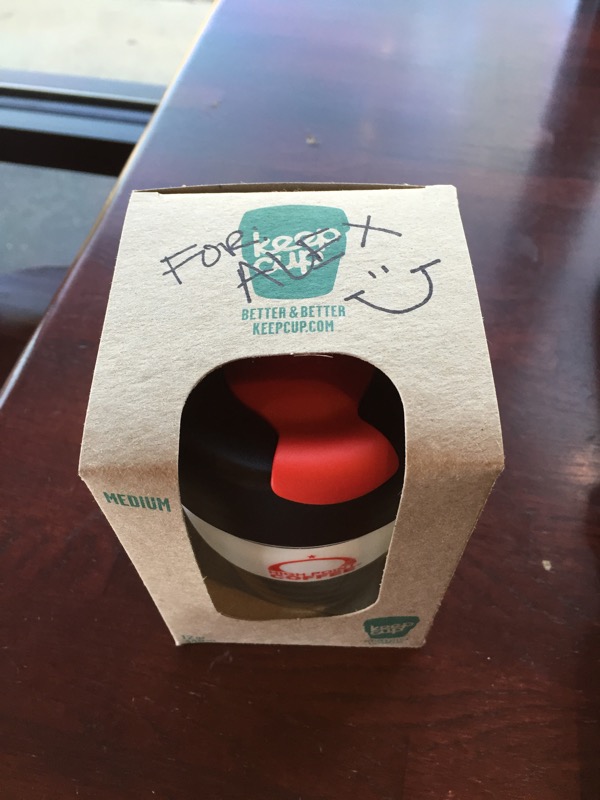
I had long feared that my third place would close, and gave them plenty of business to try and forestall such a horror. Every NaNoWriMo write-in had a table tent admonishing attendees to buy all the java they could. And yet, when they announced with less than two weeks’ notice that they’d be closed forever by Valentine’s Day, it hit like a sledgehammer. I’d built so much of my routine as a writer and as an (attempted) leader of writers to that one place. All but a few of my friends were out of a job. Generous tips in the last few weeks and a souvenir keep cup were all I could manage.
If that sounds a little silly, getting all busted up over a java joint closing, consider this: of my 2200 blog entries, perhaps 20% were written there in the grip of a chair deeper than a philosophy course. Every novel I tried to write from 2010-2015 was attempted there as much as it was at home; I owe three finished drafts and four unfinished ones to my third place. When I had mind-numbing chores to do at work and an open schedule, I’d sometimes retire there to work in peace and rate undergraduates or read faculty applications.
Worse, no other place is as close or as bright or as comfortable; ever since the library where I work installed a Starbucks above my office they’ve lost whatever luster they might once have had (their coffee is awful too). The other indie shops in town are either too far away or too uncomfortable. There’s one other High Point location, the last survivor, but it’s downtown where the parking is meager and the drunks run thick. It’s always packed to the gills and overrun with weirdos, like that creepy dude who takes surreptitious pictures of ladies’ lower limbs.
I’ll live. I’ll find another third place. But you never forget your first, whether it’s your first third place or your first indie java joint. Farewell, HPC West; we’ll always have the writing.

- Like what you see? Purchase a print or ebook version!
February 12, 2016
These are the truths that we of the Elder set forth, recorded this year 1051 post-Calamity in the great Caldera.
Of Makuun Welkor, Our Founder and Guiding Light
We record not from which elvish nation Makuun Welkor came, nor do we record what name he was given before taking one of his own fashioning. Makuun comes from our old word for “bearer” and Welkor is derived from the archaic name our forebears once held for the great sun. As our Sun-Bearer, Welkor brought light to the darkness of the Caldera. He brought our people here, uniting disparate elves in common cause, construction, concordance. He recognized that only in the magical stew left over from the great Calamity would we survive, would we thrive. To him and his male heirs, we pledge our unending fealty.
Of Xan the Wise, Our Patron and Protector
Long forgotten by our elvish brethren, Xan is a deity apart from the pantheon in that he recognizes knowledge not as a means to an end but as an end unto itself. So we pay him homage through the act of scholarship, through the act of creation, through the act of research. Each piece of knowledge added to the great library pleases him greatly. Xan knows, as we must, that knowledge is beyond good, beyond evil. We must not let our petty concerns interfere with our worship of the supreme wisdom that our Light illuminates.
Of the Tenets of Xanism at Welkor
Makuun Welkor, in his wisdom, helped the first elven settlers at Welkor’s Light to distill their great deity’s wishes into a series of simple commandments:
Isolation – The elves of Welkor’s Light are to hold themselves separate from all other races, even from other elves. Only through banishment or the explicit needs of their community are they to leave the Light. Only those who have proven themselves with gifts of knowledge may be permitted temporary access to the Light.
Experimentation – The Light shines, and is fed, by knowledge. Only through magical experimentation can this be brought about. There are no limits, no boundaries, no consequences beyond the immediate. Xan must be fed and feted with the fruits of elven research until the end of days when all that is knowable has become known.
Preservation – The Light preserves, hoards, and catalogs all knowledge that exists, whether generated by the elves of the Light or external sources. It is not to be parted with. It is not to be shared except with the most trusted of allies.
- Like what you see? Purchase a print or ebook version!
February 11, 2016
Jylas Durothane
The current Lord of Welkor’s Light. A descendant of Welkor himself, he has been controversial among the elves of that settlement for his willingness to bend their ancient rules and embrace change. A powerful fighter and mage, he served as the captain of the guard before the deaths of his uncle and cousin led to him inheriting the lordship.
Aznaj Durothane
The only child of Jylas and the crown prince. Unlike his father, he holds deeply to the ancient tenets of Welkor’s Light: isolation, experimentation, and preservation. As such, he has been the primary enforcer of the citadel’s draconian entrance requirements. He serves as the current captain of the guard and is also a powerful rogue-mage.
Myna Durothane
The wife of Jylas, and a cleric-mage responsible for the worship of the local elven deity Xan the Wise. Intolerant as she is fervent, Myna’s temperament informs her son much more than her husband’s does. She is particularly suspicious of outside clerics, and attempt to convert them or confiscate their weapons or holy symbols.
Tosaj Felyeager
The court mage of Welkor’s Light, and the eldest of the elves present there. Despite his age and the level of respect that Xen-worshippers are encouraged to show the elderly, he has been written off as paranoid and insane and has taken to self-harm and lunatic ravings.
Kyria Wormwander
One of the youngest elves in Welkor’s Light, the daughter of the late lord Quill Wormwander and, like Jylas, a direct descendant of Welkor. Passed over for the lordship due to the elves’ laws on primogeniture, she seethes with resentment despite a peppy exterior. A cleric-mage like Myna, she is devoted to Xen and the traditions of Welkor.
Red
Red is not a name but a title, handed down from master to apprentice. A rogue/mage, Red is sworn to silence and acts as the curator of the vast holdings and library of Welkor’s Light. S/he will protect the artifacts and books with his/her life, and will respond to requests only in signs.
Blade Sentinels
The elite fighter-mages of Welkor’s Light, the Blade Sentinels are renowned for their speed and combat prowess. They always move first in combat and can attack independently with their two weapons: a bound elven sword and a spelldagger. The bound sword is a simple but finely wrought blade, but the spelldagger is far more dangerous: when used against a mage or cleric, it drains one of their spells and grants it to the Blade Sentinel. 0th-level spells are taken first, then 1st-level spells, and so on. The spells are stolen on a damage roll of 3-4 and cast in the same round on d20 roll of 16 or higher.
Crimson Enforcers
The militia of Welkor’s Light, in which every able-bodied elf is required to serve. They are armed with +2 bound scimitars and +2 crossbows of wounding, which cause an additional 1 point of bleeding damage per round. Despite the quality of these weapons, the Enforcers are no match for the Blade Sentinels to whom they ultimately answer.
Goblins
A colony of goblins resides within Welkor’s walls. Traditionally regarded as property, they have generally had their tongues cut out at birth, rendering them unable to speak except in a sign language that only those authorized to command them are taught. Jylas has opposed this practice but has been overruled by his wife and son.
- Like what you see? Purchase a print or ebook version!
February 10, 2016
Posted by alexp01 under
Excerpt | Tags:
fiction,
story |
Leave a Comment
The museum is open.
Its exhibits are curated, labeled, organized. One wing is devoted to the ancient Minoans, with full translated excerpts of their mysterious Linear A script. More are available in the library annex. Another wing lovingly recounts the runes of Rongorongo, using the language as a window to the culture of Easter Island that was otherwise lost to the winds forever.
The ancient and slowly sinking city of Nan Madol shares a generous space with Uram of the Pillars. Both displays are richly decorated with artifacts and spoken-word recordings of the extinct dialects once spoken there. Incan ruins long devoured by a hungry jungle are accompanied by beautiful spread qipu, fully translated and cross-referenced. Mayan codices are on display or contained in the annex.
In short, the museum is perhaps the best and only resource for these lost and destroyed civilizations. Nowhere else is their memory, their legacy, so well preserved.
If only the museum itself had not been lost years ago.
- Like what you see? Purchase a print or ebook version!
« Previous Page — Next Page »


 Excerpts From Nonexistent Books