March 2021
Monthly Archive
March 11, 2021
Posted by alexp01 under
Excerpt | Tags:
fiction,
story |
Leave a Comment

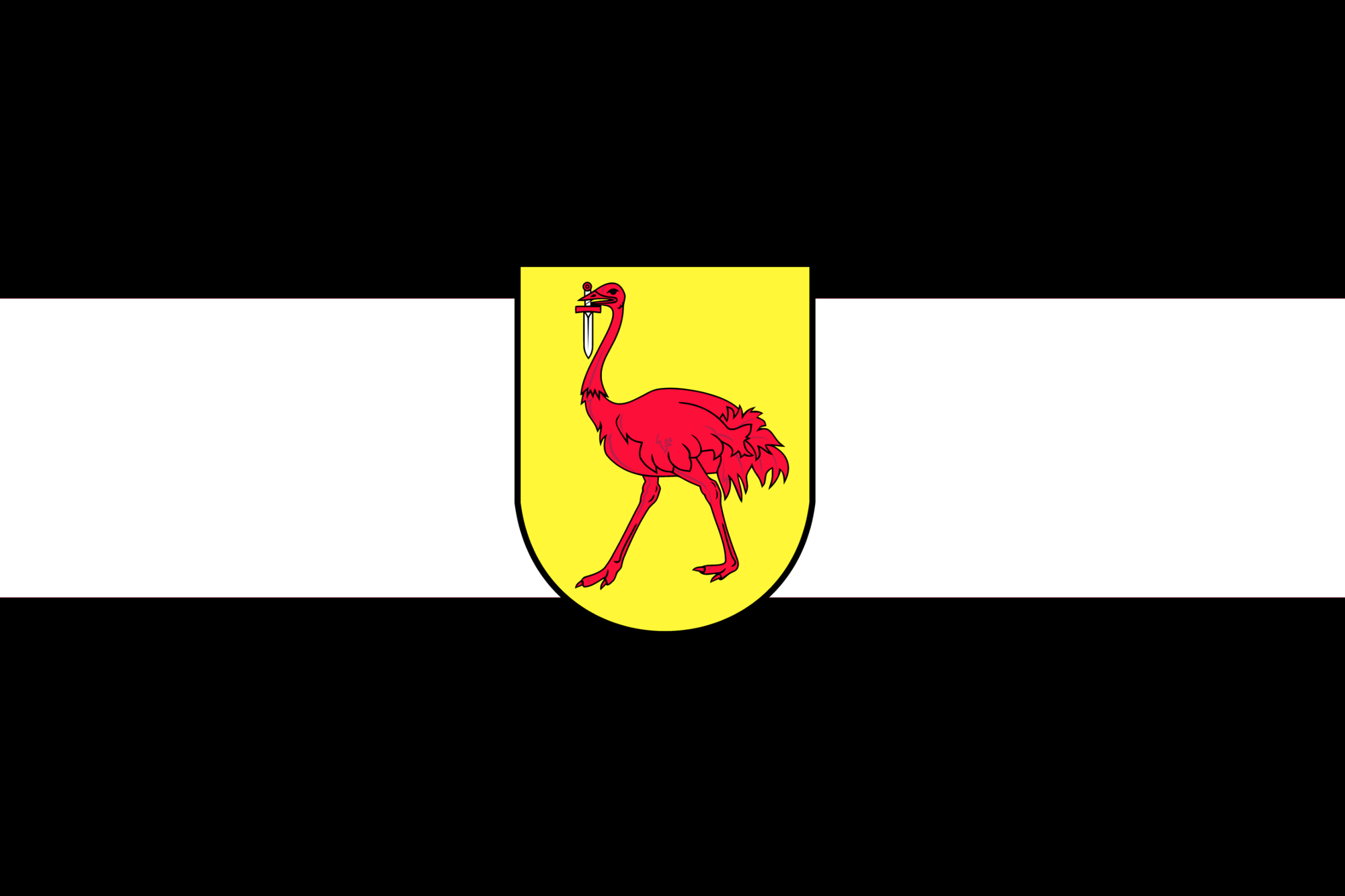
Flag of the Empire of Ostrich prior to the First Republic.
The traditional flag of the Empire of Ostrich is made up of the Emperor’s personal colors of black and white with the arms of the Von Streuthen dynasty. The Empire’s name comes from the Old High Church Teutonic word Ostarrîchi, itself a more-or-less literal translation of the Latin Marchia Orientalis, the Eastern March of the Teutons, with the Marchia Occidentalis, the Western March of the Teutons, essentially corresponding with the Holy Teuton Empire, Ostrich’s greatest rival and closest ally.
While the name of the Empire and the name of the African flightless bird are only identical thanks to an etymological quirk, this was not lost on the old Emperor Karl II, famous for his whimsy. It was Karl II that made the bird the symbol of his empire, adopting an ‘ostrich close with dagger’d beak’ as his personal arms, with its addition to the flag coming at a later date. Karl II responded to his chancellor’s suggestion that he choose “a more distinguished bird” with the retort that he “would make it distinguished.” He also noted the ruler of Luxnebe, the Prince of Chartreuse, had made ‘a humble color his own, and an Ostrich was far less humble than a Pear.”
White ostrich feathers were thereafter popular parade and dress plumes in the imperial Ostrichian army, though the term “Ostrichia” came to dominate as time went on and represents the modern name of the (much smaller) modern nation-state.
- Like what you see? Purchase a print or ebook version!
March 10, 2021
Posted by alexp01 under
Excerpt | Tags:
fiction,
story |
Leave a Comment
To this day, it’s not entirely clear what happened, but Rezograd had been a center in the manufacture of magical scrolls and other sorcery development. It had pioneered the combination of the standard Flame and Wind spells into the popular Fireball conflagration, after all, and many of the basic spellwriting languages originate from products that were created or at least improved there.
What seems likeliest is that a small but significant error was made in the Rezograd labs, perhaps in a spell that relied on crystal resonance for its motive power. In any case, the entire town and a good portion of the countryside was turned to clear, faintly purple crystal in a matter of moments. Some of those on the outskirts, notably a family of farmers, were able to flee the cataclysm but thousands of others had no such chance. The countryside for 66.66 versts around a point just south of the center of Rezograd were crystalized, with every indication that this extended to 66.66 versts above and below. Onlookers reported birds and clouds plummeting, crystallized, to the ground and subsequent excavations showed a smooth crystal surface sloping away near the boundary.
This would be a tragedy, surely, simply on the basis of the lives lost, but everything, living or dead, that touched the crystal inside that 66.66 verst limit subsequently became crystallized itself, as the bodies of some unfortunates found half-inside and half-outside demonstrated. Crystal brought outside the limit would endure but seemed to lose its infectious properties.
The Rezograd crystal turned out to have many properties that made it an ideal soulstone and summonstone, with the properties increasing in potency the closer to the epicenter the shards were collected. Pieces of living things were also more potent, with shards from crystalline humans near the old city center being worth more than their weight in gold.
Crystal hunters still travel into the region, alone or with guides, despite the littered remains of those who in the years since have become part of the marvelous, pure, and terrifying sculpture.
- Like what you see? Purchase a print or ebook version!
March 9, 2021
Posted by alexp01 under
Excerpt | Tags:
fiction,
story |
Leave a Comment

Royal Flag of Calleporto.
Calleporto was a small kingdom that had been an uneasy neighbor (and sometimes province) of larger Esper for centuries. It had maintained its independence largely thanks to its mercantile navy and far-flung trading empire, pursuits reflected in its flag designed by Dom Manuel IV the Great, the king who led its expansion into a world power.
The white crosses against a blue sea represented the trade routes pioneered by Calleportese vessels plying the ocean, while a gold armillary sphere represented those same mariners’ famed navigational prowess. The crown of Manuel I, the first king of the nation after its reconquest from the Saracens, tops a heater shield upon which is each of the possible rolls of a six-sided die. This represents the Wager of Manuel, in which a key siege against the Saracens was decided by a single roll of the dice, both Manual and his opponent Mullah Hacén having agreed to “let the Lord, or Allah, decide without bloodshed.” A long-held legend attributes the iconography to another wager, this time for the port of Sindapur, that was also won by the Calleportese. A more cynical view makes note of Manuel IV’s love of gambling, the debts of which the state inherited on his passing.
In any case, unlike neighboring Esper, Calleporto was never fully occupied by Valois. Its royal family escaped overseas and the Valoise Emperor did not even deign to name one of his relatives as a puppet king, instead seconding whatever conquests his troops made to Esper. This had the effect of inflaming Calleportese sentiment still further, and their struggle against the invasion remains a point of national pride in contrast to Esper, which “rolled over and died before it rose again.”
- Like what you see? Purchase a print or ebook version!
March 8, 2021
Posted by alexp01 under
Excerpt | Tags:
fiction,
story |
Leave a Comment
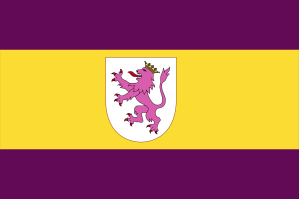
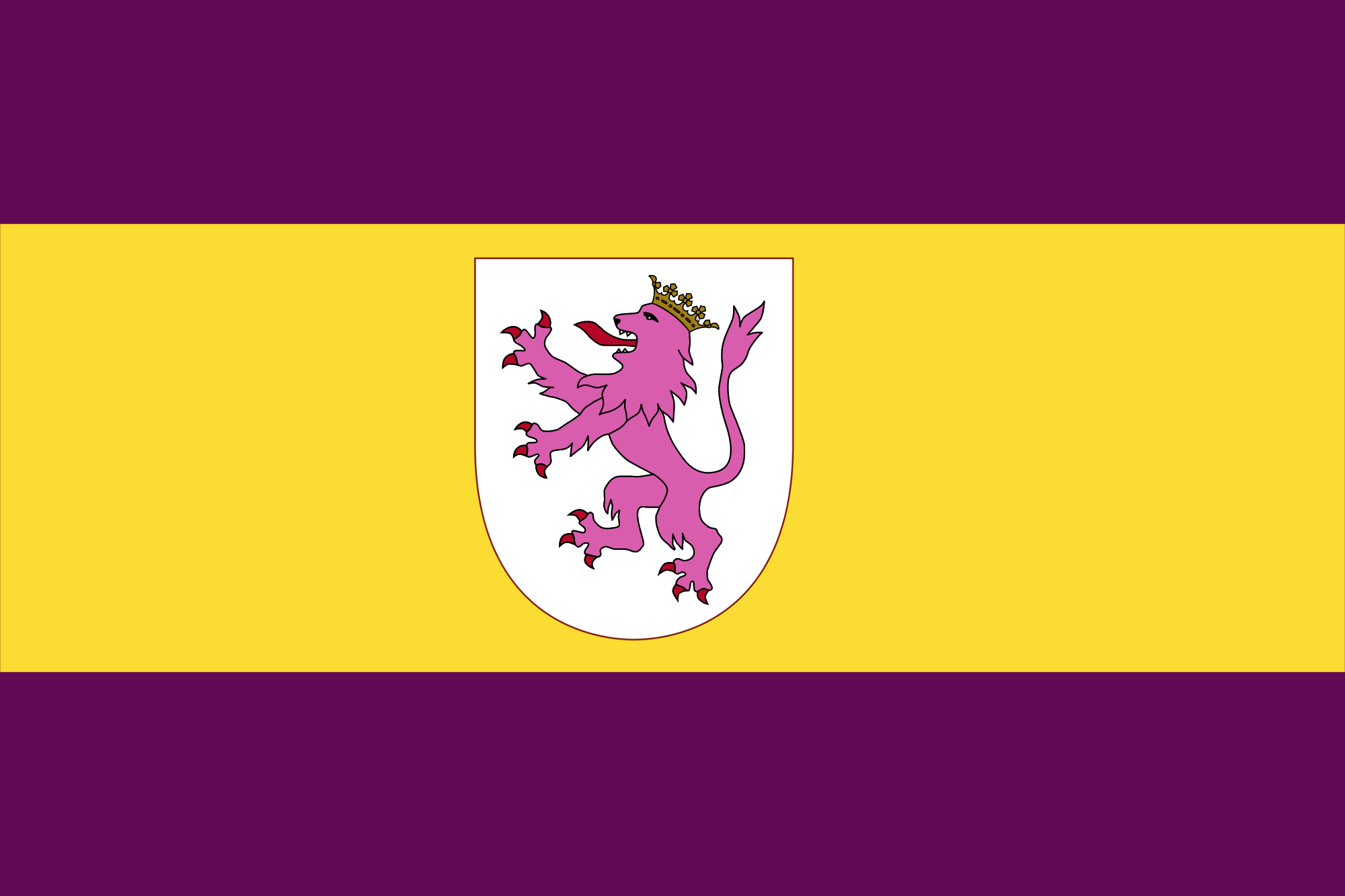
Royalist Flag of Esper.
The Kingdom of Esper, also known as Hesper or Hesperia depending on the language used, had become a world power under the Catholic Dynasty of its founders but by the time of the Empire of Valois had fallen on difficult times, defeated in multiple wars and had long periods of unrest, child kings under regencies, and general disorder. Its flag still flew across half the world, with the yellow and murrey (purple) of Esper’s predecessor kingdoms along with the Pink Lion of the Catholic Dynasty on a pure white shield, but it no longer commanded the respect it once had.
It was this unreliability, along with the persistent fear from its ally Valois that Esper would defect, that led to its eventual invasion and virtual annexation under the Emperor’s brother as King of Esper, overthrowing the young King Amadeo XXII and his regent Queen Joanna IV. Young King Amadeo eventually became infamous as “the basest king in Esper history: cowardly, selfish, grasping, suspicious, and vengeful, incapable of any perception of the commonweal, thinking only in terms of his power and security, unmoved by the enormous sacrifices of his people to retain their independence and preserve his throne.” But his youth and inexperience, compared with the despotic incompetence of the Valois-installed regime, led his standard to be raised again and again in revolt against the occupiers.

Flag of Valois-Occupied Esper.
Valois modified the flag of Esper during its occupation in what one contemporary called a “base mockery,” modifying their
Scierie-Soleil flag with the gold-and-murrey colors of Esper and making the center of the sun the same shade as the Pink Lion. Intensely unpopular, this flag was repeatedly hauled down in an act of vandalism and at one time nearly one eighth of cloth shipped from Valois to Esper was for replacement banners. When the Emperor’s brother fled the country for the third and final time, the remaining flags were widely burned in streets.
- Like what you see? Purchase a print or ebook version!
March 7, 2021
Posted by alexp01 under
Excerpt | Tags:
fiction,
story |
Leave a Comment

Flag of the Teuton Confederation, also known as the First Teuton Republic.
After the Valois Empire destroyed the old Holy Teutonic Empire, reducing the former Emperor to a mere tributary/allied King, the Valoise reorganized the other lands into the Teuton Confederation, sometimes also called the First Teuton Republic especially after the creation and fall of the Second Teuton Republic 150 years later. Despite the name, the Confederation was only nominally republican, and virtually all of the reigning monarchs retained their thrones. Each was, as a condition of peace, required to send a delegate to a central legislature or Bundesrat as well as providing troops to fight alongside Valois in its further campaign.
In theory, the Bundesrat and its presiding officer, the Bundeskanzler, were a more democratic alternative to the old Imperial Electorate and Emperor, voting on all major decisions. In practice, though, the Bundeskanzler was derisively referred to as an ersatzkaiser or valoisenkaiser–the ‘substitute Emperor’ or ‘Valoise Emperor.’ All decisions were nakedly made for the benefit of Valois, there was little room for discussion or debate, and all the delegates were essentially Valoise puppets. This perhaps contributed to the swift collapse of the Confederation in the face of the resurgent Preuben, Ostrich, and Poccnor forces.
- Like what you see? Purchase a print or ebook version!
March 6, 2021
Posted by alexp01 under
Excerpt | Tags:
fiction,
story |
Leave a Comment

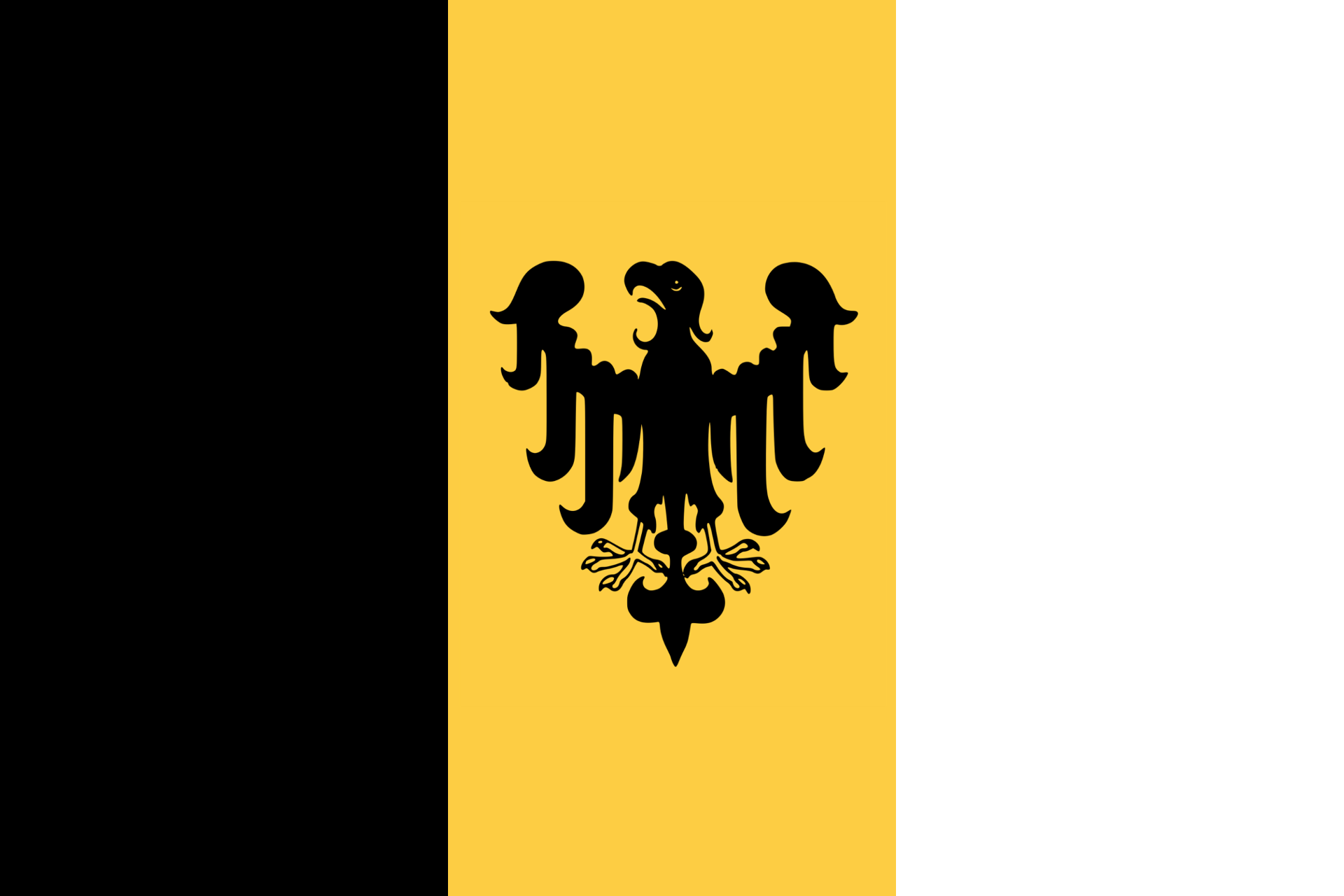
Flag of the Teutonic Empire and later the Kingdom of Preuben.
A decentralized and incredible confusing jumble of principalities, kingdoms, duchies, grand duchies, and bishoprics, the Holy Teutonic Empire was famously denigrated as “neither holy, nor Teutonic, nor an empire” by the Duc d’Arouet in Valois. In this case, it was a literal truth: the Reformation had destroyed the stranglehold the Church had once had on the religious sphere, less than half of the subjects spoke Teutonic at home, and the decentralized and elective nature of the Imperial crown meant that few Emperors were able to act as anything but a first among equals.
This was, perhaps, one of the reasons why the Valois Revolution resulted in the Empire’s total downfall and dissolution. Other than a common currency, a common flag, and a common army, there was little to bind the various states together, so after the armies were shattered and the last Emperor captured, there was little to prevent a catastrophic breakup of the Teutonic lands. Only the core of the Emperor’s personal lands in the Electorate of Preuben remained loyal, leading Emperor Frederick Wilhelm VIII to declare himself King of Preuben in an attempt to maintain his royal power and prerogatives. This led to the old Teutonic Empire flag continuing to be used as the flag of Preuben for over a century afterwards.
- Like what you see? Purchase a print or ebook version!
March 5, 2021
Posted by alexp01 under
Excerpt | Tags:
fiction,
story |
Leave a Comment
Name: Horiuchi Kei
Title: Divine Gardener
Weapon: The Tines of Destiny
Horiuchi Kei’s gardens, from their topiary to their koi ponds to their careful bonsai, are extensions of Horiuchi himself, and his legendary eye for detail. He has therefore a reputation as being extremely cold, irritable, and even misanthropic, but nevertheless he is extremely warm and nurturing to plants and small animals like koi fish. Patrons have reported receiving letters addressed to their gardens, and if they reply in a way that indicates a problem–or do not reply at all–Horiuchi Kei has been known to appear at their door demanding answers. His garden tool, the Tines of Destiny, is a twin of the Unmei no Fuguhiki forged by Sengo Muramasa and despite its simple nature is the equal of any weapon on the battlefield or off.
Name: Ike Takashi
Title: Divine Weaver
Weapon: Tengoku no harinezumi no hari
Patterns, textiles, silks, and satins; Ike Takashi is a master of every form of textile creation. Having worked his way up from a runner at a weaving concern to the undisputed head of the weavers’ guilds and a master of the art, Ike is by far the most institutionalized of the Seven Divine Crafters, generally traveling only as it relates to supervising and auditing weavers around the country rather than wandering as he sees fit. But this does not speak to any softness or weakness on his part; his signature weapons is a pair of steel needles connected by a chain called Tengoku no harinezumi no hari, the Spines of the Divine Hedgehog.
- Like what you see? Purchase a print or ebook version!
March 4, 2021
Posted by alexp01 under
Excerpt
Leave a Comment
Name: Shoda Yoshiko
Title: Divine Dancer
Weapon: Gunsen and Tessen
Shoda Yoshiko is of peasant stock, which explains why, despite her incredible talents, she has never been able to officially perform for the Emperor’s court or the Shogun. Nevertheless, despite originating with a farming family, Shoda was able to rise to favor by the most unlikely of means. Taken prisoner by bandits when her farmstead was raided, she nevertheless entertained the bandits enough with her natural movements that she was able to slip a concealed knife into the bandit leader and escape. Joining a group of touring musicians and entertainers, she used her increasing fame and pay to have a pair of war fans crafted, the Gunsen and Tessen, and trained extensively in their use. Despite being by far the youngest of the Seven Divine Crafters, Shoda is nevertheless unquestioned in the position since the death of Mukai Juro in Kyoto.
Name: Kataoka Natsuko
Title: Divine Singer
Weapon: None
Kataoka Natsuko’s background is almost entirely unknown, and even her name is likely an alias. All that can be said for sure is that she was either a friend or protege of Yonamine Mitsuko, the previous Divine Singer, and rumor has it that Kataoka killed her, possibly with nothing more than her voice. Scholars consider this impossible, naturally, though it has been suggested that Kataoka’s is able to hit a high enough note with her voice to pain and distract opponents. In combat, this is her modus operandi: using extremely high or low notes to bamboozle opponents and then to attack them with either her bare hands or a knotted silk scarf. Despite–or perhaps because of–this violent, mysterious, and dangerous reputation she remains in extremely high demand as a songstress.
- Like what you see? Purchase a print or ebook version!
March 3, 2021
Posted by alexp01 under
Excerpt | Tags:
fiction,
story |
Leave a Comment
Prince Vladimirov was found dead the day after he closed the Imperial Marionette Theatre and transferred its building and assets to the ballet company that were run by his lover. The Okhrana opened up a special investigation to deal with the matter, since it seemed obvious that one of the marionette makers had been involved. Vladimirov had, after all, been found in his own dressing room, hung from the same horsehair ropes that were used in the elaborate puppetry masques of old.
But the staff were carefully accounted for in the investigation, with the orchestra playing at an engagement across the Neva and the major marionette players performing at a private engagement for Grand Duke Mikhail. Even vengeful old Sakharov, the theater’s owner, manager, and head puppetteer, had spent the previous day vainly attempting to secure a personal audience with the Czar or Czarina. The Okhrana determined their movements rather precisely, given their informants and the aristocratic circles in which the puppeteers and musicians tended to move.
In the end, those in the Prince’s inner circle privately suggested that he had used the marionette cord, which had been quite accessible to him after the theatre’s closure, for an unwise bout of autoerotic asphyxiation. Nevertheless, Sakharov was officially charged with the crime and exiled to Siberia–who, after all, would have wanted to tell the Czar that his second cousin had died in such a sinful way?
The Okhrana report tactfully omitted the tiny footprints found in the dust on the closet floor and on Vladimirov’s shirt.
- Like what you see? Purchase a print or ebook version!
March 2, 2021
Posted by alexp01 under
Excerpt | Tags:
fiction,
story |
Leave a Comment
I think they’re alive, living. I’ve seen them bleed, I’ve seen them flee from danger. There might even be language in the words coming from their mouths, if you can call them mouths. And yet when they’ve been followed to their obscure lands of origin, through chinks and cracks from the natural world into places that are wrong, it is as if they’ve forgotten how to be a people, how to be a civilization.
Their buildings, dwellings, whatever you want to call them are magnificent. Edifices built to some age-old plan and a purpose that defies understanding. But even now they clearly do not know that purpose. The beings squat in the decaying ruins, using them as little more than base shelters where once clearly much more was meant to be.
There is infrastructure, technology even, in those places. I see them use it, but it is never repaired, never extended. When it crumbles, they simply go elsewhere. I may not be able to understand much about the intricacies of their world, but I think I understand this much.
They are living beings, and they have forgotten how to live.
- Like what you see? Purchase a print or ebook version!
« Previous Page — Next Page »



 Excerpts From Nonexistent Books