April 2019
Monthly Archive
April 10, 2019
Posted by alexp01 under
Excerpt | Tags:
fiction,
story |
Leave a Comment
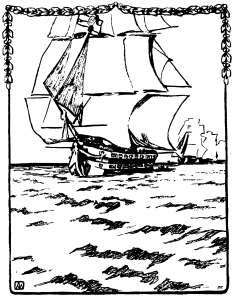
“Sir, we have the weather gauge. Shall I order the attack?”
Admiral Strauß lowered his glass, worrying the brass and leather as he did so. He said nothing to his second, who was waiting patiently.
Strauß was only there by dint of his family’s connections and several close relatives in or married to those at court. No one had expected a naval war to break out, so his utter inability to sail and the queasy seasickness that had bent him over the rail after every meal…well, they had seemed less glaring.
But then Admiral Leipnitz had been killed when his squadron had been ambushed and destroyed, and Admiral Hummel had died in an accident shortly after his squadron had routed enemies trying to enforce a blockade. That only left Grand Admiral Wettin and Strauß himself, and Wettin was 88 years old, blind as a bat, deaf as a post, and so riddled with gout he couldn’t walk.
Even so, Wettin had been carried aboard the flagship SMS Drache on a bier at Strauß‘s request. He had only been hauled off after a breathless courier had arrived one hour before the fleet made sail, bearing a message from the Chancellor himself. Many passages had been underlined in red that had faded to rust, giving Strauß the uneasy feeling that Chancellor Schroeder-Mayer had augmented the missive with his own blood.
“Sir…?” Admiral Strauß‘s second, Ignaz Ender, had been hastily promoted after the previous aide-de-camp had been partially swept off the deck by a cannonade. If the boy had any fear after learning that his predecessor had been buried at sea in two distinct stages, he wasn’t showing it.
Strauß could feel every pore on his body prickling with sweat. The upcoming battle, coming after a decisive defeat and a decisive victory, would decide the war at sea. Every last available ship was under his command, and if the fleet suffered a defeat or even a stalemate, there would be no one else to blame.
“Eternal glory if we win…eternal damnation if we lose…” Strauß muttered.
Ender looked at him. “Sir?” he said. “I didn’t quite catch that.”
Strauß clutched at the butt of his holstered flintlock with one hand and the heavy cutlass—too ornate and poorly bedded to ever split a real skull—with the other. It was simply too much.
He unholstered his pistol and pulled the trigger with his thumb.
Ignatz Ender, shocked, stood agape a moment. Then he pointed to the enemy fleet, scrambling to form battle lines. “Treachery!” he cried. “They’ve shot the admiral from their rigging! His final order was to attack…all ships carry it out!”
- Like what you see? Purchase a print or ebook version!
April 9, 2019
Posted by alexp01 under
Excerpt
Leave a Comment
Do YOU have a thirst for thrills that can only be satiated by freshly-spilled blood? Do YOU ache to recapture the sounds, the scents, and the sensations of cold-blooded murder for hot-blooded reasons? If so, POST-MORTEM MILLS has the breakfast cereal for YOU!
Introducing new Type-Os: The Cereal for Serial Killers™!
Our startling new PLASMA-PAK™ technology helps each Type-O burst with the scent and flavor of REAL human blood! Activated by the mastication process, you’ll note a distinct tangy note of iron in among the sweet taste of high fructose corn syrup. And the bright red ichor, fading to dull brown only as it dries, will be visible in your smile for all to see!
And that’s just the cereal bits! Type-Os™ includes a fun variety of MARROW MARSHMALLOWS as well, combining the sweet taste you crave with the buttery texture of bone marrow that haunts your darkest dreams. Be on the lookout for Damaging Daggers, Gagging Garrotes, Chocolate Clubs, Pink Pistols, Red Splatters, and more!
Be sure to look out for boxes with the new POST-MORTEM MILLS MAIL-AWAY CLEAVER promotion, too! Just send in 5 box tops–one for every liter of blood in the human body!–plus postage in a SASE, and in 8-10 weeks you’ll receive your very own Type-Os™ branded meat cleaver from our friends at Carbide Steel! Honed to a fine edge, this cleaver pierces cloud, shadow, earth, and flesh! Limited quantities are available, so ACT NOW!
- Like what you see? Purchase a print or ebook version!
April 8, 2019
Posted by alexp01 under
Excerpt | Tags:
fiction,
story |
Leave a Comment
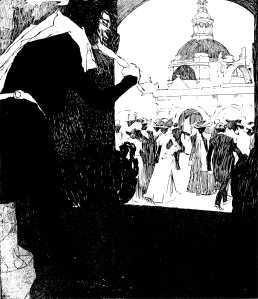
The plaza was already filling with people, notables in their Sunday finest. Men, in suits and hats all made from animals that had lived and died continents away, clutching fine hardwood canes. Women, parasols in hand, their raiment soaring to such heights of impracticality that many had maids about to help manage their trains and massive hats. All of them thronging on the square’s ancient cobbles toward the assembly building. It looked like a great religious edifice, but it was a secular one until noon, when the emperor himself would address the crowd.
Already, moving throughout the throngs, secret policemen could be seen–the only men in ill-fitting suits who looked like they’d seen a little sun. An occasional shout from above, too, as curious folk who had flocked to the upper-story windows in the Old Town were cleared out. The sharp-eyed might have seen the barrel of a bolt-action rifle, the glint of a high-power scope, from some of those now-darkened windows. There had been no sign of them, but it was an absolute certainty that some of those cleaned-out apartments and tenements hid the new repeating rifles, machine guns. The State Evidence Bureau–what an innocuous name for such a far-reaching and keen-beaked octopus!–was taking no chances in a repeat of the Peace Riots from the year before.
From the shadows in a bricked-up arch, Jan watched the preparations, quietly gnawing on a piece of tough meat from an Old Town street vendor. “They might think they’re prepared, but those preparations are ten years out of date. When the emperor is actually out there, spouting his nonsense, we’ll see who is really safe.”
- Like what you see? Purchase a print or ebook version!
April 7, 2019
Posted by alexp01 under
Excerpt | Tags:
fiction,
story |
Leave a Comment
They arrived quietly for folks committed to utterly destroying the town.
The old Fox manor, on the outside of town, had been left fallow since Mrs. Fox had died in ’87. Her only relatives, two bitter cousins from upstate, were both happy to let the place crumble so long as the other didn’t inherit. One morning, though, there was activity there. Lights in repaired windows, brush cleared away, and planking over the roof holes. Perhaps most distressingly for the high school students, decades’ worth of graffiti had been scrubbed off the brick and one of the premier love nests in a fifteen-mile-radius was suddenly off-limits.
At a city council meeting, a concerned citizen who was definitely not acting as a shill for one of the Fox cousins, asked Sheriff Decker directly about the new ownership. “I just want to make sure it’s legal and lawful,” she said, “and not some dirty squatters building a meth lab just to get their dirty crystals into our schools quicker.”
Decker, seated at the end of the council table with cowboy boots on the table, waved the concern away. “They’re great people living there, great people,” he said. “The best. Not like most of the folks come though here, just looking to steal, not like all those folks on Pettus St., but good folks.”
“Well, have you been over there? Have you talked to them? Are they paying taxes? What’s their name?”
Once again, Decker flapped a hand as if shooing away a fly. “They say they bought the land, and I believe them. Didn’t catch their name, but I’m sure they’re paying taxes. Very nice young man answered the door, said his grandmother bought the place to retire in. I’m sure they’ll be great citizens.”
“Have you checked? Looked at the paperwork?”
Decker deliberately lowered his cowboy boots from the table and rocked forward. The big Stetson he wore to hide that Decker family baldness tilted as he looked down the length of his nose at the council chamber.
“I’m sure they’ll be great citizens,” he said with an air of finality. “You want more than that, you can go there and bother them yourself.”
Business soon moved on to voting for sewer repairs (failed), money for repainting the elementary school (failed) and–the reason Decker was there–expansion of the county jail to house inmates from one county over for a fee (passed). As the discussion continued, an attendee slipped out of the back of the chamber and sauntered away. Twenty minutes later, after a brisk walk, they whistled into the Fox house.
“Looks like we’re good,” they said. “What can I say? I’m a convincing liar, especially when the sheriff is that clueless.”
“The Marquess heard Syd’s news with quiet elation.” A voice, soft and feminine but commanding, a steel saber in a velvet scabbard, replied. “She went on to ask if anyone at the town meeting had expressed any concerns, for as Syd well knew, the first days after their arrival were always the most dangerous to their work.”
“Other than a shill who took twenty bucks from Veronica Fox to complain? Nah.” As Syd spoke, their voice and appearance changed, running like tallow and fluttering in pitch. They’d entered the manse looking like a nondescript middle-aged busybody, the sort that would attend city council meetings for kicks, but once the Marquess had finished, Syd was sporting pink hair in a buzz cut, some very metal attire, and a distinctly more feminine look.
- Like what you see? Purchase a print or ebook version!
April 6, 2019
Posted by alexp01 under
Excerpt | Tags:
fiction,
story |
Leave a Comment
After a few moments’ search, Chris found the source of the noise. A kid, barely a teenager, was perched on the lip of a concrete retaining wall, overlooking the highway and onramp. There was a sharp glittering of reflected light as Chris approached, and it only took a moment to ascertain why: the kid’s upper body was covered with protruding crystals, a deep violet hue all.
“Yeah, I can see you staring,” the kid said, without looking. “I know I’m crystalizing. Stick around long enough and you’ll get to see how far it’ll go.” The words were half-choked by sobs, and in the flashes of gas station light, Christ could see tear-streaked eyes.
“They used to think you could catch it,” said Chris softly. “They called it a crystophage, gave everyone medicine to protect themselves against it. But you know what? They’re just scared.”
“Yeah,” sniffed the kid. He drew a sleeve across his oozing nose. “You’ve heard what they call folks like me.”
“Oh sure,” Chris said. “Rock salt. Prism. Crystal meth was a big one when I was your age.”
“My parents keep asking if I want to go away,” the kid continued. “They say there are camps…places where they can cut out the crystals before they grow. Make you…normal.”
“Horrible places, and they don’t even work for all the nightmares they inflict on poor kids like you,” said Chris. “You wanna be normal that bad?”
“Yeah,” said the kid.
“Really?”
There was a moment’s pause. “Normal is how they keep everyone in line,” the kid said after a moment. “Normal is how they make you feel how you’re the one who’s wrong, for nor being what they want you to be. Like you have a choice. And you know what? I like me. The crystals? They’re beautiful. They have this hum about them…it’s like music. When the light and the wind are right, there’s this hum, this tingle, and it’s the best thing in the world.” He paused. “Like being in love, only better.”
Chris nodded. “I know exactly what you mean, kiddo.”
The kid smiled a wan smile. “I’ve heard a lot of folks say that, but they never do. The school counselor’s favorite, even if she wouldn’t know what I’m going through if it bit her on the ass. I bet you think you’re helping, but you have no idea.”
“Oh no?” Chris rolled up a sleeve, exposing a lattice of brilliant heptagonal crystals. Beginning around the elbow, they grew in complexity and color until they were nearly black where the fabric cut them off again. “I cover them up.”
“Why would you do that?”
“Because it’s easier. Because when I was your age there was nobody for me to look up to, nobody to sit down next to me and tell me it was okay.” Chris sighed, and looked out over the car lights on the highway. “Maybe I’m a coward. I don’t know.”
The kid was quiet for a bit. “You know what? That helps a little. Sometimes you forget that you’re not the only one.”
- Like what you see? Purchase a print or ebook version!
April 5, 2019
Posted by alexp01 under
Excerpt | Tags:
fiction,
story |
Leave a Comment
“Ha! Get away from here, you!” Sergei swung his torch at the creature. Alexei barely had a glance at the thing as it scuttled away like a deer on the hoof, easily bounding over the fence. But what he saw was disturbing: darker than the oppressive night that surrounded them both, slick and smooth in the cool night air.
“What was that?” Alexei whispered.
“Barrowmorph,” said Sergei. “Never heard of them?”
His apprentice shook his head.
“I’m not surprised. Death is a taboo topic, and the things that happen to the dead after they no longer have any problems of their own are even more so. Well, consider this entry number one in your bestiary.”
Alexei looked down at where the creature had been as they approached. The lantern light cast stark shadows over a fresh grave, with the earth atop it disturbed down to the coffin. The still-bright triple-beamed cross was visible, giving the reflected lamplight a ghostly sheen of the underworld.
“Shall I fill it in?” Alexei asked.
“Yes, do so. And listen while you work, afterward we’ll set some traps.”
Alexei began to shovel the earth in, while Sergei leaned on a nearby headstone.
“Barrowmorphs come in from the countryside and try to dig up fresh graves,” Sergei said. “I don’t know what they do out there when they’re not graverobbing. Maybe they’re part of the life cycle of something else, I don’t really care. But when you find one, and you will find more, scare it off if you must and shoot it if you can.”
“Should have brought the revolver tonight?” Alexei grunted.
“Normally not a good idea unless you know something foul is about,” said Sergei. “My mentor shot a man laying midnight flowers once.”
“I see.”
“Barrowmorphs try to get into the recently dead. Then they devour the corpse, messy business that, and take on its form. That’s why they like fresh ones, you see. Less to get wrong. The fresher they are, the more of a sense they get of who that person was when they crack open the skull and suck out the brains.”
Alexei’s stomach heaved a bit. “So that barrowmorph…was trying to eat and take the form of whoever was buried here?”
“That’s right.” Sergei glanced at the headstone. “Maria Feororovna here almost wandered back into town wearing her burial clothes. And that we do not want.”
“What…what happens then?”
“It varies, but it’s never pretty. Usually folks catch on pretty quick, and there’s a ruckus as the thing is killed. Pretty traumatic when you’re already in mourning. Some folks, grief-addled, see this thing that looks like their beloved and parrots some of their words. So they bring the damn thing in and start living with it. I think that’s what they want, honestly, to be cared for and fed.”
The dirt was mostly back in the grave, now; Alexei began tamping it down with the shovel blade as he’d been shown earlier. “What if they don’t meet anybody that knew the dead?” he said.
“Well, then you get even more complications. Especially if the barrowmorph is around when somebody else dies—they might just decide they like that form better and have themselves a little feast. In real bad cases, like one up in Zelekhovo, they might sort of hop around for a long time, getting fed and pampered by grieving folks.”
Alexei drove his shovel into the ground. “Why not just let them?” he said.
“What?” said Sergei.
“Let them. Let the things eat up the dead, who have no use for those bodies anymore, and go get fed. What’s the difference?”
“Some folks aren’t approving of their relations getting devoured, for one,” Sergei said. “Not exactly the Resurrection they were promised. Some of the Barrowmorphs are real good mimics, but that’s all they are. Like a parrot. There’s no real soul there, just an animal looking for a meal ticket.”
Alexei shrugged. “Some folks might be okay with that.”
“Most folks aren’t okay with the barrowmorph deciding to cut out the middleman and start murdering folk,” said Sergei. “In Zelekhovo, they found a whole nest of them. One had gotten away, been left alone, and they eventually found twenty-seven dead.”
- Like what you see? Purchase a print or ebook version!
April 4, 2019
“Hear me, if you would.”
“We walk under the same sky, breathe the same air, and should we perish, we return to the same earth. That alone binds us as tightly as any family. And like any family, we are may be cross with one another. We may act out. But yet, we may also forgive.”
“You did what you thought to be right. It may have been so, it may not, but the important thing is that you acted from the heart. In placing you here, I was acting not from the heart, but from the head. In my deepest being, I wish I could have let you do what you would, to follow your own star.”
“But the crown on my brow compelled me to action. Not to vengeance, but to mercy. Placing you here was necessary, but it is no longer. You need not repent of what you have done; all I ask is that you hear me out and consider that we might go together as one. The heart and the head often diverge, but we can set them alight together on the proper path.”
“Your stay here was only to allow passions to cool, to convince the people below that there was no threat. They are brilliant folk, hardworking and true, but you have seen how panicky they can be, how often they react with fear instead of love. But now that the heat of the moment has passed, I come before you clear-eyed and with open arms.”
“I ask that we work to right the wrongs that have been inflicted upon our people, to bring justice to those whose transgressions were far beyond whatever petty squabbles you and I may have had. Join me in agreeing on this, if we can agree on nothing else: the people of this place deserve protection, they deserve to fulfill the purpose life has in store for them. Join me in seeing that this comes to pass.”
- Like what you see? Purchase a print or ebook version!
April 3, 2019
Posted by alexp01 under
Excerpt | Tags:
fiction,
story |
Leave a Comment
The procedure is simple enough. You provide a stimulus, check to see what neurons fire, and then target them for elimination just like you would if you painted a target for a precision warhead.
Once she was on the floor, I knelt around her, squeezing inward with both knees to keep her prone. As that dirty bitch Caleb is so fond of observing, the same techniques you use to look good in a formal dress are the ones you can use to subdue someone in a formal dress.
“Read the words on this card,” I said, holding it up.
“Fuck you,” Sanderson said, between clenched teeth.
“Not when I’m on the clock, sweetie,” I said. It was really just for the sake of a personal joke; Sanderson was about fifteen years too old for me, and I could see the ghosts of several lasered-off tramp stamps now that I was up close.
I applied a little shock with the “joy buzzer” – much more effective than a gun, in my experience. She couldn’t even scream; the same mechanism that made every nerve fiber burn made her completely lock up.
“Let’s try that again, shall we?” I said. “Speak clearly, so the electrodes on your skull can hear.”
“Merger…acquisition…inheritance…board of directors…” Sanderson read.
Some prefer nanobots, but they leave more of a trace, and can even be tracked back to their manufacturer. I prefer targeted ionizing radiation; there’s a higher risk of cancer and brain damage, but it’s untraceable. And if we’re being honest, the folks that hire me aren’t concerned with cancer or brain damage.
Sanderson responses had lit up the scanner beautifully; I made a few quick notes on my phone and then switched it to “kill mode.” The brief, intense burst of radiation left her passed out and slack-jawed on the floor. I rolled her on her side and poured out her drink; anyone who stumbled in would think she’d just gone on a bender.
You might think it would just be easier to kill a target. After all, that kills every memory you want gone, and can be done remotely from blocks away, or via a drone. But not so often as you think. People who have recently been disinherited are always a major draw, as are business competitors. Kill a good idea, but keep a young and hungry VP from ascending to CEO.
- Like what you see? Purchase a print or ebook version!
April 2, 2019
They called it kobito no haru, the “sweetheart’s spring,” because you were supposed to meet your destined there. I’m sure the was passed around, whispered, in the halls and bathrooms of every high school in Sapporo. It said that you would meet your soulmate at the spring, and that you would know because your heart would flutter, your knees would wobble, and you might even pass out.
I didn’t believe in this, of course, butI was curious. So I went to the spring on a day there wasn’t likely to be anyone there, the evening of the first day of school, when most folks young or naive enough to believe in that were furiously cramming.
When I first saw the ghostly apparition, the spectral figure of a woman in Sengoku-era raiment…well, my heart fluttered, my knees wobbled, and I started to see that dark tunnel vision you get just before you pass out
- Like what you see? Purchase a print or ebook version!
April 1, 2019
On an exceptionally hot evening early in July a young man came out of the garret in which he lodged in S. Place and walked slowly, as though in hesitation, towards K. bridge.
He had successfully avoided meeting his landlady on the staircase. His garret was under the roof of a high, five-storied house and was more like a cupboard than a room. The landlady who provided him with garret, dinners, and attendance, lived on the floor below, and every time he went out he was obliged to pass her kitchen, the door of which invariably stood open. And each time he passed, the young man had a sick, frightened feeling, which made him scowl and feel ashamed. He was hopelessly in debt to his landlady, and was afraid of meeting her.
This was not because he was cowardly and abject, quite the contrary; but for some time past he had been in an overstrained irritable condition, verging on hypochondria. He had become so completely absorbed in himself, and isolated from his fellows that he dreaded meeting, not only his landlady, but anyone at all. He was crushed by poverty, but the anxieties of his position had of late ceased to weigh upon him. He had given up attending to matters of practical importance; he had lost all desire to do so. Nothing that any landlady could do had a real terror for him. But to be stopped on the stairs, to be forced to listen to her trivial, irrelevant gossip, to pestering demands for payment, threats and complaints, and to rack his brains for excuses, to prevaricate, to lie—no, rather than that, he would creep down the stairs like a cat and slip out unseen.
This evening, however, on coming out into the street, he became acutely aware of his fears.
“I want to attempt a thing like that and am frightened by these trifles,” he thought, with an odd smile. “Hm… yes, all is in a man’s hands and he lets it all slip from cowardice, that’s an axiom. It would be interesting to know what it is men are most afraid of. Taking a new step, uttering a new word is what they fear most…. But I am talking too much. It’s because I chatter that I do nothing. Or perhaps it is that I chatter because I do nothing. I’ve learned to chatter this last month, lying for days together in my den thinking… of Jack the Giant-killer. Why am I going there now? Am I capable of that? Is that serious? It is not serious at all. It’s simply a fantasy to amuse myself; a plaything! Yes, maybe it is a plaything.”
The heat in the street was terrible: and the airlessness, the bustle and the plaster, scaffolding, bricks, and dust all about him, and that special Petersburg stench, so familiar to all who are unable to get out of town in summer—all worked painfully upon the young man’s already overwrought nerves. The insufferable stench from the pot-houses, which are particularly numerous in that part of the town, and the drunken men whom he met continually, although it was a working day, completed the revolting misery of the picture. An expression of the profoundest disgust gleamed for a moment in the young man’s refined face. He was, by the way, exceptionally handsome, above the average in height, slim, well-built, with beautiful dark eyes and dark brown hair. Soon he sank into deep thought, or more accurately speaking into a complete blankness of mind; he walked along not observing what was about him and not caring to observe it. From time to time, he would mutter something, from the habit of talking to himself, to which he had just confessed. At these moments he would become conscious that his ideas were sometimes in a tangle and that he was very weak; for two days he had scarcely tasted food.
He was so badly dressed that even a man accustomed to shabbiness would have been ashamed to be seen in the street in such rags. In that quarter of the town, however, scarcely any shortcoming in dress would have created surprise. Owing to the proximity of the Hay Market, the number of establishments of bad character, the preponderance of the trading and working class population crowded in these streets and alleys in the heart of Petersburg, types so various were to be seen in the streets that no figure, however queer, would have caused surprise. But there was such accumulated bitterness and contempt in the young man’s heart, that, in spite of all the fastidiousness of youth, he minded his rags least of all in the street. It was a different matter when he met with acquaintances or with former fellow students, whom, indeed, he disliked meeting at any time. And yet when a drunken man who, for some unknown reason, was being taken somewhere in a huge waggon dragged by a heavy dray horse, suddenly shouted at him as he drove past: “Hey there, German hatter” bawling at the top of his voice and pointing at him—the young man stopped suddenly and clutched tremulously at his hat. It was a tall round hat from Zimmerman’s, but completely worn out, rusty with age, all torn and bespattered, brimless and bent on one side in a most unseemly fashion. Not shame, however, but quite another feeling akin to terror had overtaken him.
“I knew it,” he muttered in confusion, “I thought so! That’s the worst of all! Why, a stupid thing like this, the most trivial detail might spoil the whole plan. Yes, my hat is too noticeable…. It looks absurd and that makes it noticeable…. With my rags I ought to wear a cap, any sort of old pancake, but not this grotesque thing. Nobody wears such a hat, it would be noticed a mile off, it would be remembered…. What matters is that people would remember it, and that would give them a clue. For this business one should be as little conspicuous as possible…. Trifles, trifles are what matter! Why, it’s just such trifles that always ruin everything….”
He had not far to go; he knew indeed how many steps it was from the gate of his lodging house: exactly seven hundred and thirty. He had counted them once when he had been lost in dreams. At the time he had put no faith in those dreams and was only tantalising himself by their hideous but daring recklessness. Now, a month later, he had begun to look upon them differently, and, in spite of the monologues in which he jeered at his own impotence and indecision, he had involuntarily come to regard this “hideous” dream as an exploit to be attempted, although he still did not realise this himself. He was positively going now for a “rehearsal” of his project, and at every step his excitement grew more and more violent.
With a sinking heart and a nervous tremor, he went up to a huge house which on one side looked on to the canal, and on the other into the street. This house was let out in tiny tenements and was inhabited by working people of all kinds—tailors, locksmiths, cooks, Germans of sorts, girls picking up a living as best they could, petty clerks, etc. There was a continual coming and going through the two gates and in the two courtyards of the house. Three or four door-keepers were employed on the building. The young man was very glad to meet none of them, and at once slipped unnoticed through the door on the right, and up the staircase. It was a back staircase, dark and narrow, but he was familiar with it already, and knew his way, and he liked all these surroundings: in such darkness even the most inquisitive eyes were not to be dreaded.
“If I am so scared now, what would it be if it somehow came to pass that I were really going to do it?” he could not help asking himself as he reached the fourth storey. There his progress was barred by some porters who were engaged in moving furniture out of a flat. He knew that the flat had been occupied by a German clerk in the civil service, and his family. This German was moving out then, and so the fourth floor on this staircase would be untenanted except by the old woman. “That’s a good thing anyway,” he thought to himself, as he rang the bell of the old woman’s flat. The bell gave a faint tinkle as though it were made of tin and not of copper. The little flats in such houses always have bells that ring like that. He had forgotten the note of that bell, and now its peculiar tinkle seemed to remind him of something and to bring it clearly before him…. He started, his nerves were terribly overstrained by now. In a little while, the door was opened a tiny crack: the old woman eyed her visitor with evident distrust through the crack, and nothing could be seen but her little eyes, glittering in the darkness. But, seeing a number of people on the landing, she grew bolder, and opened the door wide. The young man stepped into the dark entry, which was partitioned off from the tiny kitchen. The old woman stood facing him in silence and looking inquiringly at him. She was a diminutive, withered up old woman of sixty, with sharp malignant eyes and a sharp little nose. Her colourless, somewhat grizzled hair was thickly smeared with oil, and she wore no kerchief over it. Round her thin long neck, which looked like a hen’s leg, was knotted some sort of flannel rag, and, in spite of the heat, there hung flapping on her shoulders, a mangy fur cape, yellow with age. The old woman coughed and groaned at every instant. The young man must have looked at her with a rather peculiar expression, for a gleam of mistrust came into her eyes again.
“Raskolnikov, a student, I came here a month ago,” the young man made haste to mutter, with a half bow, remembering that he ought to be more polite.
- Like what you see? Purchase a print or ebook version!
« Previous Page
 Excerpts From Nonexistent Books